County Palatine · North East England
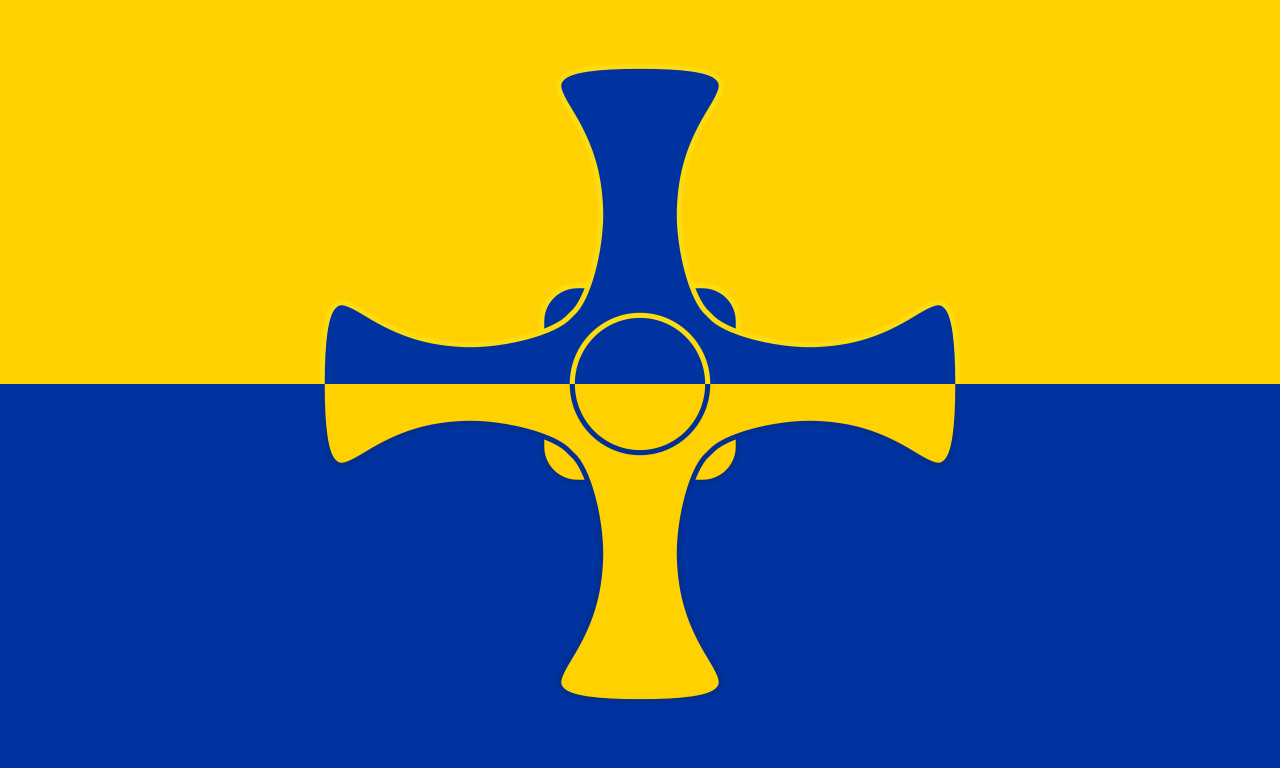
County Durham flies the cross of Saint Cuthbert — the gold-and-garnet pectoral cross found in the saint’s own coffin — set in blue and gold, the historic colours of the county. Behind it lies an extraordinary history: for centuries Durham was a county palatine, a realm within England ruled not by the king but by the Prince-Bishops of Durham.
Click on a country to learn more
| Country | England (United Kingdom) |
|---|---|
| Region | North East England |
| County town | Durham |
| Emblem | The cross of Saint Cuthbert (blue & gold) |
| Flag registered | 21 November 2013 (Flag Institute) |
| Historic status | County Palatine of the Prince-Bishops |
Flag of County Durham — St Cuthbert’s cross, counterchanged in blue and gold
The flag is divided in two — gold above, blue below — and across the join sits the pectoral cross of Saint Cuthbert, counterchanged: blue where it crosses the gold, gold where it crosses the blue. Its widening arms and central boss copy the shape of the actual seventh-century cross. Blue and gold are the ancient colours of the county and of the Diocese of Durham.
The flag itself is recent, and democratic in the making. A public competition in 2013 drew a shortlist of six designs; the winning cross took about a quarter of some three thousand votes. It was unfurled at a ceremony in Durham Cathedral on 21 November 2013 and entered on the Flag Institute’s registry.
Saint Cuthbert (died 687) is the great saint of the North of England — monk, hermit and bishop of Lindisfarne, whose holiness made his shrine the most revered in the northern kingdoms. After Viking raids drove his community from Holy Island, they carried his coffin for generations before finally settling at Durham, where the great cathedral was raised over his tomb.
Buried with him — or laid in his coffin soon after — was a small pectoral cross of gold set with garnets. Lost to memory for centuries, it was rediscovered in 1827 when his tomb was opened, and it is displayed at Durham Cathedral to this day. It is that cross, and no other, that the county flies.
For much of the Middle Ages Durham was no ordinary county but a county palatine — a realm within the realm. Its rulers were the Prince-Bishops of Durham, who held temporal power alongside their spiritual office: they raised armies, minted their own coin, held their own courts and parliament, and answered to the king only loosely, guarding England’s troubled border with Scotland.
Their unique authority is written into their heraldry: the Bishop of Durham bears a mitre encircled by a ducal coronet — not a plain mitre — and a crozier crossed in saltire with a sword, the spiritual and the temporal together.
Arms of Durham County Council (granted 30 May 1961, in succession to the palatinate): Azure, on a cross Or between four lions rampant argent, each ducally crowned gold and grasping a sword, five lozenges sable; the shield ensigned with a mural crown gold.
The council’s lions grasp swords and wear coronets precisely to recall the Prince-Bishops from whom its authority descended — a shield that remembers a thousand years of near-kings on Wear-side.
The flag of County Durham is a gold-and-blue field bearing the pectoral cross of Saint Cuthbert, counterchanged so the cross is blue on the gold half and gold on the blue half. It was chosen by public vote and registered with the Flag Institute in 2013.
It is the gold-and-garnet pectoral cross of Saint Cuthbert, who died in 687. Found in his coffin and rediscovered in 1827, it is kept at Durham Cathedral, and its distinctive shape gives the county flag its emblem.
The Bishops of Durham ruled County Durham as a county palatine, holding near-royal temporal power alongside their spiritual office — raising armies, minting coin and holding their own courts. Their arms uniquely show a mitre encircled by a coronet and a crozier crossed with a sword.
Blue and gold are the historic colours of the county and of the Diocese of Durham. They were carried into the arms of Durham County Council and then into the modern county flag.
The flag was chosen in a public competition in 2013 and unfurled at a ceremony in Durham Cathedral on 21 November 2013, then registered with the Flag Institute.
Last reviewed by the Emblema Mundi editorial team on September 20, 2026.