Country
The state emblems of Ukraine compress a millennium of eastern European history into two of the simplest heraldic compositions on the continent. The golden trident (tryzub) on an azure field is a direct restoration of the princely mark of Volodymyr the Great, Grand Prince of Kyiv around the year 1000. The blue-and-yellow bicolour, whose modern form crystallised at the Ruthenian Congress of Lviv in 1848, draws on the medieval heraldry of the Kingdom of Ruthenia. Both were re-adopted within a few weeks of one another by the newly independent Verkhovna Rada in early 1992.
Flag
Not available
Coat of Arms
Not available
| Country | Ukraine (Україна) |
|---|---|
| Coat of arms adopted | 19 February 1992 (Verkhovna Rada Resolution No. 2137-XII) — Small State Coat of Arms |
| Flag adopted | 28 January 1992 (Resolution No. 2067-XII); ratio 2:3 |
| Constitutional anchoring | Article 20, Constitution of Ukraine, 28 June 1996 |
| Tinctures (arms) | Azure and Or |
| Central charge | Trident (tryzub) Or — the sign of the Princely State of Volodymyr the Great |
| Designers (1992 restoration) | Andriy Grechylo, Ivan Turetsky, Oleksy Kokhan |
| Great State Coat of Arms | Mandated by Article 20; never enacted |
| Subdivisions | 24 oblasts, 1 autonomous republic (Crimea), 2 cities with special status (Kyiv, Sevastopol) |
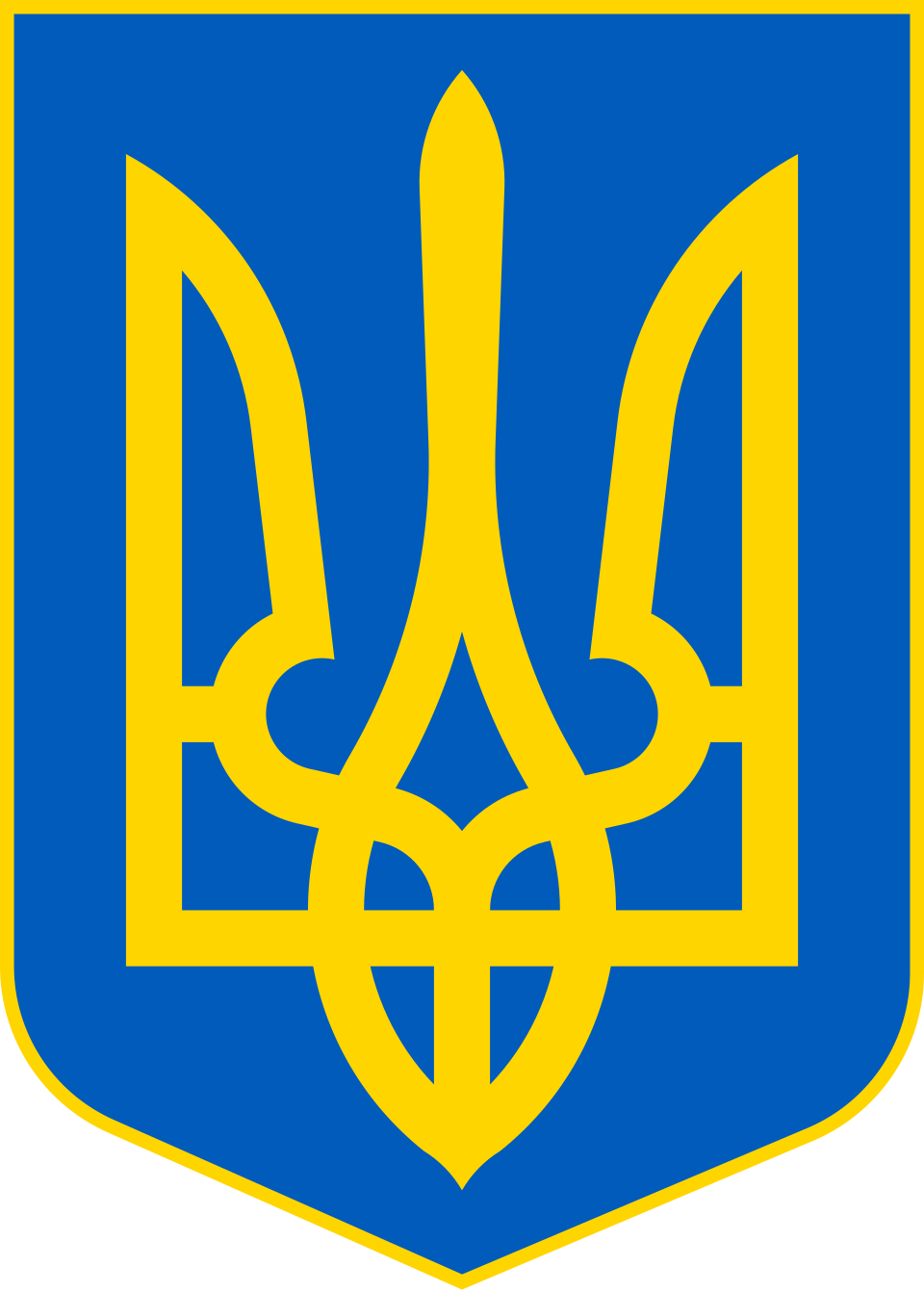
Small State Coat of Arms of Ukraine — Azure, a trident Or. Adopted by Verkhovna Rada Resolution No. 2137-XII, 19 February 1992.
Azure, a trident Or, the outer prongs incurved and terminating in ring-shaped finials, the central prong tapered to a point — the historical znak Rurykovychiv, or sign of the House of Rurik, in the form borne by Grand Prince Volodymyr Sviatoslavych.
The composition is exceptionally spare: two tinctures, one charge. This economy is deliberate. The 1992 restoration deliberately avoided ornament in order to reconnect visually with the earliest documented Rus'-era exemplars — coins and lead seals whose reduced surface admitted only a single, unambiguous mark.
| Colour | Heraldic name | Element | Traditional symbolism |
|---|---|---|---|
| Blue | Azure | Field | Sovereignty, fidelity; continuity with the azure field of the medieval Ruthenian lion |
| Gold | Or | Trident | Princely dignity, permanence; the metal of coinage on which the mark first survived |
Heraldic note — the arrangement is a canonical metal-on-colour composition; unlike the Russian or Serbian eagles, no metal-on-metal licence is invoked.
The trident first appears in the archaeological record on the silver sriblianyky and lead seals of Volodymyr Sviatoslavych (Volodymyr the Great, r. c. 980–1015), Grand Prince of Kyiv, and continues under his sons Sviatopolk and Yaroslav the Wise. It functioned less as a state emblem in the modern sense than as a znak — a princely mark of ownership stamped on coinage, sealing wax and, later, on the walls of state buildings such as the Church of the Tithes.
No contemporary text explains what the sign was meant to represent. Six modern hypotheses coexist:
The Constitution of 1996 sidesteps the debate by naming the charge only as the Sign of the Princely State of Volodymyr the Great (Znak Kniazhoi Derzhavy Volodymyra Velykoho), leaving the historiographical question open.
c. 980–1015 — Volodymyr the Great. The trident appears on Kyivan coinage; a bifid variant is used by Sviatopolk, a strict trident by Yaroslav.
11th–13th centuries — Rurikid usage. Successive princes vary the mark by adding cross-bars or points to distinguish their branch of the dynasty. The sign fades from official use after the Mongol invasion of 1240.
13th–14th centuries — The Kingdom of Ruthenia. The Galician-Volhynian principality substitutes a golden lion rampant on an azure field, documented on the seal of King Yuriy I of Halych in 1316. This is the direct heraldic source of the modern blue-and-yellow bicolour.
22 March 1918 — The Ukrainian People’s Republic (UNR). The Central Rada adopts the trident as the state emblem. The design is by Vasyl Krychevsky, who couples the historical Volodymyr mark with a stylised olive wreath. The Constitution of the UNR (29 April 1918) confirms the emblem in Article 22.
1919–1991 — The Ukrainian SSR. The trident is proscribed and replaced by the hammer-and-sickle within a wheat wreath, first surrounded by a Cyrillic UkSSR banner (1919) and, from 1949, by a red-and-azure ribbon anticipating the modern flag.
19 February 1992 — Restoration. Following an open heraldic competition, the Verkhovna Rada adopts by Resolution No. 2137-XII the design of Andriy Grechylo, Ivan Turetsky and Oleksy Kokhan: a strict return to the Volodymyr form, without wreath or supporters.
28 June 1996 — Constitutional Anchoring. Article 20 of the new Constitution enshrines the Small Coat of Arms and instructs the legislature to enact a Great Coat of Arms by two-thirds majority.
Article 20 of the Constitution requires that the Great State Coat of Arms combine two historical elements: the trident of Volodymyr and the emblem of the Zaporozhian Host — a cossack in profile, holding a musket over the shoulder, known as the kozak z musketom. Several designs have been submitted since 1996; the most recent, by Andriy Grechylo, passed a first reading in the Verkhovna Rada on 10 July 2020 but was never enacted. In practice, only the Small Coat of Arms is used by the state.
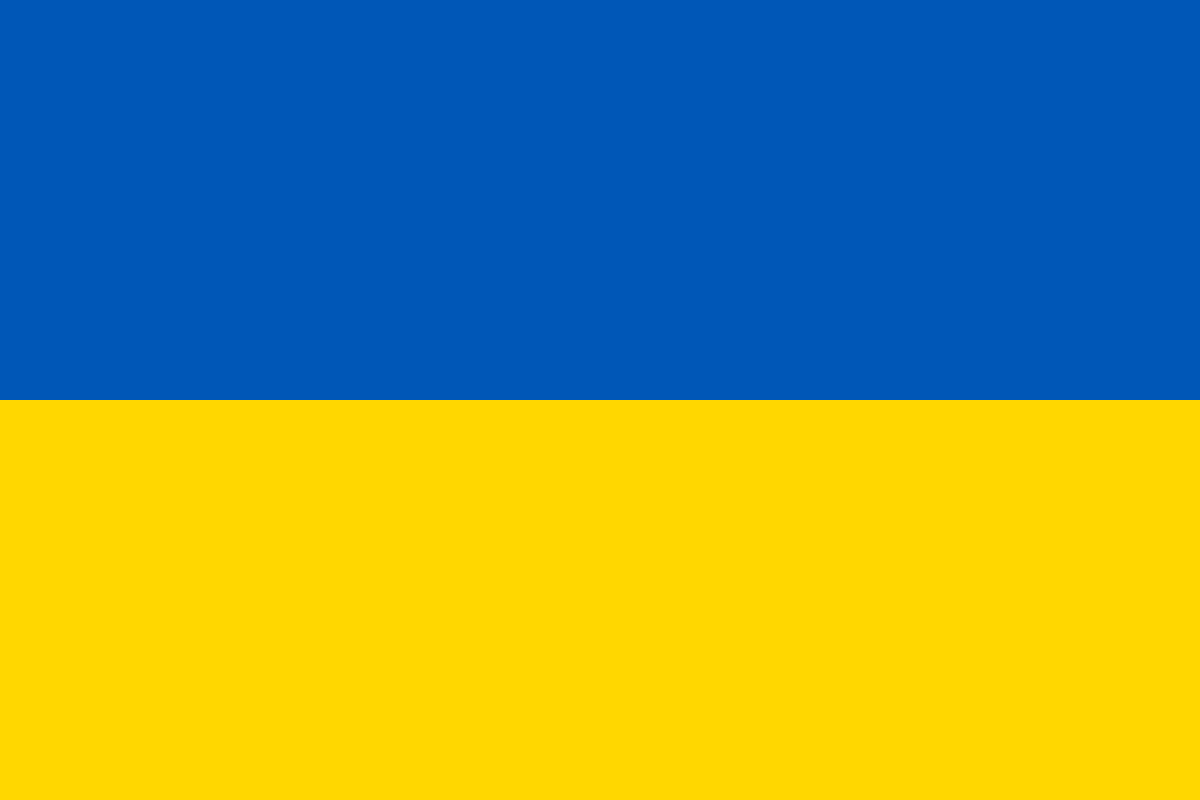
Flag of Ukraine — Two equal horizontal bands: azure (top) and or (bottom). Ratio 2:3. Re-adopted 28 January 1992.
The blue-yellow combination is not, contrary to a common folk reading, a poetic evocation of sky above wheat. It descends directly from the heraldry of the Kingdom of Ruthenia (Galicia-Volhynia), whose arms — a golden lion rampant on an azure field — are documented on the seal of King Yuriy I of Halych in 1316 and reappear consistently in Central-European armorials of the 14th and 15th centuries (Zurich Roll, Gelre Armorial).
Through the late medieval and early modern period, the same tinctures identify the province of Rus’ within the Polish-Lithuanian Commonwealth, and were carried by Ruthenian nobiliary companies and student fraternities.
The modern national reading was fixed during the Spring of Nations. On 25 June 1848, the Supreme Ruthenian Council (Holovna Ruska Rada), meeting in Lviv under Bishop Hryhoriy Yakhymovych, adopted the blue-yellow bicolour as the national banner of the Galician Ruthenians — explicitly drawing on the Ruthenian lion’s tinctures. The order (azure over or) matches the natural heraldic reading of the medieval arms: the field above the charge.
22 March 1918 — The Central Rada of the Ukrainian People’s Republic adopts the blue-yellow flag as the national ensign.
13 November 1918 — The Western Ukrainian People’s Republic, proclaimed in Lviv, uses the same bicolour.
15 March 1939 — The one-day republic of Carpatho-Ukraine adopts it in Khust before being overrun.
1949 — The Ukrainian SSR modifies its red banner by adding a lower azure band — a distant, ideologically muted echo of the earlier bicolour.
24 August 1991 — On the day the Verkhovna Rada declares independence, People’s Deputy Ivan Zaiets brings a blue-yellow flag into the chamber; on 4 September it is hoisted over the parliament building.
28 January 1992 — Resolution No. 2067-XII fixes the current design (azure over or, ratio 2:3).
23 August (from 2004) — Presidential decree institutes the Day of the State Flag of Ukraine.
The interpretation of the flag as “a blue sky above golden wheat fields” is a 20th-century poetic gloss, popularised in the diaspora and in school textbooks. It has no basis in the 1848 or 1918 acts of adoption, both of which cite the medieval Ruthenian arms explicitly. It survives because it is memorable and because it agrees with a landscape shared by much of the country, but it is not the historical or legal source of the colours.
Ukraine, Belarus and the western territories of the Russian Federation all descend heraldically from the Rurikid principalities of Kyivan Rus’. Their modern symbols follow three divergent restoration strategies:
| State | Restored source | Century of reference | Route to modern use |
|---|---|---|---|
| Ukraine | Princely mark of Volodymyr the Great | 10th c. | UNR 1918 → 1992 |
| Russia | Byzantine double-headed eagle | 15th c. (Ivan III) | Empire 1721 → 1993 |
| Belarus | Soviet-era arms (revised 1995) | 20th c. | Continuity, not restoration |
| Historical: Kingdom of Ruthenia | Golden lion rampant on azure | 13th c. (Yuriy I) | Local Galician usage |
Ukraine is the only successor state to Kyivan Rus’ that reaches directly back to the pre-Byzantine, Rurikid layer — a heraldic decision that also distances the modern emblem from the imperial vocabulary of Moscow.
Ukraine is divided into 24 oblasts, one autonomous republic (Crimea) and two cities with special status (Kyiv and Sevastopol). Each subdivision carries its own coat of arms, most drawing on the heraldic tradition of the medieval principalities, voivodeships and Cossack regimental structures on whose territory the modern region was constituted. A few notable examples:
Click on Ukraine on the interactive map above to browse all subdivisions.
No single interpretation is universally accepted. Six competing hypotheses circulate — a falcon in a dive (Boris Rybakov, 1940), a Trinitarian Christian symbol, a stylised anchor, the weapon of Perun, a Turkic tamga, or a Cyrillic ligature of the name Volodymyr. Article 20 of the Constitution (1996) leaves the debate open by naming it only as the Sign of the Princely State of Volodymyr the Great.
It appears in the archaeological record on the silver coins and lead seals of Volodymyr Sviatoslavych, Grand Prince of Kyiv (r. c. 980–1015). Its adoption as a modern state emblem dates to the Ukrainian People’s Republic on 22 March 1918, and its restoration by independent Ukraine to 19 February 1992.
No. That reading is a 20th-century folk gloss, not an official interpretation. Both the 1848 Ruthenian Congress and the UNR of 1918 traced the colours to the medieval arms of the Kingdom of Ruthenia — a golden lion rampant on an azure field — documented on the seal of King Yuriy I of Halych in 1316.
The order matches the natural heraldic reading of the Ruthenian arms (field above charge) and was formalised at the Ruthenian Congress of Lviv in 1848. Some Western Ukrainian and diaspora usages between 1918 and 1949 inverted the arrangement, but Verkhovna Rada Resolution No. 2067-XII of 28 January 1992 finalised the current form.
Constitutionally, yes — but it has never been enacted. Article 20 requires a Great State Coat of Arms combining the trident with the emblem of the Zaporozhian Host (a cossack with a musket). A 2020 design by Andriy Grechylo passed a first reading in the Verkhovna Rada but did not reach the two-thirds majority required. Only the Small Coat of Arms is in official use.
Last reviewed by the Emblema Mundi editorial team on 5 July 2026.