Department of France
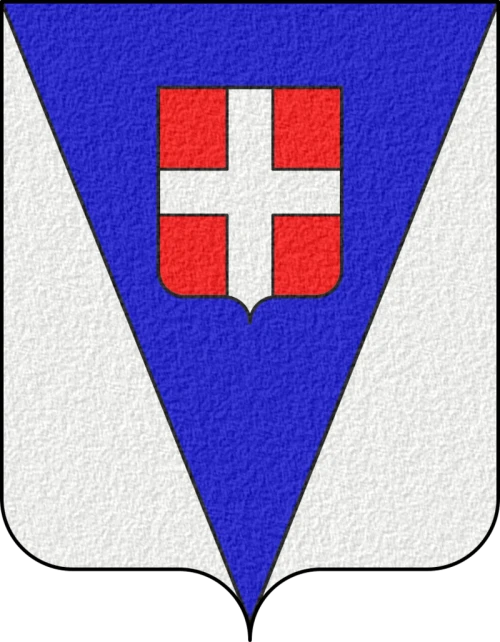
Savoie has no coat of arms of its own: it flies the white cross on red of the old duchy, shared with Haute-Savoie and first seen on a seal of 1143. The shield shown here, the cross of Savoy above silver valleys, was proposed by Robert Louis and never adopted.
Coat of Arms
Not available
| Department | Savoie (73) — prefecture Chambéry; created 15 June 1860 |
|---|---|
| Arms in use | Those of the old duchy: Gules, a cross Argent, shared with Haute-Savoie |
| Arms shown here | Proposed by Robert Louis: the cross of Savoy on blue, with silver valleys |
| Status | No official arms; the cross appears on the department’s logo |
| Flag | De facto: a white cross on red, reaching the edges |
Coat of arms of Savoie proposed by Robert Louis — Azure chaussé Argent; in chief an escutcheon Gules charged with a cross of the second.
Azure chaussé Argent; in chief an escutcheon Gules charged with a cross of the second.
This is the design the heraldist Robert Louis proposed for the department in 1950. It is the picture of Savoy among its mountains: the duchy’s shield, held above the shape of the valleys.
The arms of the counts, then dukes, of Savoy are Gules, a cross Argent: a white cross on red. They were not always so. The first arms of the Humbertians, the family that became the house of Savoy, were Or, an eagle Sable — the banner of the Emperor.
The cross first appears on a pennon on a seal of 1143, on a charter of Count Amédée III, kept at the abbey of Saint-Maurice d’Agaune. For two centuries the counts alternated between the cross and the eagle, depending on their politics. A fifteenth-century chronicler, Jean Cabaret d’Orville, traced the cross to Amédée III’s part in the Second Crusade — but the count left for it in 1147, a few years after the seal.
Amédée V settled the matter in the fourteenth century, and the cross became the main emblem of the house. Tradition ties his choice to 1315, after he helped the Knights of St John defend Rhodes against the Ottomans.
The department of Savoie, created on 15 June 1860 after Savoy was united with France, has no official coat of arms. By tradition it uses the arms of the old duchy — and so does its neighbour, Haute-Savoie. The cross is shared by the two departments, appears on both their logos, and is used freely by local authorities on either side.
Many towns of the old duchy carry it too: Chambéry, Albertville, Montmélian and others set the cross of Savoy in their own arms.
In 1950, in Marques symboliques des départements français, Robert Louis gave the two departments sister designs built on the same small shield of Savoy: for Savoie, a chaussé evoking the valleys; for Haute-Savoie, a chapé evoking the mountains. Neither was adopted.
The flag of Savoy is the cross of the arms on a banner: a white cross on a red field. It is the de facto flag of the region, flown everywhere, but it has no official status: its proportions, the width of the cross and the exact shade of red are not regulated, and several versions are in use.
The two are easily told apart. On the Swiss flag the cross is couped: its arms stop short of the edges. On the flag of Savoy the arms of the cross run all the way to the edges of the flag.
No. By tradition it uses the arms of the old duchy of Savoy, Gules, a cross Argent, which it shares with Haute-Savoie. The arms with the blue field were proposed by Robert Louis in 1950 and never adopted.
Both show a white cross on red. On the Swiss flag the cross stops short of the edges; on the flag of Savoy it reaches them.
It first appears on a seal of Count Amédée III in 1143. The counts long alternated it with an eagle; Amédée V made it permanent in the fourteenth century.
The blue field with silver pieces rising from the base, the chaussé, evokes the valleys; the small red shield with a white cross is Savoy.
The arms are described from the published blazon and the texts above, not from the drawing.
Last reviewed by the Emblema Mundi editorial team on 1 October 2026.