Region of France
Rhône-Alpes was a region of southeastern France stretching from the Lyon basin to the summit of Mont Blanc, the highest point in the Alps and in Western Europe. Its coat of arms bears a silver lion on red with a royal French chief — combining the heraldry of the ancient Dauphiné with the mark of French sovereignty.
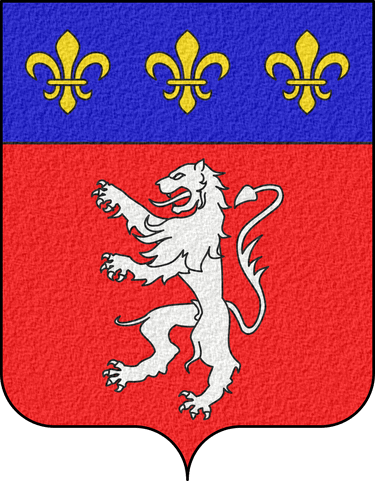
Coat of Arms
Not available
| Status | Former administrative region of France (1972–2015) |
|---|---|
| Current region | Auvergne-Rhône-Alpes (since 1 January 2016) |
| Capital | Lyon |
| Departments | Ain, Ardèche, Drôme, Isère, Loire, Rhône, Savoie, Haute-Savoie |
| Area | 43,698 km² |
| Historic territories | Dauphiné, Savoie, Lyonnais, Bresse, Bugey |
Coat of Arms — Gules, a lion Argent armed and langued of the same, on a chief Azure three fleurs-de-lis Or.
Gules, a lion Argent armed and langued of the same, on a chief Azure three fleurs-de-lis Or.
The Dauphiné was a principality in the pre-Alps, ruled by the counts of Albon who called themselves "Dauphins" from the early 12th century. In 1349, Humbert II, the last Dauphin d'Albon, sold the territory to France — specifically to the future Charles V. From that moment the title "Dauphin de France" became the designation of the heir to the French throne. The silver lion on red is a simplified version of the Dauphiné's historic arms; the addition of the French royal chief affirms the territory's integration into the kingdom. The administrative region of Rhône-Alpes also included Savoie (which joined France only in 1860) and the ancient Lyonnais territory centred on Lyon, France's third-largest city.
The regional flag displayed the coat of arms — silver lion on red, with a blue chief bearing three gold fleurs-de-lis. The combination of red, silver, blue and gold gave the flag a rich heraldic appearance typical of medieval territorial arms.
The arms were designed for the administrative region created in 1972 and drew on the medieval heraldic tradition of the Dauphiné. The Savoy cross (white cross on red) was sometimes used informally alongside the official arms to acknowledge the Savoyard heritage of the region's Alpine departments.
Since the merger into Auvergne-Rhône-Alpes in 2016, the Rhône-Alpes arms are no longer the official regional emblem, but they continue to be displayed locally, particularly in Lyon, Grenoble and the Alpine ski resorts. The new region has its own combined arms, but sub-regional identities remain strong.
The arms show a silver lion on red with a blue chief of three gold fleurs-de-lis, combining the heraldry of the historic Dauphiné (the silver lion on red) with the mark of French royal sovereignty (the fleurs-de-lis chief).
The Dauphiné was the medieval principality centred on Grenoble, sold to France in 1349 by Humbert II. From that moment the title "Dauphin de France" designated the heir to the throne. Much of the Dauphiné lies within Rhône-Alpes.
Lyon is France's third-largest city and the regional capital. It stands at the confluence of the Rhône and Saône, was a major Roman city (Lugdunum), and became the silk and banking capital of France in the Renaissance. It is today celebrated for its gastronomy and its silk-weaving heritage.
On 1 January 2016, Rhône-Alpes merged with Auvergne to form Auvergne-Rhône-Alpes, with Lyon as its capital.
The region encompasses most of the French Alps, including Mont Blanc (4,808 m — highest peak in Western Europe), the Chartreuse, the Vercors, the Vanoise and the Belledonne massifs. Major ski resorts include Chamonix, Courchevel, Méribel, Tignes and Val d'Isère.
Last reviewed by the Emblema Mundi editorial team on June 29, 2026.