City of France
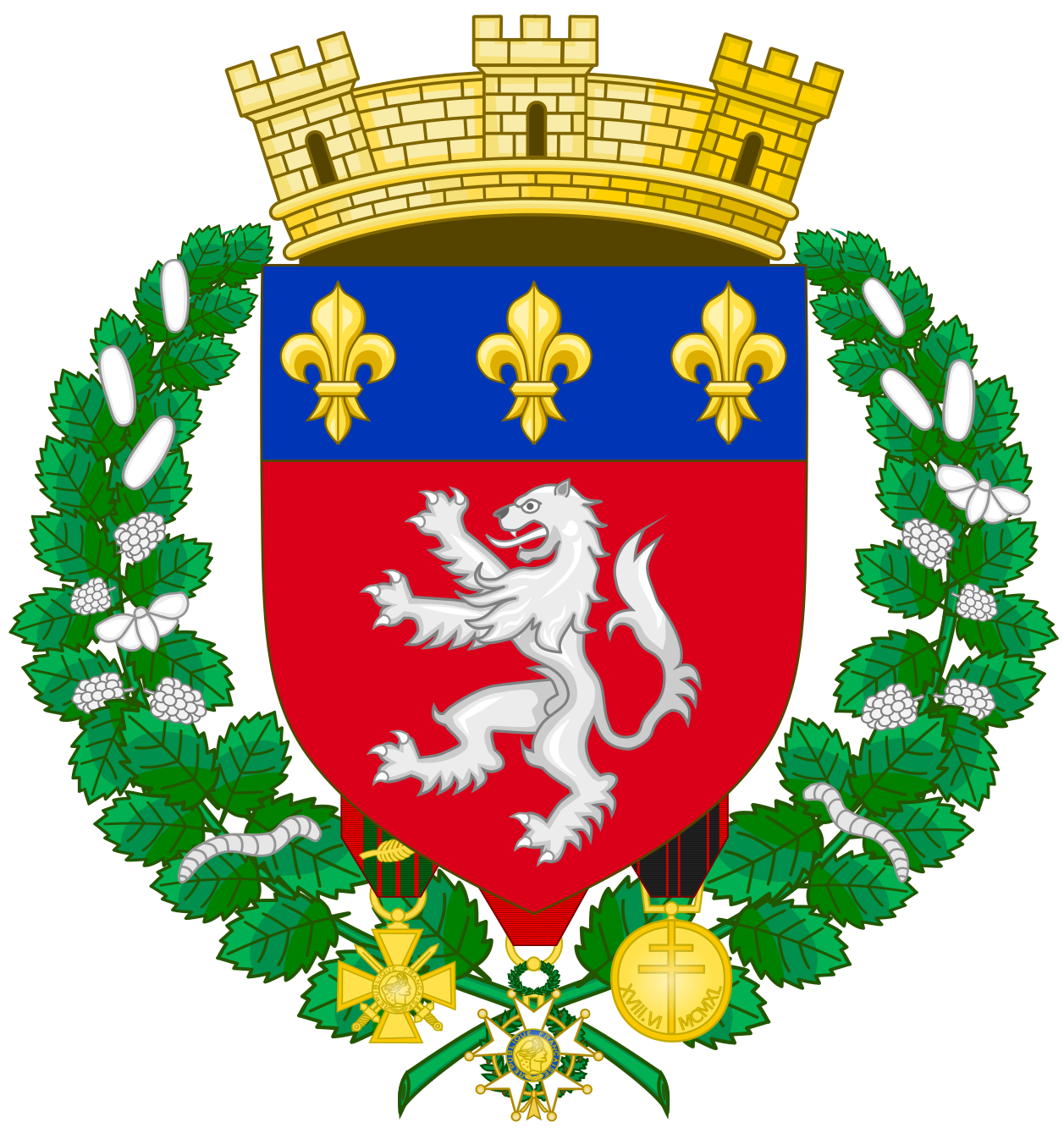
The arms of Lyon, prefecture of Auvergne-Rhône-Alpes, show a silver lion on a red field under a blue chief charged with three gold fleurs-de-lis. They are canting arms: the lion stands for the sound of the city’s name. Once the arms of the counts of Lyon, they changed with the regimes, from the bees of the Empire to the sword of 1819 and the stars of the July Monarchy.
Coat of Arms
Not available
| City | Lyon (Francoprovençal: Liyon), at the confluence of the Rhône and the Saône; prefecture of the Auvergne-Rhône-Alpes region and of the Rhône, seat of the Métropole de Lyon |
|---|---|
| Inhabitants | Lyonnais |
| Arms | Gules, a lion Argent, a chief Azure charged with three fleurs-de-lis Or |
| Ornaments | A mural crown; two branches of white mulberry as supporters; the Légion d’honneur, the croix de guerre and the médaille de la Résistance |
| Motto | Virtute duce, comite fortuna |
| War cry | Avant, Avant, Lion le melhor! (Francoprovençal) |
The greater arms of Lyon, with their external ornaments.
De gueules au lion d’argent, au chef d’azur chargé de trois fleurs de lys d’or.
That is: on a red field, a silver lion, under a blue chief charged with three gold fleurs-de-lis. This is the blazon given by French Wikipedia’s article on the arms of Lyon, which also gives a fuller form for the arms the city bears today: De gueules au lion rampant armé, lampassé d’argent au chef d’azur chargé de trois fleurs de lys d’or.
They are canting arms: the blazon reads like a rebus, the silver lion standing for the sound of the name Lyon. The name itself has nothing to do with the animal: it comes from the Latin Lugdunum. According to the article on the arms, this chance likeness influenced the choice of the lion, but the lion was perhaps already an emblem of the city in Antiquity, possibly in honour of Marc-Antoine, who had taken it as a symbol: from 43 BC, the mint of Lugdunum struck a quinarius of the triumvir with a lion passant on the reverse and the inscription LUGUDUNI A XL.
According to the article on the arms, the counts of Lyon, lords of the city in the 10th century, took as their arms de gueules au lion d’argent, a silver lion on red. The chief of France was then added as a sign of royal protection: around 1320 with its three fleurs-de-lis, according to the article on the city; in 1320 as a chief strewn with fleurs-de-lis, simplified to three after 1376 when Charles V reduced the royal arms to three lilies, according to the article on the arms. That article adds that the chief is said to be cousu, sewn on, to avoid breaking the rule that forbids placing a colour on a colour, here blue on red, and that it is only from the charter of 1320 that established the consulate that the city had arms of its own as a municipality.
At the beginning of the 15th century, the archbishop Amédée II de Talaru, then at odds with the city’s échevins, tried to have the lion removed from the arms, arguing that it came from the counts of Lyon. The échevins appealed to Charles VI, who ruled in their favour, and took the matter to the Parlement when the archbishop’s side refused to carry out the royal order, confirming the city’s full ownership of its arms. On 10 July 1584, François de Mandelot, governor of the Lyonnais, even offered the city a real lion; the consulate thanked him but declined, lacking the money to keep such a beast during the Wars of Religion.
The arms disappeared with the Revolution: the city’s representatives used a seal bearing only a goddess of Liberty. A decree of 1809 restored them under the First Empire, with three bees in place of the fleurs-de-lis: De gueules au lion d’argent au chef des bonnes villes de l’Empire (de gueules à trois abeilles d’or). Napoléon Ier granted the city a mural crown with seven gold crenellations, a symbol of the fortified cities of Antiquity. Under the Restoration, letters patent of Louis XVIII dated 27 February 1819 added a sword in the lion’s paw, recalling the siege Lyon underwent for the royal cause in 1793: De gueules à un lion d’argent tenant dans sa patte dextre une épée haute du même, et un chef d’azur à trois fleurs de lis d’or.
After 1830, the July Monarchy replaced the fleurs-de-lis of the chiefs of France with gold stars for the sake of neutrality. Under the Second Empire, in 1859, the keeper of the seals asked senator Vaïsse to restore the arms with the lion and the lilies alone, but the city council adopted this only at the beginning of the 20th century, according to the body of the article on the arms, whose introduction dates the present form from 1859; in the meantime, many fanciful versions appeared, under the Third Republic according to the article on the arms, from 1830 according to the article on the city, which says they were called fausses armoiries, false arms. Lyon thus bears today, without the sword, the arms it bore for six centuries.
The traditional motto of Lyon is Virtute duce, comite fortuna, which the article on the city translates as virtue for guide and fortune for companion, and the article on the arms as luck for companion and courage for guide. According to the article on the city, it was borrowed from Sébastien Gryphe, who printed it at the head of his editions, and is taken word for word from a letter of Cicéron to Lucius Munatius Plancus, the founder of the city. Another motto, Fortitudine ac prudentia, is also found. The war cry Avant, Avant, Lion le melhor! is attested since 1273 according to the article on the arms; the article on the city calls it the war cry of the rebeyne of 1269.
The city received several decorations in the 20th century that it may bear with its arms: the cross of chevalier of the Légion d’honneur, the croix de guerre and the médaille de la Résistance with rosette. In old depictions the shield is usually shown alone; two angels were sometimes added as supporters, with no constant usage. Some authors also note the lion’s tail, turned outward at the end, which they blazon à la queue léopardée. The shield of Lyon appeared on a 70-centime postage stamp in 1958, in the third series of the Armoiries de villes.
Lyon is a commune in the south-east quarter of France, at the confluence of the Rhône and the Saône. In 2023 it was the third most populous commune of France, behind Marseille and Paris. It is the prefecture of the circonscription départementale du Rhône and of the Auvergne-Rhône-Alpes region, and the seat of the Métropole de Lyon, created in 2015, which brings together 58 communes. The city is divided into nine arrondissements.
Former capital of the Gauls under the Roman Empire, Lyon is the seat of an archdiocese whose holder bears the title of Primat des Gaules. At the Renaissance it became a great trading city and financial centre, its prosperity also carried by silk and printing. The Vieux Lyon, the hill of Fourvière, the Presqu’île and the slopes of the Croix-Rousse are on the UNESCO World Heritage List.
The name is attested in the forms Lugdon and Luon, then Lyon from the 13th century. According to the article on the city, the ancient Lugdunum is made of two Gaulish words, Lug, a Celtic god whose messenger is a crow, and dunos, fortress or hill: the fortress of Lug, the hill of the god Lug or the hill of crows; Julius Pokorny links the first part to the Indo-European root *lūg, which would make it the hill or the bright mount. The article on the arms also mentions the Latin lux, light, and the Gaulish lugos, crow. It first designated the hill of Fourvière, on which the ancient city was founded. During the Revolution, a decree of the Convention renamed Lyon Commune-Affranchie on 12 October 1793; it took back its name in 1794.
Gules, a lion Argent, a chief Azure charged with three fleurs-de-lis Or: a silver lion on red under a blue chief with three gold fleurs-de-lis.
They are canting arms: the lion stands for the sound of the name Lyon, although the name comes from the Latin Lugdunum and has nothing to do with the animal.
Letters patent of Louis XVIII of 27 February 1819 added the sword to recall the siege of 1793; the city later went back to the lion without a sword.
Virtute duce, comite fortuna, taken from a letter of Cicéron to Lucius Munatius Plancus, the founder of the city.
A mural crown with seven gold crenellations, a symbol of the fortified cities of Antiquity, granted by Napoléon Ier.
Illustration: Wikimedia Commons. Coat of arms: drawing by Heralder (CC BY-SA 4.0).
Last reviewed by the Emblema Mundi editorial team on 10 November 2026.