City of France
The arms of Nice, prefecture of Alpes-Maritimes, show a crowned red eagle with lowered wings standing on three green mounts that rise from a blue sea, on a silver field. According to French Wikipedia, they are a sign of allegiance and fidelity to the House of Savoy; the city chose the protection of the county of Savoy in 1388 and was ceded to France in 1860.
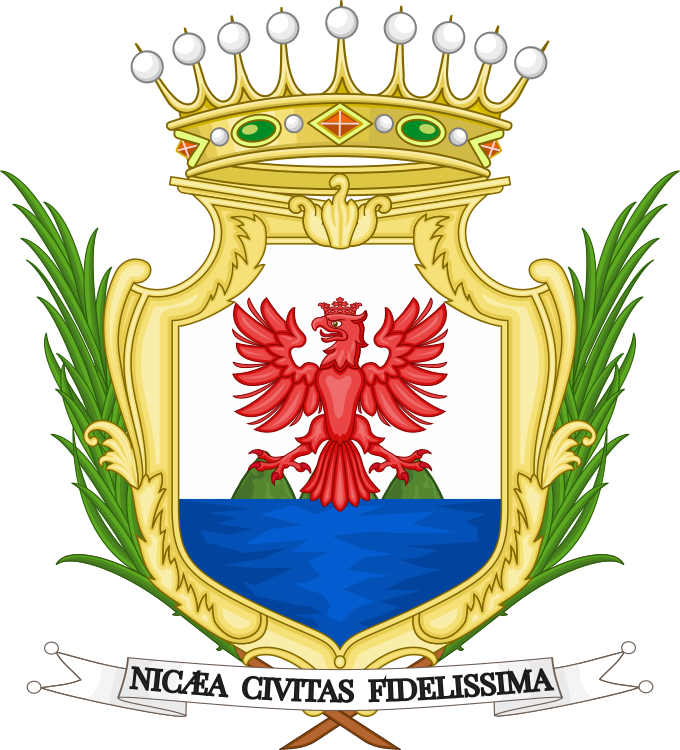
Coat of Arms
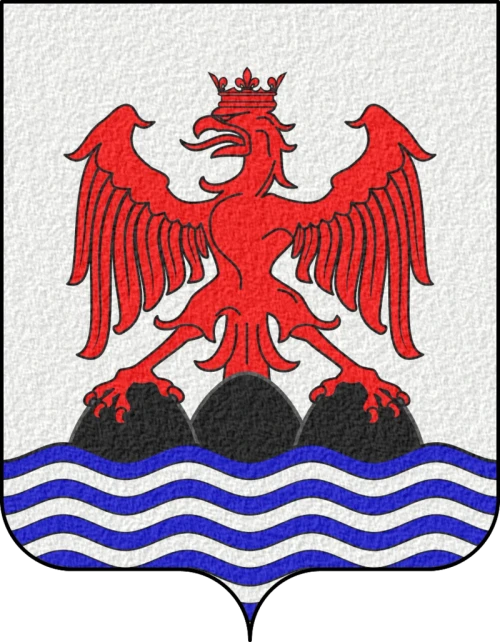
Not available
| City | Nice (Niçois Occitan: Nissa or Niça; Italian: Nizza), prefecture of Alpes-Maritimes, in the Provence-Alpes-Côte d’Azur region |
|---|---|
| Inhabitants | Niçois and Niçoises |
| Arms | Argent, an eagle crowned Gules with wings lowered, standing on a mount of three hillocks Vert rising from a sea Azure issuing from the base, wavy Argent |
| Motto | Nicaea fidelissima, Nice the Most Faithful |
The coat of arms of Nice.
D’argent à l’aigle couronnée de gueules au vol abaissé, empiétant une montagne de trois coupeaux de sinople issant d’une mer d’azur mouvant de la pointe et ondée d’argent.
That is: on a silver field, a red eagle, crowned, with its wings lowered, standing on a green mount of three hillocks that rises from a blue sea, wavy silver, at the base of the shield. This is the blazon given by French Wikipedia’s armorial of the communes of Alpes-Maritimes.
According to French Wikipedia’s article on the city, the arms of Nice first appear in a copy of the Statuts of Amédée VIII, probably made shortly after their promulgation in 1430. The pays niçois is then symbolised by a red eagle on a white field, standing on three mounts, which can be blazoned d’argent à une aigle de gueules posée sur trois coupeaux. The arms then underwent only minor changes: the eagle became more and more stylised and received a count’s crown, symbolising its rule over the county of Nice, and the three mounts came to be edged by a stylised sea, giving d’argent à l’aigle de gueules, le vol abaissé, posée sur trois coupeaux de sinople, mouvants d’une mer d’azur.
The same article explains that the eagle, an imperial emblem, shows that these arms are linked to the power of Savoy: the counts and then dukes of Savoy justified their rule over the pays niçois by their title of imperial vicar. The eagle dominating the three hills is thus an illustration and a legitimation of the House of Savoy. The pairing of white and red, argent and gules, takes up the tinctures of the cross of Savoy, and the three mounts symbolise a territorial honour, with no concern for geographic realism. By their emblematic structure, the arms of Nice are therefore a sign of allegiance and fidelity to the House of Savoy.
The imperial decree of 6 June 1811 gave the city of Nice new arms: Un lion passant de gueules surmonté d’un soleil rayonnant du même, adextré d’un olivier et sénestré d’un oranger de sinople au chef de gueules chargé de trois abeilles d’or qui est le signe des bonnes villes de l’Empire. That is: a red lion passant under a radiant red sun, between a green olive tree and a green orange tree, under the red chief with three gold bees of the bonnes villes de l’Empire. The traditional arms were restored after the fall of the Empire.
The motto of the city is Nicaea fidelissima, Nice the Most Faithful, according to the article on the city; the armorial gives it as Nicæa civitas fidelissima, Nice, most faithful city.
Nice is a commune of the south-east of France, prefecture of the Alpes-Maritimes department and the second most populous city of the Provence-Alpes-Côte d’Azur region after Marseille. It lies about thirty kilometres from the French-Italian border, on the shores of the Mediterranean, along the baie des Anges and at the mouth of the Paillon. It is the fifth commune of France by population, after Paris, Marseille, Lyon and Toulouse.
In 1388 the city chose the protection of the county of Savoy, and in 1526 it became the capital of the county of Nice. It later belonged to the kingdom of Piedmont-Sardinia, under which it was called Nizza Marittima, before being ceded to France in 1860 in exchange for the help of Napoléon III in building Italian unity. In the 19th century the city grew thanks to winter seaside tourism, notably from England; on 27 July 2021, Nice, the winter resort town of the Riviera, was inscribed on the UNESCO World Heritage List. The promenade des Anglais is one of its best-known sites.
The name is attested as Nicaea in the 1st century AD and Nikaia in the 2nd. It comes from the Greek (thea) nikaia, she who gives victory, an epithet attached to the name of a goddess, perhaps Artemis or Athena, honoured at Marseille. An old hypothesis saw behind it a Ligurian root *nis, source, but the main toponymists reject it, since no such word is formally attested.
On a silver field, a crowned red eagle with lowered wings, standing on three green mounts that rise from a blue sea.
According to French Wikipedia, the eagle, an imperial emblem, links the arms to the House of Savoy, whose counts and dukes justified their rule over the pays niçois by their title of imperial vicar.
In a copy of the Statuts of Amédée VIII, probably made shortly after their promulgation in 1430.
The imperial decree of 6 June 1811 gave Nice a red lion under a sun, between an olive tree and an orange tree, under the chief of the bonnes villes; the traditional arms returned after the fall of the Empire.
Nicaea fidelissima, Nice the Most Faithful; the armorial of Alpes-Maritimes gives Nicæa civitas fidelissima.
Illustration: Wikimedia Commons. Coat of arms: drawing by Ashoppio (CC BY-SA 4.0).
Last reviewed by the Emblema Mundi editorial team on 10 November 2026.