Region of France
Provence-Alpes-Côte d’Azur (commonly abbreviated PACA) is a region of southeastern France bordering Italy, Monaco and the Mediterranean Sea. Its coat of arms is one of the most complex in France, combining three distinct heraldic traditions: the four pallets of Provence, the dolphin of the Dauphiné and the eagle of the County of Nice — three territories with very different historical paths to becoming part of France.
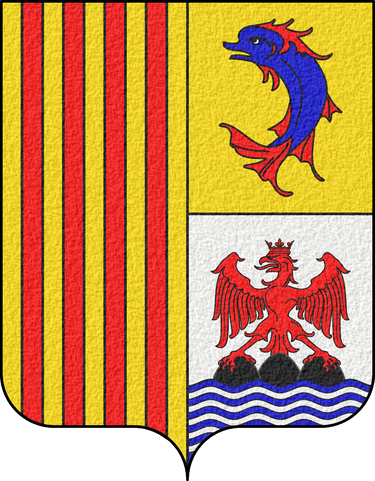
Coat of Arms
Not available
| Status | Administrative region of France (since 1972) |
|---|---|
| Capital | Marseille |
| Departments | Alpes-de-Haute-Provence, Hautes-Alpes, Alpes-Maritimes, Bouches-du-Rhône, Var, Vaucluse |
| Area | 31,400 km² |
| Population (approx.) | 5.1 million |
| Historic territories | County of Provence, Dauphiné, County of Nice, Comtat Venaissin |
Coat of Arms — Per pale: 1st Or, four pallets Gules (Provence); 2nd per fess, Or a dolphin Azure crested, barbed, lored, finned and eared Gules (Dauphiné), and Argent an eagle crowned Gules upon a mountain of three coupeaux Sable issuing from a sea Azure wavy Argent (County of Nice).
Per pale: 1st Or, four pallets Gules; 2nd per fess, Or a dolphin Azure crested, barbed, lored, finned and eared Gules, and Argent an eagle crowned Gules standing upon a mountain of three coupeaux Sable issuing from a sea Azure wavy Argent.
Provence was united to France in 1481 through the will of Charles du Maine, the last count of Provence of the Valois line. The Dauphiné was purchased by France in 1349 from Humbert II, the last Dauphin d’Albon. Nice was ceded in 1860 following a plebiscite negotiated between Napoléon III and Camillo di Cavour as part of the deal for French support of Italian unification. The administrative region created in 1972 combined these three territories, and its arms were designed to reflect all three heraldic traditions simultaneously.
The regional flag reproduces the coat of arms, with gold, red, blue, silver and black all present. The division per pale (left/right) separates Provence from the Dauphiné-Nice combination, while the lower-right quarter is further divided per fess to accommodate both the dolphin and the eagle.
The four pallets of Provence have been used as a banner since the medieval period, associated with the counts of Provence and the Crown of Aragon. The dolphin of the Dauphiné was a seal and banner emblem from the 12th century. The eagle of Nice was used by the commune and county of Nice before French annexation.
The regional council of PACA (headquartered in Marseille) displays the arms prominently. The four pallets of Provence are also widely used alone as a popular regional symbol, particularly in the context of Provençal cultural identity and the tourism industry.
The arms combine three territories: the four red pallets on gold for Provence, the blue dolphin on gold for the Dauphiné, and the red eagle on a mountain above the sea for the County of Nice — each with a different history of joining France.
The four red vertical stripes on gold are the arms of the counts of Provence, derived from the Crown of Aragon through the house of Barcelona. They are shared with the arms of Catalonia, Aragon and several other territories historically tied to the Crown of Aragon.
The dolphin represents the Dauphiné — the historic principality whose lords bore the title "Dauphin". From 1349, the title became the designation of the heir to the French throne (Dauphin de France), and the dolphin entered French royal symbolism as a result.
The County of Nice was ceded by the Kingdom of Sardinia to France in 1860, following a plebiscite, as part of Napoléon III’s deal with Cavour supporting Italian unification. The eagle on a mountain above the sea in the arms commemorates this Nissart heritage.
PACA is one of France’s most visited regions: the French Riviera (Côte d’Azur), Marseille (France’s second-largest city), Aix-en-Provence, Avignon (city of the Popes), the lavender fields of the Luberon, the Calanques and the Verdon Gorge.
Last reviewed by the Emblema Mundi editorial team on June 29, 2026.