City of France
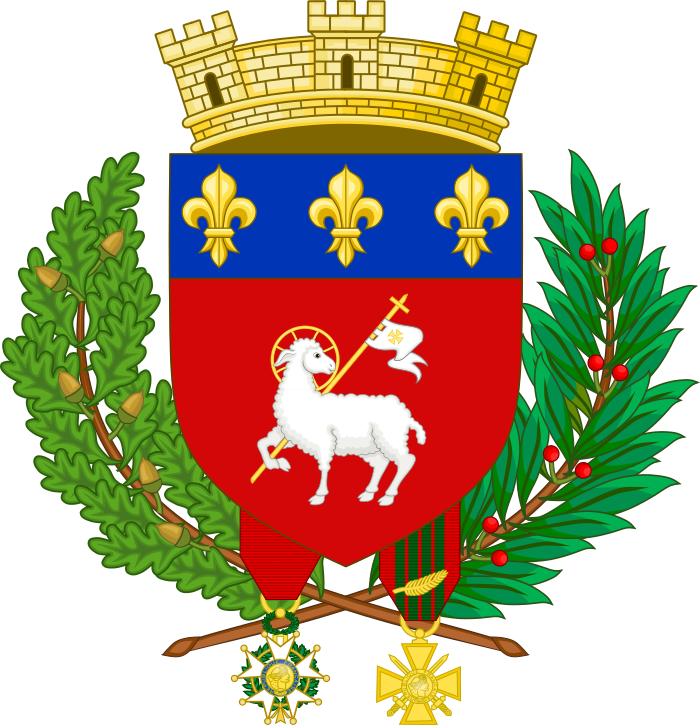
The traditional arms of Rouen, prefecture of Seine-Maritime and capital of Normandy, show a silver Paschal lamb carrying a small banner with a gold cross, on a red field, under a blue chief with three gold fleurs-de-lis. According to Adolphe Chéruel, the city’s medieval seal first showed a lion facing forward, or leopard, then this lamb, which French Wikipedia also ties to the pastures of the valleys around Rouen.
Click on a country to learn more
| City | Rouen, prefecture of Seine-Maritime and capital of the Normandy region, on the Seine |
|---|---|
| Inhabitants | Rouennais and Rouennaises |
| Arms | Gules, a Paschal lamb Argent, its head haloed and turned back, carrying a banner of the same charged with a small cross Or; a chief sewn on Azure with three fleurs-de-lis Or |
| Nickname | Ville aux Cent Clochers (city of a hundred bell towers) |
The arms of the city of Rouen.
De gueules à l’agneau pascal d’argent, la tête nimbée et contournée, portant une bannerette du même chargée d’une croisette d’or, au chef cousu d’azur semé de trois fleurs de lys d’or.
That is: on a red field, a silver Paschal lamb, its head haloed and turned back, carrying a small silver banner charged with a little gold cross; a blue chief, sewn on, strewn with three gold fleurs-de-lis. French Wikipedia’s article on the city gives this blazon as the traditional arms of Rouen.
The mayors of Rouen had the right to a seal in the 12th, 13th and 14th centuries. According to Adolphe Chéruel, quoted by the article, their seal first showed a lion facing forward, or leopard, then a lamb carrying a guidon, a small flag. Alfred Canel cites several examples of this first seal from the early 13th century, and according to Chéruel the last known example dates from 1309.
Léopold Delisle gives two examples of the seal with the lamb, dated 1355 and 1364, and considers that this seal of the city is not earlier than 1266; before that, it was already used by corporations, before the city adopted it for its arms. The archives of the Seine-Maritime department hold impressions of the seal with the lamb from the 13th century, one of 1238 from the abbey of Jumièges, one of 1246 from the Jacobins of Rouen and one of 1293 from the Chapter.
The two types of seal were therefore used at the same time for a while: a charter of a mayor of Rouen of 1362 shows them together in the same frame. Canel describes a lamb with a guidon set upright and charged with a leopard; likewise, on the frontispiece of the main post office of Rouen, rue Jeanne-d’Arc, the lamb carries a small banner charged with a lion-léopardé passant, a lion passant. The leopard later disappeared from the guidon and was sometimes replaced by a cross or the words Agnus Dei. According to Canel, the three fleurs-de-lis would have been added from the first half of the 16th century.
According to the article, the Paschal lamb shown on the arms is an animal essentially bound up with local culture, since the valleys of the area are surrounded by gently sloping hillside pastures, suited to these animals, which were hunted by wolves in the Middle Ages. The name of the commune of Canteleu, the singing wolf in the Norman language of Rouen, refers precisely to this predator.
Rouen is a French commune, prefecture of the Seine-Maritime department and capital of the Normandy region, crossed by the Seine. It is the thirty-fifth most populous commune of France and the second of Normandy after Le Havre. Between 911 and 1204 it was the capital of the duchy of Normandy. Claimed by both the French and the English during the Hundred Years’ War, it is where Jeanne d’Arc was imprisoned, tried and burned alive in 1431.
Its many religious buildings have earned it the nickname of Ville aux Cent Clochers, and its cathedral Notre-Dame is one of the tallest in the world; the city was labelled a ville d’art et d’histoire in 2002. Badly damaged during the Semaine rouge of 1944, Rouen is one of the few cities decorated, after the Second World War, with the Légion d’honneur and the croix de guerre 1939-1945.
The name is attested as Ratumacos on the coins of the Véliocasses and as Rotomagus in the 4th century. According to the linguist Xavier Delamarre, *Rotomagos would mean the market of the wheel or rather the racecourse, given the Celts’ passion for chariot races; the historian Patrice Lajoye leans instead towards the market of (good) fortune, a solution that neither the toponymists Albert Dauzat and François de Beaurepaire nor Delamarre consider.
Gules, a Paschal lamb Argent, its head haloed and turned back, carrying a small banner charged with a gold cross, under a blue chief with three gold fleurs-de-lis.
According to Chéruel, the seal of the mayors of Rouen first showed a lion facing forward, or leopard, then a lamb carrying a guidon, the two seals being used together for a while; French Wikipedia also ties the lamb to the hillside pastures of the valleys around Rouen.
According to Chéruel, the first seal of the mayors of Rouen showed a lion facing forward, or leopard. Alfred Canel also describes a lamb whose guidon was charged with a leopard; the leopard later disappeared from the guidon.
According to Alfred Canel, the three fleurs-de-lis would have been added from the first half of the 16th century.
After the Second World War, Rouen was among the few cities decorated with the Légion d’honneur and the croix de guerre 1939-1945.
Illustration: Wikimedia Commons. Coat of arms: drawing by Euryrel (CC BY-SA 4.0).
Last reviewed by the Emblema Mundi editorial team on 10 November 2026.