Region of France
Normandie is a historic region of northwestern France, stretching from Rouen and the Seine valley to Caen, the Cotentin peninsula, and the D-Day beaches. Its coat of arms — two golden leopards on red — is one of the most ancient and celebrated in France, born with Guillaume le Conquérant and the medieval Duchy of Normandie, a power that shaped England, Sicily, and the Mediterranean world.
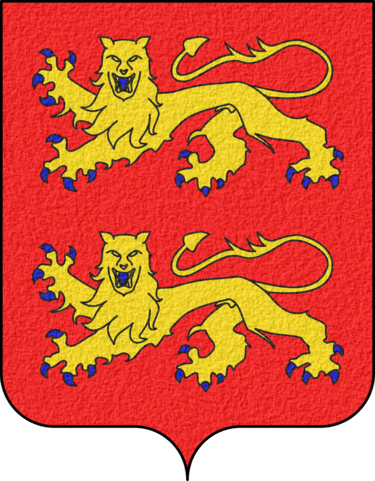
Coat of Arms
Not available
| Region | Normandie (reunified in 2016) |
|---|---|
| Capital | Rouen |
| Departments | Calvados, Eure, Manche, Orne, Seine-Maritime |
| Blazon | Gules, two leopards Or armed and langued Azure passant one above the other |
| Tinctures | Gules (red), Or (gold), Azure (blue) |
Coat of Arms of Normandie — Gules, two leopards Or armed and langued Azure passant one above the other
Gules, two leopards Or armed and langued Azure passant one above the other.
The Norman leopards trace their origin to the Duchy of Normandie, founded by the Viking chieftain Rollon in 911 following the Treaty of Saint-Clair-sur-Epte with the Frankish king Charles le Simple. The arms evolved under the Norman dukes and became firmly associated with Guillaume le Conquérant (William the Conqueror), who carried them to England in 1066. The English royal arms of three leopards derive directly from this Norman tradition. After the duchy's reunification with France in 1204 under Philippe II Auguste, the two-leopard version remained the symbol of Normandie.
The flag of Normandie is a banner of arms: the two golden leopards on a red field. The colors red and gold (Gules and Or) are the classic Norman colors, instantly recognizable across the Channel on both the French and English sides of Norman heritage.
The Norman leopard banner was carried in battle by the dukes of Normandie from the 11th century. It appears on the Bayeux Tapestry — the famous embroidered account of the 1066 conquest — and in countless medieval illuminations. The banner is one of the oldest continuously documented heraldic devices in French history.
Since the 2016 merger of Basse-Normandie and Haute-Normandie back into the single region of Normandie, the leopard arms continue as the primary symbol of regional identity. They are displayed on public buildings, tourism materials, and official communications across all five departments — Calvados, Eure, Manche, Orne and Seine-Maritime — of the reunified Normandie.
The coat of arms of Normandie uses the traditional Norman arms: Gules, two leopards Or armed and langued Azure passant one above the other. Two golden leopards with blue claws and tongues walk across a red field — the iconic symbol of the Duchy of Normandie since the 12th century.
The Duchy of Normandie originally bore two leopards. When Guillaume le Conquérant became King of England in 1066, the arms evolved. The royal arms of England later displayed three leopards (lions passant guardant), but the two-leopard version remained associated with Normandie itself.
Guillaume le Conquérant (c. 1028–1087) was Duke of Normandie who conquered England in 1066. His dynasty spread Norman heraldic traditions across England, Sicily, and southern Italy. The Norman leopards on the arms of Normandie directly evoke his legacy.
Normandie encompasses Rouen and the Seine valley, Caen, the Cotentin peninsula, and the D-Day beaches of 1944. In the medieval period it was the Duchy of Normandie, one of the most powerful feudal states in Western Europe, whose dukes ruled England from 1066 and carved out kingdoms in Sicily and southern Italy.
Basse-Normandie and Haute-Normandie were created in 1956 as separate administrative regions, splitting the historic province in two. The division was purely administrative and never produced two different coats of arms: both halves continued to bear the same Norman leopards. In 2016 the two regions were merged back into a single Normandie, restoring the territorial unity of the medieval duchy.
Last reviewed by the Emblema Mundi editorial team on June 29, 2026.