City of France
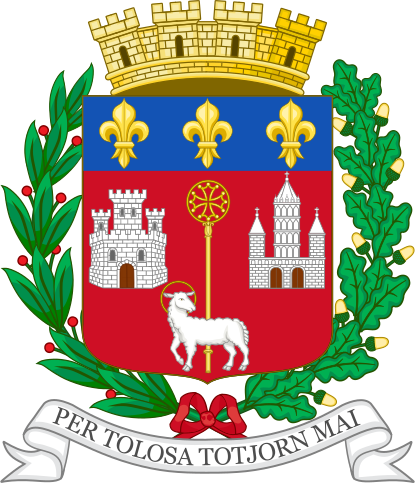
The arms of Toulouse, prefecture of Occitanie and of Haute-Garonne, show on a red field the gold cross with twelve pommettes of the counts of Toulouse, set on a gold pallet, with a silver Paschal lamb in base and the cross flanked by a castle and a basilica, under a chief of France. The city’s motto, Per Tolosa totjorn mai, carries its Occitan name, Tolosa.
Coat of Arms
Not available
| City | Toulouse (Occitan: Tolosa), prefecture of the Occitanie region and of Haute-Garonne, seat of Toulouse Métropole |
|---|---|
| Inhabitants | Toulousains and Toulousaines |
| Arms | Gules, a cross clechée, voided and pommetty of twelve pieces Or on a pallet of the same, a lamb passant Argent in base, the cross between a castle and a basilica Argent; a chief of France |
| Motto | Per Tolosa totjorn mai |
| Nicknames | La ville rose (the pink city), from its brick; the cité des violettes, from the Toulouse violet |
The coat of arms of Toulouse.
De gueules à la croix cléchée, vidée, pommetée de douze pièces d’or, sur une vergette du même, accompagnée en pointe d’un agneau passant d’argent, la tête nimbée, contournée, brochant sur la vergette, la croix accostée à dextre d’un château d’argent, et à sénestre d’une basilique du même, au chef de France.
That is: on a red field, a gold cross clechée, voided and pommetty of twelve pieces, set on a narrow gold pale; in base, a silver lamb passant, its head haloed and turned back, over the pale; the cross is flanked on the dexter side by a silver castle and on the sinister side by a silver basilica; a chief of France. This is the blazon given by French Wikipedia’s article on the city, which flags it as insufficiently sourced, and by the description of the drawing on Wikimedia Commons. French Wikipedia gives the arms the status of official arms and links the castle to the Château Narbonnais and the basilica to the Basilica of Saint-Sernin.
The armorial of the communes of Haute-Garonne gives a more detailed wording, with a castle with three towers, the basilica of the place and a chief of France ancient: De gueules à la croix cléchée, vidée, pommetée de douze pièces d’or, sur une vergette du même, accompagnée en pointe d’un agneau passant d’argent, la tête nimbée et contournée, brochant sur la vergette, la croix accostée à dextre d’un château d’argent donjonné de trois tours, et à sénestre de la basilique du lieu du même ; au chef de France ancien.
French Wikipedia explains that the old arms of the Kingdom of France were blue strewn with gold fleurs-de-lis, and the new ones blue with three gold fleurs-de-lis. Because these arms were so well known, a blazon can simply say “a chief of France”, adding “ancient” or not, or “a chief of France modern” when the chief repeats the modern version.
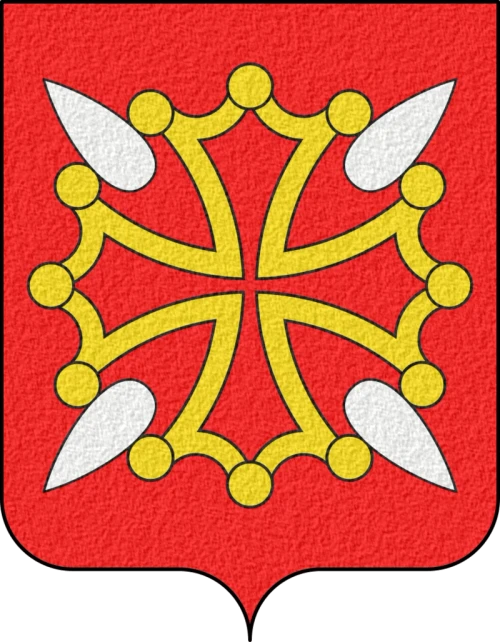
According to French Wikipedia’s article on the Occitan cross, the cross with twelve pommettes appears from the second half of the 12th century on the arms of the counts of Toulouse. The cross called “of Toulouse” is the banner of the Raymondine counts; on the arms of Toulouse, it is carried by the Paschal lamb. It is shown on the reverse of the seal of Raymond VI of Toulouse, dated 1204, where the count rides with this cross on his shield, and on a keystone of Toulouse cathedral datable to 1211. On the obverse of the same seal, the castle that appears on the arms of Toulouse, called “château Narbonne” in that article, is shown above the count’s shoulder. The cross also appears on the seal of the city of Toulouse of 1211; a new city seal was created in 1243.
The meaning of the twelve pommettes is uncertain: the same article lists astrological, mythological, religious and solar readings, none of which can be taken as certain. On the Place du Capitole, the twelve signs of the zodiac are set on the cross.
Under the First Empire, Toulouse was one of the bonnes villes and was entitled, as such, to request arms from the new regime. In these arms, the chief of France gives way to the red chief charged with three gold bees of the bonnes villes de l’Empire: De gueules à la croix cléchée, vidée, pommetée de douze pièces d’or, sur une vergette du même, accompagnée en pointe d’un agneau passant d’argent, la tête nimbée, contournée, brochant sur la vergette, la croix accostée à dextre d’un château d’argent, et à sénestre d’une basilique du même, au chef de gueules chargé de trois abeilles d’or, qui est des bonnes villes de l’Empire.
The motto of Toulouse is Per Tolosa totjorn mai. Tolosa, the ancient name of the city, is also its Occitan name.
Toulouse is a commune of the south-west of France, prefecture of the Occitanie region and of the Haute-Garonne department, and the seat of Toulouse Métropole. In 2023 it was the fourth most populous city of France, after Paris, Marseille and Lyon. The Roman city of Tolosa was founded on the banks of the Garonne at the beginning of the 1st century; in the 5th century, Toulouse was the capital of the Visigothic kingdom, then the heart of a powerful county held by the Raymondins until the middle of the 13th century, before becoming an important royal city and the capital of Languedoc.
It is often called la ville rose, the pink city, after the colour of its traditional building material, terracotta brick; the growing of the Toulouse violet in the 19th century made the flower an emblem of the city and earned it the nickname cité des violettes. The Canal du Midi has been a UNESCO World Heritage Site since 1996, and the Basilica of Saint-Sernin, the largest Romanesque building in Europe, since 1998 as part of the Routes of Santiago de Compostela in France.
The name Tolosa appears in ancient writings no earlier than the 2nd century BC; its etymology is still uncertain. In French, it became Tholose, then Toulouse, probably under the influence of the Occitan pronunciation, towards the end of the 17th century.
On a red field, a gold cross clechée, voided and pommetty of twelve pieces on a gold pallet, a silver lamb in base, a silver castle and a silver basilica on either side of the cross, and a chief of France.
It is the cross of the counts of Toulouse, today called the Occitan cross: on the arms of the city it is the banner carried by the Paschal lamb.
French Wikipedia links the castle to the Château Narbonnais and the basilica to the Basilica of Saint-Sernin.
As one of the bonnes villes de l’Empire, Toulouse replaced the chief of France with a red chief charged with three gold bees.
Per Tolosa totjorn mai; Tolosa, the ancient name of the city, is also its Occitan name.
Illustration: Wikimedia Commons. Coat of arms: drawing by Nescd (CC BY-SA 4.0).
Last reviewed by the Emblema Mundi editorial team on 8 November 2026.