Region of France
Midi-Pyrénées was the largest administrative region of metropolitan France by area, stretching from the valleys of the Garonne and Lot to the high peaks of the Pyrenees. Its coat of arms bore a single powerful symbol: the Occitan cross (croix occitane) — a gold cross on red — the age-old emblem of the county of Toulouse and of Occitan civilisation.
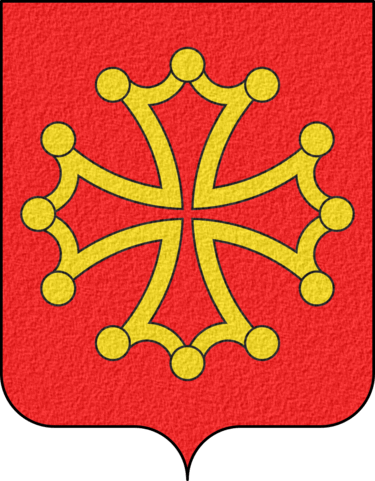
Coat of Arms
Not available
| Status | Former administrative region of France (1972–2015) |
|---|---|
| Current region | Occitanie (since 1 January 2016) |
| Capital | Toulouse |
| Departments | Ariège, Aveyron, Haute-Garonne, Gers, Lot, Hautes-Pyrénées, Tarn, Tarn-et-Garonne |
| Area | 45,348 km² |
| Historic territories | County of Toulouse, Gascony, Rouergue, Quercy |
Coat of Arms — Gules, a cross cleché and pommetty of twelve pieces Or.
Gules, a cross cleché and pommetty of twelve pieces Or.
The Occitan cross was borne by the counts of Toulouse at least from the time of Raymond IV de Toulouse (who led the First Crusade). It appears prominently on coins, seals and monuments throughout medieval Languedoc. The county of Toulouse was the heart of the Cathare civilisation before its suppression during the Albigensian Crusade (1209–1229). When the county was absorbed into the French royal domain, the cross survived as a cultural symbol. The modern administrative region of Midi-Pyrénées adopted it as its sole emblem in 1972, reflecting the Occitan identity of the Toulouse basin and the surrounding territories.
The regional flag bore the Occitan cross in gold on a red field, matching the blazon exactly. This simple two-colour design — gold on red — is one of the most visually striking in French regional heraldry.
The Occitan cross has been used informally as a banner and cultural flag by Occitan movements since the 19th-century Félibrige literary revival. The administrative region of Midi-Pyrénées formalised it as the official regional emblem when it was established in 1972.
Since the merger into Occitanie in 2016, the Occitan cross has been adopted as the primary emblem of the new region, affirming cultural and historical continuity. It is displayed on the regional council building in Toulouse and used on official communications of Occitanie.
The arms display the Occitan cross (croix occitane) — a gold cross with twelve ball-shaped terminals on red — the historic symbol of the county of Toulouse and of Occitan culture across southern France.
Both regions used the Occitan cross, but Midi-Pyrénées bore it alone on red, while Languedoc-Roussillon combined it quarterly with the four pallets of Aragon to represent both Languedoc and Roussillon.
The Occitan cross is a cross cleché and pommetty of twelve pieces — each arm is hollow at the extremity and ends in a ball. It is the emblem of Occitan cultural identity, associated with the counts of Toulouse since the 12th century.
On 1 January 2016, Midi-Pyrénées merged with Languedoc-Roussillon to form Occitanie, the largest metropolitan region of France by area, with Toulouse as its capital.
The regional capital was Toulouse (France's fourth-largest city and Europe's aerospace capital). Other major cities included Montauban, Albi, Tarbes, Rodez, Cahors and Auch.
Last reviewed by the Emblema Mundi editorial team on June 29, 2026.