City of France
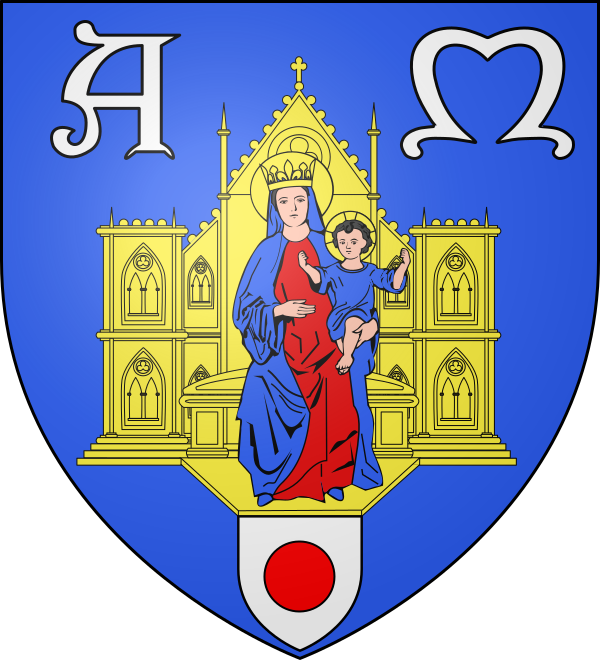
The arms of Montpellier, prefecture of Hérault, show on a blue field the Virgin and Child seated on a gold throne, under the letters A and M, for Ave Maria, with below them the small shield with a red roundel of the lords of Montpellier, the Guilhem. The Virgin is Notre-Dame des Tables, the patron saint of the city.
Coat of Arms
Not available
| City | Montpellier (Occitan: Montpelhièr, nicknamed Clapas), prefecture of Hérault, in the Occitanie region |
|---|---|
| Inhabitants | Montpelliérains and Montpelliéraines |
| Arms | Azure, the Virgin and Child proper, the Virgin robed Gules and mantled Azure, seated on a throne Or, the Child vested Azure, the whole under the uncial letters A and M Argent and above a small shield of the same charged with a roundel Gules |
| Patron saint | Notre-Dame des Tables, celebrated on 31 August |
| Old motto | Virgo Mater, natvm ora, vt nos jvvet omni hora. |
The coat of arms of Montpellier.
D’azur à la vierge de carnation vêtue d’une robe de gueules et d’un manteau du champ, assise sur un trône gothique d’or, tenant l’Enfant Jésus aussi de carnation vêtu d’azur, le tout surmonté des lettres « A » et « M » onciales d’argent et soutenu en pointe d’un écusson du même chargé d’un tourteau de gueules.
That is: on a blue field, the Virgin in natural colours, in a red robe and a blue mantle, seated on a gold Gothic throne and holding the Child Jesus, also in natural colours and dressed in blue; above them, the uncial letters A and M in silver; below, a small silver shield charged with a red roundel. This is the blazon given by French Wikipedia’s article on the city. Its armorial of the communes of Hérault describes the throne as antique rather than Gothic: D’azur à la Sainte Vierge de carnation vêtue d’une robe de gueules et d’un manteau du champ, assise sur un trône antique d’or, tenant l’Enfant Jésus aussi de carnation vêtu d’azur, le tout surmonté des lettres A et M onciales d’argent et soutenu en pointe d’un écusson du même chargé d’un tourteau de gueules.
According to the article on the city, the Virgin shown is Notre-Dame des Tables, the patron saint of the city, named after the tables of the money changers that stood near the church of Notre-Dame; she is the emblem of the city and is celebrated on 31 August. The letters A and M stand for Ave Maria. The small shield, d’argent au tourteau de gueules, a red roundel on silver, is the arms of the lords of Montpellier, the Guilhem.
A text quoted by the article says that from time immemorial the arms of Montpellier were the Virgin seated on a gold Gothic chair, holding the Child in her arms, with under her feet a small shield charged with a red roundel, which the old Guillaumes had taken as their arms in their expeditions to the Holy Land. In 1627, at the request of the Catholics, these arms were restored by Gabriel de La Vallée (1575–1636), marquis de Fossez and governor of Montpellier.
During the First Empire, the arms of Montpellier changed slightly: Montpellier was one of the bonnes villes and, as such, was entitled to request arms from the new regime. They added a red chief charged with three gold bees, the throne being described there as antique.
According to a note by Charles de Tourtoulon (Aix-en-Provence, 1896) cited by the article, Montpellier has no heraldic motto as such, but one is found on old seals of the consuls dating from the 13th century: Virgo Mater, natvm ora, vt nos jvvet omni hora, Virgin Mother, pray to your Son that He may help us at every hour. This legend is sometimes considered the motto of the city and is sometimes shown around the municipal shield.
The historic centre of Montpellier is called the Écusson, the shield: the name comes from its shape, like a medieval shield, given by the old medieval walls.
Montpellier is a commune of southern France, prefecture of the Hérault department and centre of a métropole, Montpellier Méditerranée Métropole. It lies in the Occitanie region, in the former historic province of Languedoc. By population it is the seventh commune of France and the third on the Mediterranean axis after Nice and Marseille, the largest and most populous commune of Hérault and the second of Occitanie after Toulouse.
The land first belonged to the counts of Melgueil, who gave it in 985 to a certain Guilhem in return for his devotion. At the beginning of the 13th century the lordship of Montpellier passed to the crown of Aragon (king Jacques Ier d’Aragon was born in Montpellier in 1208), then to the kingdom of Majorca, before being bought in 1349 by the king of France Philippe VI de Valois. Sold again in 1365 to the king of Navarre Charles le Mauvais, Montpellier finally returned to the kingdom of France in 1383.
The first known mention of Montpellier is the deed of gift of 985, where the mount appears in the Latinised form de Monte pestellario; the present spelling first appears around 1370. Hermann Gröhler proposed mons pestellarius, the mount where woad grows; Ernest Nègre, following the Old Occitan sense of pestel, latch or bolt, proposed a mount that can be bolted shut, probably meaning a fortress on a mount. Locally, the city is nicknamed Clapas, the heap of rocks.
On a blue field, the Virgin and Child seated on a gold throne, under the silver letters A and M, above a small silver shield with a red roundel.
Notre-Dame des Tables, the patron saint of the city, named after the money changers’ tables near the church of Notre-Dame.
They stand for Ave Maria.
It is the arms of the lords of Montpellier, the Guilhem: d’argent au tourteau de gueules, a red roundel on silver.
According to Charles de Tourtoulon, not a heraldic motto as such, but the legend Virgo Mater, natvm ora, vt nos jvvet omni hora, found on 13th-century consular seals, is sometimes considered the motto of the city.
Illustration: Wikimedia Commons. Coat of arms: drawing by Pierre Audité and Thom.lanaud (CC BY-SA 3.0).
Last reviewed by the Emblema Mundi editorial team on 10 November 2026.