Region of France
Languedoc-Roussillon was a region of southern France combining the historic lands of Languedoc — the heartland of Occitan culture and the county of Toulouse — and Roussillon, a Catalan-speaking territory bordering Spain. Its coat of arms united the golden Occitan cross on red with the four pallets of Aragon, embodying this dual Mediterranean heritage.
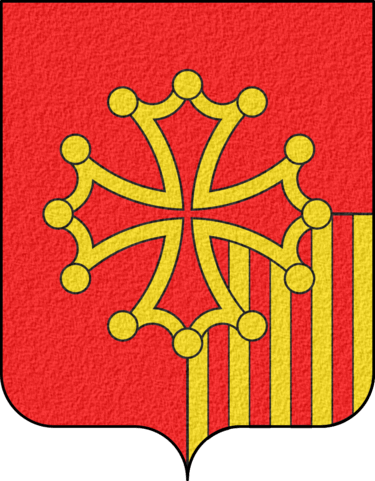
Coat of Arms
Not available
| Status | Former administrative region of France (1972–2015) |
|---|---|
| Current region | Occitanie (since 1 January 2016) |
| Capital | Montpellier |
| Departments | Aude, Gard, Hérault, Lozère, Pyrénées-Orientales |
| Area | 27,376 km² |
| Historic territories | Languedoc, Roussillon, Cévennes |
Coat of Arms — Quarterly: 1st, 2nd and 3rd Gules; 4th Or, four pallets Gules; over all a cross cleché and pommetty of twelve pieces Or debruising the whole.
Quarterly: 1st, 2nd and 3rd Gules; 4th Or, four pallets Gules; over all a cross cleché and pommetty of twelve pieces Or debruising the whole.
The Occitan cross was carried by the counts of Toulouse from at least the 12th century. Its most celebrated bearer was Raymond VI de Toulouse, who clashed with Pope Innocent III and whose lands were devastated during the Albigensian Crusade (1209–1229). After the crusade, the county of Toulouse eventually passed to the French crown. The four pallets of Aragon entered the regional arms to represent Roussillon, a Catalan-speaking territory acquired by France from Spain in 1659. When France created its administrative regions in 1972, these two emblems were combined into a single quarterly composition.
The regional flag reproduced the coat of arms on a white background. The dominant colours were gold (Or) and red (Gules), reflecting both the Occitan cross and the Aragonese pallets. No separate flag design existed distinct from the arms.
The flag tradition in French regions is primarily heraldic: the emblem used on official documents, buildings and communications was always the arms themselves rather than a standalone flag. The Occitan cross had been used informally as a banner by Occitan cultural movements long before the administrative region was created.
Since the merger into Occitanie in 2016, the Occitan cross has been retained as the central element of the new region's identity, affirming continuity with the medieval heritage of southern France. The cross remains widely displayed in the region as a cultural and political symbol of Occitan identity.
The arms combine the Occitan cross in gold on red (from the county of Toulouse) with the four red pallets on gold of the Crown of Aragon (representing Roussillon), reflecting the region's dual Languedoc and Roussillon heritage.
The Occitan cross is a cross cleché and pommetty of twelve pieces — its arms are hollow and each extremity ends in a ball. It is the symbol of Occitan culture and was prominently borne by Raymond VI de Toulouse and his successors.
The four red pallets on gold represent Roussillon, historically part of the Crown of Aragon. This territory passed to France by the Treaty of the Pyrenees in 1659, but retained its Aragonese heraldic memory in the regional arms.
The region was abolished on 1 January 2016 when it merged with Midi-Pyrénées to form Occitanie, as part of the French territorial reform reducing metropolitan regions from 22 to 13.
The region encompassed the historic Languedoc (land of the Oc language, including cities such as Montpellier, Nîmes and Carcassonne) and Roussillon (Catalan-speaking, centred on Perpignan), along with the remote uplands of the Lozère.
Last reviewed by the Emblema Mundi editorial team on June 29, 2026.