City and department of France
The arms of Paris carry a silver ship on red beneath the royal fleurs-de-lis: the badge of the medieval river merchants who ran the city. With it goes one of the best-known mottoes in Europe, Fluctuat nec mergitur — beaten by the waves, it does not sink.

Coat of Arms
Not available
| Status | City and department (75), capital of France |
|---|---|
| Arms | A silver ship on red, under a blue chief strewn with gold fleurs-de-lis |
| Origin | The seal of the water merchants, 1210 |
| Motto | Fluctuat nec mergitur — official since 24 November 1853 |
| Colours | Blue and red |
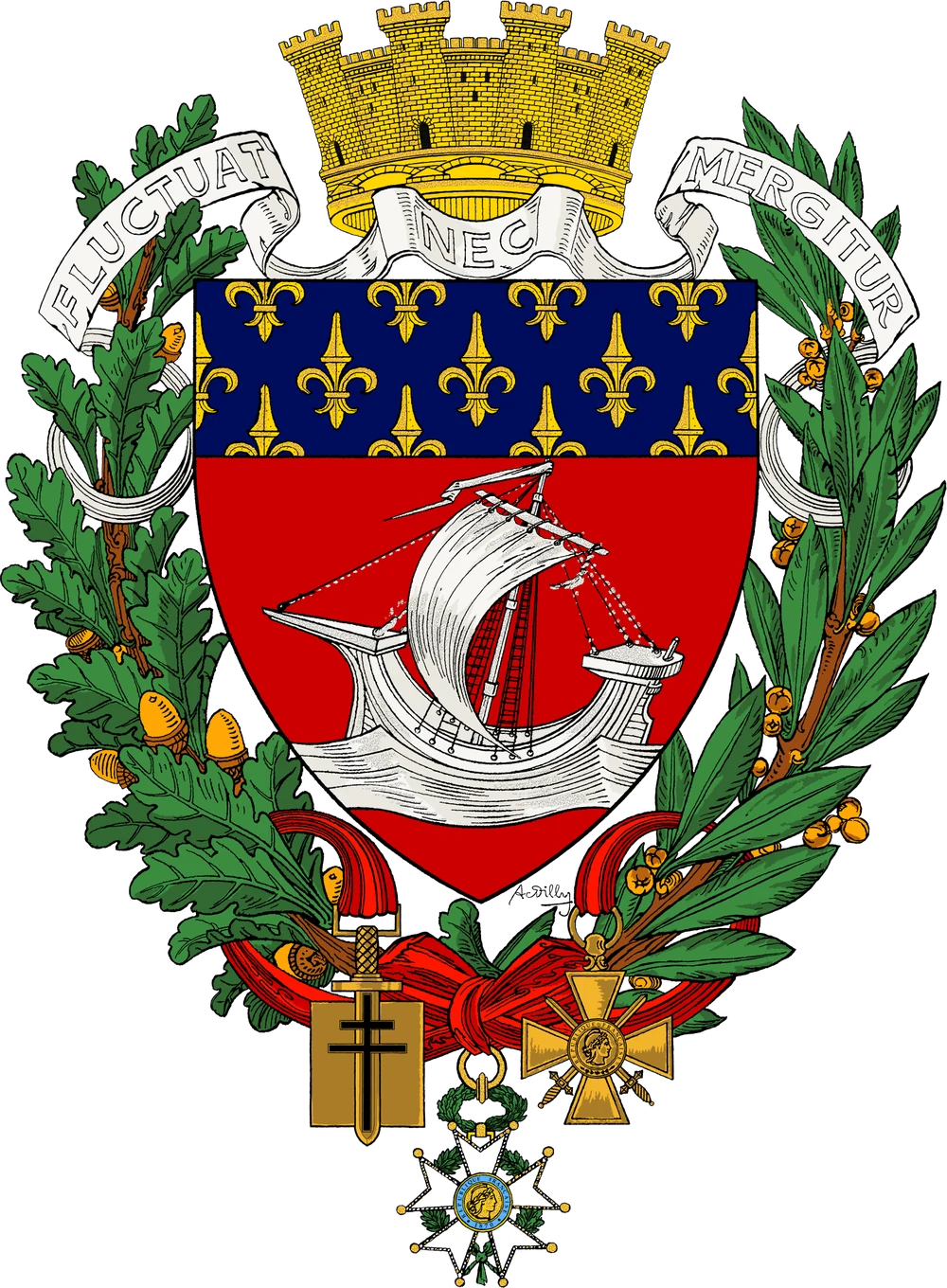
Coat of arms of Paris — Gules, a ship rigged and dressed Argent sailing on waves of the same issuant from the base; on a chief Azure semy-de-lis Or. Shown here with the mural crown, the motto, the branches of oak and laurel and the city’s three decorations.
Gules, a ship rigged and dressed Argent sailing on waves of the same issuant from the base; on a chief Azure semy-de-lis Or.
Blue placed directly on red breaks the heraldic rule that a colour should not sit on a colour. French blazon marks the exception with a word of its own: the chief is said to be cousu, “sewn” onto the field.
The wording was last fixed by a decree of 20 August 1949, which describes the vessel as an antique boat and adds the mural crown above the shield. A prefectoral order of 20 June 1942 had already settled the arms of every commune of the Seine department, Paris included, and declared the drawings annexed to it authoritative.
The ship is not a warship and not a symbol of the sea. It is a trading boat on the Seine. It appears in 1210 on the seal of the water merchants (marchands de l’eau), the guild that controlled river trade into Paris; the seal is inscribed Sigillum mercatorum aquæ Parisius. Tradition carries the emblem further back still, to the Nautes, the boatmen’s corporation of Roman Lutetia.
The guild’s seal became the city’s because the guild became the city’s government: its head was the prévôt des marchands, the provost of the merchants, who ran municipal affairs. Paris never adopted a castle, a saint or a lion. It kept the badge of the people who fed it by boat.
The fleurs-de-lis came later, and not as a gift. The City of Paris dates them to 1358, when they were imposed by royal power. That year the provost of the merchants, Étienne Marcel, led the city against the dauphin, the future Charles V. The revolt failed, and the royal lilies were set in the chief — literally over the merchants’ ship. The shield has told that story ever since: the city below, the crown above.
The Revolution abolished coats of arms by the decree of 20 June 1790, and Paris gave up its own in November of that year. When Napoleon allowed cities to bear arms again, Paris received new ones by letters patent of 29 January 1811.
The ship stayed, but everything royal went. The chief turned red and carried three gold bees, the emblem of the Empire, in place of the fleurs-de-lis. A silver star was set above the vessel, and the goddess Isis sat at the prow — a nod to a theory, fashionable at the time, that linked the name of Paris to her cult.
It lasted six years. By letters patent of 20 December 1817, Louis XVIII restored the arms in their traditional form, and the lilies returned to the chief.
The motto means “It is beaten by the waves, but does not sink.” Its subject is the ship: the phrase describes the shield it accompanies.
It is much younger than the arms. It first turns up on municipal tokens struck at the end of the sixteenth century — in 1581 in a longer form, Fluctuat at nunquam mergitur, then in its present wording on tokens of the following years. For almost three centuries it was one motto among several. It became the official motto of Paris only on 24 November 1853, by a decision of Baron Haussmann, then prefect of the Seine.
After the attacks of 13 November 2015, the words left the coat of arms and went onto the walls: painted on the Place de la République and across the city, the old motto of the river merchants became a statement of resistance.
The full achievement of Paris adds several elements around the shield.
The colours of Paris are blue and red, the two colours of its shield. They appear as a party badge in 1358, when the supporters of Étienne Marcel wore hoods half red and half blue. The flag of Paris uses them as two vertical bands, blue at the hoist and red at the fly, with the coat of arms at the centre.
The traditional account makes these the colours of the tricolour. On 17 July 1789, three days after the fall of the Bastille, Louis XVI was handed a cockade that set the white of the monarchy between the blue and red of Paris; the account credits La Fayette or the mayor, Jean Sylvain Bailly. The historian Michel Pastoureau is more cautious: the origin of the three colours is less clear than the story suggests, and may owe as much to the colours of the Bourbons and to the American flag as to the city.
It is the emblem of the water merchants, the guild that controlled trade on the Seine. The ship appears on the guild’s seal in 1210, and became the city’s emblem because the head of the guild, the provost of the merchants, governed Paris.
“It is beaten by the waves, but does not sink.” The motto refers to the ship on the shield. It appears on tokens at the end of the sixteenth century and became the official motto of Paris on 24 November 1853.
The blue chief strewn with gold fleurs-de-lis is the old royal arms of France. According to the City of Paris, the lilies were imposed by royal power in 1358, the year of Étienne Marcel’s revolt against the dauphin.
Yes. The arms granted on 29 January 1811 replaced the fleurs-de-lis with three gold bees on a red chief, and added a silver star and the goddess Isis at the prow of the ship. Louis XVIII restored the traditional arms on 20 December 1817.
The three decorations of the city: the Legion of Honour (decree of 9 October 1900), the Croix de guerre 1914–1918 (citation of 28 July 1919) and the Cross of the Liberation (decree of 24 March 1945).
Blue and red. They are attested in 1358 and form the flag of Paris, two vertical bands with the arms at the centre. Tradition sees them in the blue and red of the French tricolour.
The arms are described from the published blazon and the texts above, not from the drawing.
Last reviewed by the Emblema Mundi editorial team on 30 September 2026.