Region of France
Île-de-France is the capital region of France, centred on Paris, and the historic heartland of the Capetian royal domain. Its coat of arms — Azure, three fleurs-de-lis Or — are the arms of France modern, carried by the region as the direct heir to the royal territory from which the kingdom of France grew.
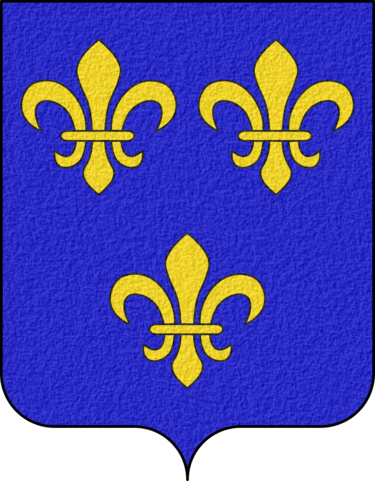
Coat of Arms
Not available
| Status | Administrative region of France (since 1976) |
|---|---|
| Capital | Paris |
| Departments | Paris, Seine-et-Marne, Yvelines, Essonne, Hauts-de-Seine, Seine-Saint-Denis, Val-de-Marne, Val-d'Oise |
| Area | 12,012 km² |
| Historic territories | Royal domain of the Capetians, County of Paris, Vexin français |
Coat of Arms — Azure, three fleurs-de-lis Or.
Azure, three fleurs-de-lis Or.
The fleur-de-lis is attested as a royal emblem in France from the reign of Louis VII (1137–1180), making it one of the oldest heraldic symbols in Europe. The original royal arms showed a blue field scattered (semé) with golden lilies. Around 1376 Charles V reduced them to three, creating the arms of France modern that remained the royal standard until the Revolution. Île-de-France, as the province from which the Capetian kings governed their realm for centuries, carries these arms as its own. The region was formally delimited in 1976 and adopted the historical arms without modification.
The arms are blazoned: Azure, three fleurs-de-lis Or. These are the arms of France modern — the royal arms of the French monarchy — retained by the region as the historic core of the Capetian royal domain.
Île-de-France is the historic heart of the royal domain of the Capetian kings, centred on Paris. Since Hugh Capet (987), it was the base from which the kings of France governed. Bearing the royal arms reflects this foundational role.
The fleur-de-lis has been a royal emblem since the 12th century. The earlier arms of France ancient showed a blue field strewn with golden lilies; around 1376 Charles V reduced them to three (France modern), forming the arms borne until the Revolution.
The royal domain was the territory governed directly by the kings of France. Under the early Capetians it covered the Paris basin and Orléanais — the core of present-day Île-de-France — before progressively expanding to cover the whole kingdom.
No. The region uses its heraldic arms — Azure, three fleurs-de-lis Or — as its official emblem, without a formally adopted regional flag distinct from the coat of arms. Royal blue and gold are its emblematic colours.
Last reviewed by the Emblema Mundi editorial team on June 29, 2026.