City of France
The arms of Bordeaux, prefecture of Gironde and capital of Nouvelle-Aquitaine, read like a summary of the city: the Grosse Cloche of the old town hall, a gold leopard recalling the English period, the Garonne and the crescent of the Port de la Lune, under a chief of France added after the English left in 1453. Its Latin motto spells it out: the lilies alone reign over the moon, the waves, the fortress and the lion.
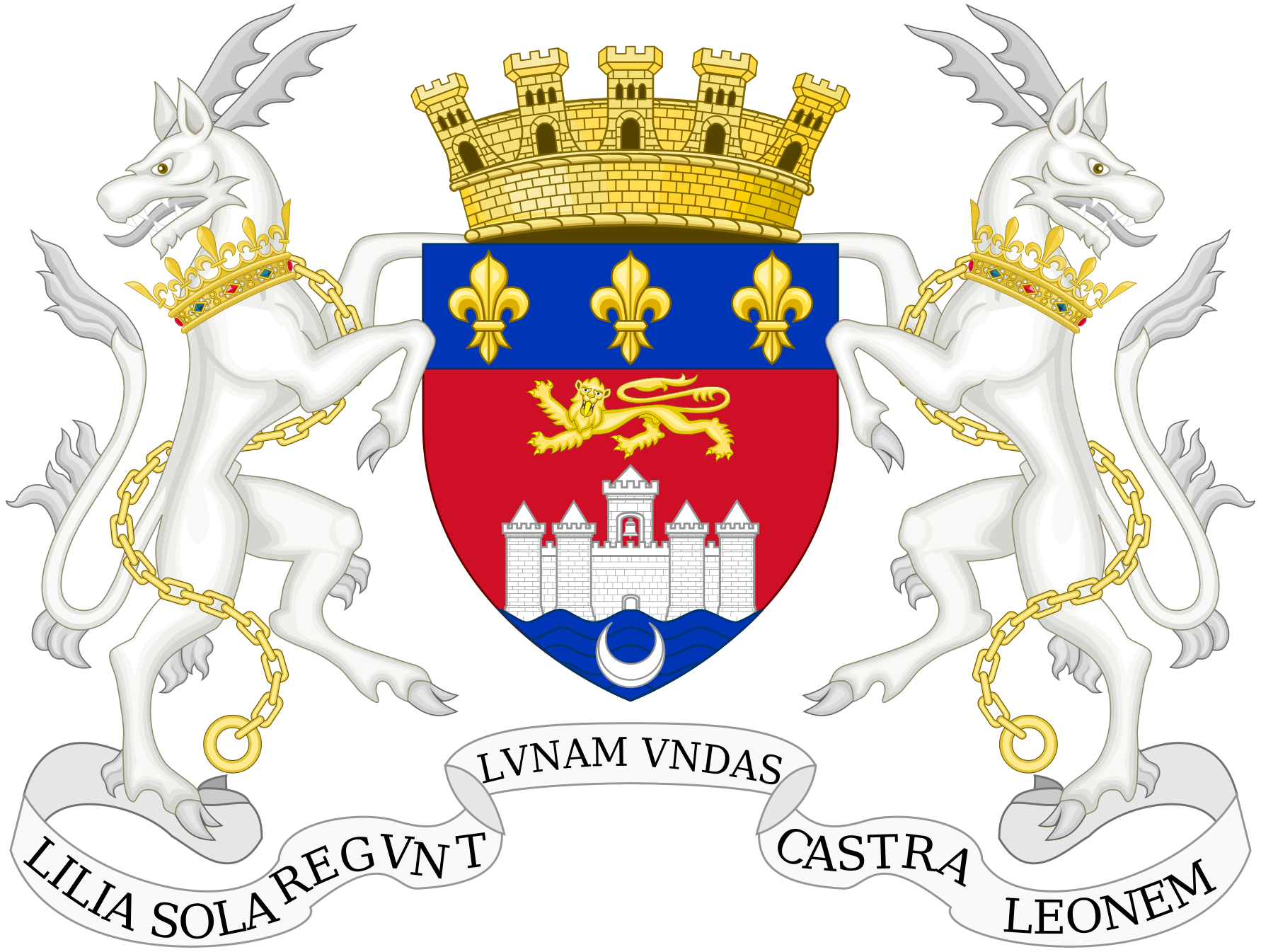
Coat of Arms
Not available
| City | Bordeaux (Gascon: Bordèu), prefecture of Gironde and capital of the Nouvelle-Aquitaine region, seat of Bordeaux Métropole |
|---|---|
| Inhabitants | Bordelais and Bordelaises |
| Arms | Gules, the Grosse Cloche open, pierced and masoned Sable, topped by a leopard Or; a sea Azure wavy Sable and Argent, charged with a crescent Argent; a chief Azure semy of France |
| Ornaments | Two white antelopes chained and collared with crowns of fleurs-de-lis as supporters; a mural crown with five towers |
| Motto | Lilia sola regunt lunam, undas, castra, leonem |
The present arms of Bordeaux, with their ornaments.
De gueules ; à la Grosse Cloche ouverte, ajourée et maçonnée de sable et sommée d’un léopard d’or ; à la mer d’azur, ondoyée de sable et d’argent, chargée d’un croissant aussi d’argent ; au chef d’azur, semé de France.
That is: on a red field, the Grosse Cloche, open, pierced and masoned black, topped by a gold leopard; a blue sea, wavy black and silver, charged with a silver crescent; a blue chief strewn with the fleurs-de-lis of France. This is the blazon proposed in 1913 by Meaudre de Lapouyade, as given by French Wikipedia’s articles on the city and on the arms. The drawing shown here is titled on Wikimedia Commons with a chief of France moderne; the article on the arms also shows a version with a chief of France ancien, the arms in force under the First Empire and a variant with grapes by Robert Louis.
According to the article on the city, every charge recalls the history and geography of Bordeaux; the article on the arms speaks of the history of the city. The Grosse Cloche stands for the towers of the old town hall, of which the Grosse Cloche survives today. The leopard refers to the arms of the kings of England: in heraldry the lion and the leopard are the same animal, called a lion when its head is in profile and a leopard when it faces the viewer; the article on the arms identifies it as the lion of the Plantagenêts. The sea wavy black and silver stands for the Garonne, and the crescent for the curved shape of the port, the reason why it has been called the Port de la Lune, according to the article on the arms, since the Middle Ages.
The first known arms of Bordeaux date from the time of Richard Cœur de Lion, and bore, among other things, the three lions of the Plantagenêts, which gradually came to be identified as the arms of England. During the English period (1154–1453), the arms of Bordeaux bore three lions. After the battle of Castillon and the end of English rule in 1453, only one was kept: the chief strewn with the fleurs-de-lis of the king of France was added in place of the other two, marking the return of Bordeaux to the sovereignty of the king of France.
The arms are supported by two white antelopes, chained and collared with crowns of fleurs-de-lis. The article on the city says they are traditionally read as a reminder of the French reconquest, the antelopes being associated with English heraldry; the article on the arms says they are probably such a reminder, the crowns with the French fleurs-de-lis firmly holding the English antelopes.
The shield is topped by a mural crown, added in the 19th century; its five towers place Bordeaux at the rank of a regional capital. Before that, Bordeaux used a count’s coronet, still shown on the gate of the town hall garden: since the 16th century the jurade de Bordeaux, the city council of the Ancien Régime, held the comté d’Ornon, which roughly covered the present communes of Gradignan and Villenave-d’Ornon. According to the article on the arms, this made Bordeaux one of the very rare local authorities in France to bear a title of nobility dating from before the Revolution.
The motto of Bordeaux, Lilia sola regunt lunam, undas, castra, leonem, translates as: the lilies alone reign over the moon, the waves, the fortress and the lion. It is a reading of the arms: the lilies stand for the French monarchy, the moon for the crescent of the port, the waves for the Garonne, the fortress for the old town hall and the lion for the legacy of the English period. It thus asserts the sovereignty of the king of France over Bordeaux after the end of English rule in 1453.
Bordeaux is a commune of the south-west of France, prefecture of the Gironde department and capital of the Nouvelle-Aquitaine region, and the seat of Bordeaux Métropole. It stands on the Garonne, near the Gironde estuary and the Atlantic Ocean, between the Bordeaux vineyards and the Landes de Gascogne. Known as Burdigala under the Roman Empire, it was one of the main cities of Gaule aquitaine, of which it was the capital. After the marriage of Aliénor d’Aquitaine to Henri Plantagenêt in 1152, the city passed under the sovereignty of the kings of England, before being definitively joined to the French royal domain in 1453.
A large part of its historic centre, known as the Port de la Lune, has been on the UNESCO World Heritage List since June 2007; the listed area covers 1,810 hectares. Bordeaux is internationally associated with wine and the Bordeaux vineyards, of which it is the main economic and commercial centre.
The ancient name is attested as Burdigala, and as Bourdígala in Greek in the geographer Strabon. Its etymology is still debated: none of the old proposals can be considered proven on its own, and the exact origin of the name cannot be established with certainty. The modern Gascon form is Bordèu. During the Convention (1792–1795), the commune temporarily received the revolutionary name of Commune-Franklin.
On a red field, the Grosse Cloche topped by a gold leopard, a blue sea wavy black and silver charged with a silver crescent, and a blue chief strewn with the fleurs-de-lis of France.
It recalls the English period (1154–1453), when the arms bore three lions of the kings of England; only one was kept after 1453.
It recalls the curved shape of the port of Bordeaux, which is why it is called the Port de la Lune.
Lilia sola regunt lunam, undas, castra, leonem: the lilies alone reign over the moon, the waves, the fortress and the lion.
The two white antelopes, chained and collared with crowns of fleurs-de-lis, are traditionally read as a reminder of the French reconquest over the English.
Illustration: Wikimedia Commons. Coat of arms: drawing by Adelbrecht (CC BY-SA 3.0).
Last reviewed by the Emblema Mundi editorial team on 10 November 2026.