City of France
The arms of Strasbourg, prefecture of Bas-Rhin and of the Grand Est region, are simple: silver with a red bend, the reversed colours of the old prince-bishopric after the burghers won their independence, according to the articles on the city and on the arms. The city flag derives from them, a wide red diagonal band on white, while its old great banner, a Virgin with outstretched arms, was destroyed in 1789.

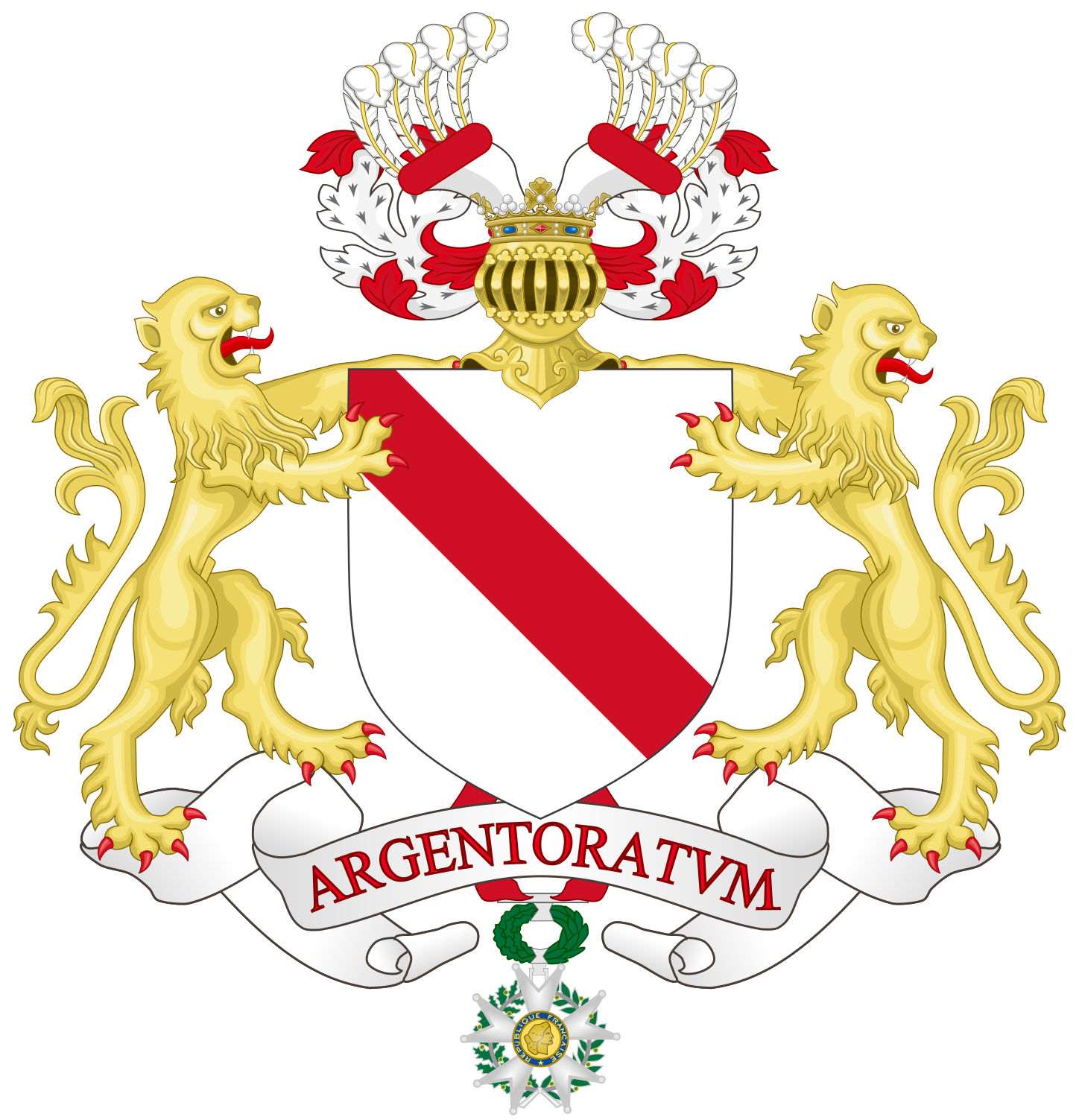
Coat of Arms
Not available
| City | Strasbourg (Alsatian: Strossburi; German: Straßburg), prefecture of Bas-Rhin and of the Grand Est region, seat of the Collectivité européenne d’Alsace |
|---|---|
| Inhabitants | Strasbourgeois |
| Arms | Argent, a bend Gules |
| Ornaments | A gold helm and crown, swan wings as crest, two gold lions armed and langued Gules as supporters, the cross of the Légion d’honneur |
| Motto | Argentoratum |
| Flag | A wide red diagonal band on a white field, derived from the arms |
The greater arms of Strasbourg.
D’argent à la bande de gueules.
That is: a silver field with a red bend. This is the blazon given by French Wikipedia’s article on the arms of Strasbourg. The article on the city gives D’argent (avec ou sans diapré) à la bande de gueules, with or without a diapered field, and notes that the blazon is apparently open to discussion: the Grand Larousse encyclopédique gives D’argent à la bande de gueules (le champ diapré). According to the same article, the diapering is only a decorative element.
In the 13th century, the burghers of Strasbourg increasingly contested the authority of the prince-bishops who governed them. In 1262 they won the battle of Hausbergen, and Strasbourg became a free imperial city of the Holy Roman Empire. According to the articles on the city and on the arms, its arms would be the reversed colours of the old bishopric: De gueules à la bande d’argent, a silver bend on red, became a red bend on silver; the same thing happened in Basel, between the cantons of Basel-Stadt and Basel-Landschaft. The article on the arms adds that the dominant silver could also refer to the ancient name Argentoratum. The article on the city banner gives the opposite account: the white banner with a red bend seems to have been at first common to the bishopric and the city, and after the city’s independence the city would have kept these colours while the bishop reversed them.
The exact origin of the arms is unknown. The article on the arms dates their first uses to the 13th century, and says they were probably used for the first time to decorate the Schwörbrief, the charter of oath, of 1399; the article on the city says their use goes back to the 13th century and that they first served officially as decoration on a municipal charter of 1399. The free city enriched them with a helm, a crown and lions. They were carved on façades and boundary stones and shown in armorials, frescoes and stained glass, sometimes with Latin inscriptions: Insignia Civitatis Argentinensis in the 16th century, Insignia Reipublicæ Argentoratensis in the 17th.
After the capitulation of 1681 and the annexation by the France of Louis XIV, a new shield seems to have been given to the city. The Armorial général de France of Charles-René d’Hozier (1696) shows a Virgin and Child enthroned above a small shield in the colours of Strasbourg: D’azur, à la Notre-Dame de carnation, assise sur un trône d’or et sous un pavillon de même ; tenant, de sa main dextre, un sceptre d’or, et, sur son bras senestre, l’Enfant Jésus aussi de carnation ; sous les pieds de la Vierge, un écusson d’argent, chargé d’une bande de gueules. These arms were set by an edict of 1696 and a royal ordinance of 23 July 1700; according to the article on the arms, they probably allude to the patronage of the Virgin over the city and symbolise the Catholic worship restored by Louis XIV. Among the different blazons of the arms of Strasbourg, the article on the city also cites one from Malte-Brun’s La France illustrée (1884), with the Virgin on a blue field and the shield with the red bend beside her rather than under her feet.
The arms were abandoned during the Revolution. Under the First Empire, letters patent of 2 August 1811 granted the city new arms with the bees of the Emperor: D’azur diapré d’or à la bande d’argent, au chef de gueules chargé de trois abeilles d’or. After the Napoleonic arms were abolished in 1814, the city council chose in 1816 the medieval arms of the old city-state with their ornaments: D’argent à la bande de gueules l’écu soutenu par deux lions et timbré d’un heaume ou casque taré de front ouvert et sans grilles orné de ses lambrequins comblé d’une couronne d’or d’où sortent deux ailes de cygne d’argent chargées chacune d’une bande de gueules le tout sommé d’une fleur de lys épanouie d’argent. The fleur-de-lis, a symbol of the French monarchy, had also been used by the free city in the Middle Ages; the royal authorities wished to add more, or even to restore the arms of 1696, but the council’s decision prevailed in practice.
The fleur-de-lis disappeared after the revolutions of 1830 and 1848, but the arms lasted through the 19th century, even after the annexation of Alsace-Lorraine by the German Empire in 1871, with the motto Argentoratum, recalling the Roman heritage. When Strasbourg became French again after the First World War, it was awarded the Légion d’honneur on 14 August 1919, which it has since shown on its arms; the article on the arms dates their present form from 1919. They remain the official arms of Strasbourg.
The flag of the city of Strasbourg.
According to French Wikipedia’s article on the city, the flag of Strasbourg derives from its arms: it shows a wide red diagonal band on a white field. Red and white are also the traditional colours of Alsace.
The city’s small banner was a rectangle of white cendal with a red bend, sometimes topped by a red streamer, called Wimpel or Schwenkel; some depictions from the end of the 15th century show a white streamer instead. Under the campaign rules of 1475, soldiers swore, on pain of death and confiscation of all their goods, never to abandon the city’s flags; true to this oath, the banner-bearer Arbogast de Kageneck was killed defending the small banner at the battle of Dornach on 22 July 1499. Taken by Heinrich Rahn of Zurich, that banner is kept at the musée national de Zurich.
A banner of the city is attested by the statutes of 1201, but its appearance is unknown before the beginning of the 16th century; in 1310 the city bought white and red cloth to make a series of banners. The great banner then showed a unique theme: a Virgin and Child on a gold ground, the Virgin with her arms spread wide and the sleeves of her garment hanging down. According to Johann Schilter it measured 7.5 Ellen high by 3.5 wide, about 4 × 3.5 m or 4.5 × 4 m depending on the author, and was carried on a cart similar to the carroccio of the Lombard cities. Because of its Marian symbolism, it was no longer used after the city adopted the Reformation in the 16th century; it was destroyed by the crowd during the riot of 21 July 1789. A smaller equestrian standard with the same image was lost in the fire of the municipal library during the bombardment of 1870.
Strasbourg is a French commune, seat of the Collectivité européenne d’Alsace and prefecture of Bas-Rhin and of the Grand Est region. Capital of the historic region of Alsace, it lies on the Rhine, on the border with Germany. On 1 January 2023 it was the largest commune of the Grand Est and the eighth of France, with 293,771 inhabitants. Its city centre, on the Grande Île, has been on the UNESCO World Heritage List since 1988, with the cathedral Notre-Dame de Strasbourg and the Petite France quarter; in 2017 the listed area was extended to part of the Neustadt.
Strasbourg has become a symbol of Franco-German reconciliation and of European integration. It is one of the three historic European capitals of the EU, with Brussels and Luxembourg, and the official seat of the European Parliament, which holds its twelve annual plenary sessions there; it is also home to the Council of Europe.
The first name of the city was Celtic, Argantorati, romanised as Argentoratum; its etymology is debated, the most common reading linking the root arganto-, silver or shining, to a river, here the Ill. After the fall of the Roman Empire, the Alamans renamed it Stratiburg, the stronghold of the roads, which became Straßburg.
Argent, a bend Gules: a red bend on a silver field, sometimes drawn on a diapered field, which is only decorative.
According to the articles on the city and on the arms, they would be the reversed colours of the old prince-bishopric, red with a silver bend, after the burghers’ revolt, dated 1262 by the article on the arms; the article on the city banner suggests instead that the city kept the colours and the bishop would have reversed them.
It derives from the arms: a wide red diagonal band on a white field. Red and white are also the traditional colours of Alsace.
A large banner showing a Virgin and Child, the Virgin with outstretched arms, unique to Strasbourg; it was destroyed by the crowd during the riot of 21 July 1789.
Argentoratum, the Latin name of the city, recalling its Roman heritage.
Illustrations: Wikimedia Commons. Coat of arms: drawing by Ssolbergj and Katepanomegas (CC BY-SA 3.0). Flag: public domain.
Last reviewed by the Emblema Mundi editorial team on 10 November 2026.