Region of France
Alsace is a historic region of northeastern France, bordered by the Rhine and the Vosges mountains. Its coat of arms — a silver bend on red, adorned with six golden crowns — is one of the most elegant heraldic compositions in France, reflecting centuries of influence from the Holy Roman Empire and the great Landgraves of Alsace.
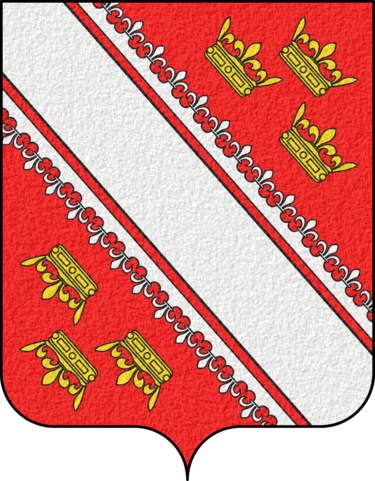
Coat of Arms
Not available
| Region | Alsace (now part of Grand Est / Collectivité européenne d'Alsace) |
|---|---|
| Capital | Strasbourg |
| Blazon | Gules, a bend Argent cottised by two cotices flory of the same and accompanied by six crowns Or ordered in orle, three in chief and three reversed in base |
| Tinctures | Gules (red), Argent (silver), Or (gold) |
Coat of Arms of Alsace — Gules, a bend Argent cottised flory, six crowns Or in orle
Gules, a bend Argent cottised by two cotices flory of the same and accompanied by six crowns Or ordered in orle, three in chief and three reversed in base.
The arms of Alsace developed during the medieval period under the Landgraves, who held authority over the region on behalf of the Holy Roman Empire. Strasbourg, as a free imperial city, was the political and commercial heart of Alsace for centuries. After the Peace of Westphalia in 1648, the region was progressively transferred to France under Louis XIV. The arms were formalized and have been used consistently since, surviving the region's turbulent history of alternating French and German sovereignty between 1871 and 1945.
The traditional banner of Alsace takes its colors directly from the coat of arms: red (Gules) and silver (Argent). The most widely used informal flag displays horizontal red and white stripes, or the full arms on a banner. The red-white color scheme is immediately associated with Alsatian identity.
The heraldic colors of Alsace were established alongside the arms in the medieval period. The silver and red palette appears consistently in representations of Alsatian princes and civic entities from the 13th century onward. During French Republican periods, the regional arms continued to be used in official and ceremonial contexts.
Today the red-and-white banner and the full coat of arms are used by the Collectivité européenne d'Alsace, established in 2021 to give Alsace renewed administrative identity within the Grand Est region. The arms appear on official documents, public buildings, and cultural events throughout Bas-Rhin and Haut-Rhin.
The coat of arms of Alsace is blazoned: Gules, a bend Argent cottised by two cotices flory of the same and accompanied by six crowns Or ordered in orle, three in chief and three reversed in base. The red field with a silver diagonal band and six golden crowns is one of the most distinctive heraldic compositions in France.
The six golden crowns on the Alsace coat of arms are thought to represent the six principal towns of the region, or alternatively to echo the crowns associated with the Holy Roman Empire, under whose authority Alsace fell for much of the medieval period.
The silver bend derives from the arms of the Landgraves of Alsace, medieval rulers of the region. The flory cotices — the small decorative borders ending in fleur-de-lis shapes — were added to enrich the composition and distinguish it from simpler bend arms.
Since 2016, Alsace was merged with Lorraine and Champagne-Ardenne into the larger administrative region of Grand Est. However, the Collectivité européenne d'Alsace was re-established in 2021, reflecting the region's strong cultural identity.
Alsace is traditionally associated with the red and white colors taken from its coat of arms. The region uses a banner derived from the arms, displaying the silver bend on a red field. The Alsatian identity flag featuring these colors is widely used at cultural and regional events.
Last reviewed by the Emblema Mundi editorial team on June 29, 2026.