Country
The national emblems of Bulgaria stack three chronological layers into a single design. The crowned golden lion on gules is a mark of the Second Bulgarian Empire (12th–14th centuries), documented in Western armorials from the 1270s. The royal-style crown, supporters and motto derive from the reconstituted Principality of Bulgaria after 1878 and its subsequent kingdom. The white-green-red tricolour was fixed by the Constitution of Tarnovo in April 1879, the founding document of the modern Bulgarian state. All three converge in the composite arms codified by the Law of 4 August 1997.
Flag
Not available
Coat of Arms
Not available
| Country | Republic of Bulgaria (Република България) |
|---|---|
| Coat of arms adopted | Law on the Coat of Arms of the Republic of Bulgaria, 4 August 1997 (State Gazette 62/1997) |
| Flag adopted | Constitution of Tarnovo, 16 April 1879 (OS); plain tricolour restored 22 November 1990 |
| Flag ratio | 3:5 |
| Earliest documentary source (arms) | Wijnbergen Armorial, c. 1270s (three lions passant) |
| Tinctures (arms) | Gules, Or, Argent, Vert |
| Central charge | Crowned lion rampant Or on a shield Gules |
| Motto | Съединението прави силата — “Unity Makes Strength” (1885) |
| Subdivisions | 28 provinces (oblasti), since 1999 |
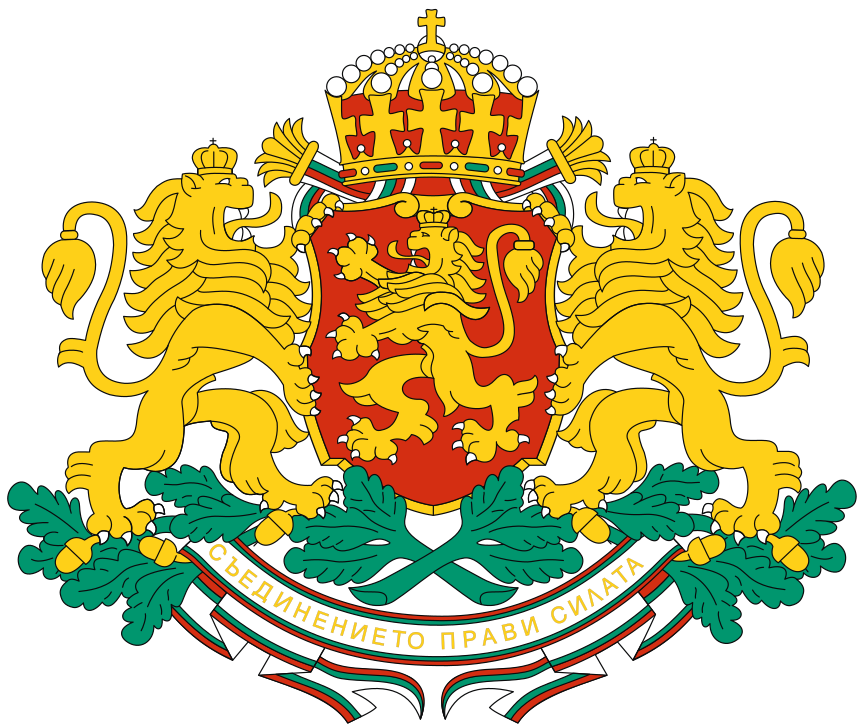
Coat of Arms of Bulgaria — Gules, a crowned lion rampant Or; historical crown above, two lion supporters, oak branches with motto below. Adopted 4 August 1997.
Gules, a lion rampant crowned Or, langued and armed Argent. The shield surmounted by the historical crown of the Second Bulgarian Empire, supported by two crowned lions rampant Or; below the shield, two crossed oak branches Vert with acorns Or, tied by a scroll Argent bearing the motto Съединението прави силата (“Unity Makes Strength”).
Unlike the sober one-shield compositions favoured elsewhere in the region (Ukraine, Slovakia, Greece), the Bulgarian arms are a full 19th-century imperial design preserved deliberately by the modern Republic — supporters, crown, motto and compartment intact.
| Colour | Heraldic name | Element | Traditional symbolism |
|---|---|---|---|
| Red | Gules | Field | Sovereignty, sacrifice; the field of the medieval Bulgarian arms |
| Gold | Or | Lion, crown, acorns | Imperial dignity, continuity with the Second Empire |
| Silver | Argent | Claws, tongue, motto scroll | Purity, peace |
| Green | Vert | Oak branches | Endurance, agrarian identity; longevity of the nation |
Bulgarian rulers are not known to have used a fixed heraldic mark in the modern sense during the First or Second Empires. The lion enters the record indirectly, through Western European armorials that catalogued the arms of Christendom’s known states:
Whether these Western entries accurately reflect Bulgarian court usage or are Western attributions in the vein of the armorial imaginaire is disputed. What is certain is that the lion becomes the retrospective national mark of the 19th-century Bulgarian revival, and stabilises into the single crowned rampant lion of the modern arms.
The scroll bears Съединението прави силата (Sʻedinenieto pravi silata, “Unity Makes Strength”), coined during the Bulgarian Unification of 6 September 1885, when Prince Alexander of Battenberg unified the Principality of Bulgaria with the autonomous province of Eastern Rumelia in defiance of the Treaty of Berlin. The motto is not medieval; it is a specifically modern national statement commemorating the moment the country ceased to be divided by Great Power arrangement.
c. 1270s — Wijnbergen. First Western record of Bulgarian arms: three lions passant Or on Gules.
13th–14th centuries — Second Empire. Sporadic lion iconography on coinage of Ivan Aleksandǎr and other tsars; usage inconsistent.
1396–1878 — Ottoman period. No sovereign Bulgarian heraldry; the lion survives as an imagined national arms in émigré and revival contexts.
1878 — The Congress of Berlin establishes the autonomous Principality of Bulgaria. Prince Alexander of Battenberg adopts a full arms with crowned lion, supporters and royal crown, drafted by the Austrian herald Karl Frisch von Frischenwald.
16 April 1879 — The Constitution of Tarnovo, Bulgaria’s founding document, references the arms and fixes the flag.
1908 — On the declaration of full independence and elevation to Kingdom under Ferdinand I, the arms are expanded to a full royal composition with mantling and pavilion.
1948–1990 — People’s Republic. The royal arms are abolished. A Soviet-model emblem replaces them: a lion within a wheat wreath, red star above, ribbons dated 681 (foundation of the First Bulgarian Empire) and 1944 (communist takeover).
15 November 1990 — The country is renamed Republic of Bulgaria; the socialist emblem is retired.
1991–1997 — A transitional period without a legally defined coat of arms. The lion alone is used informally by state bodies.
4 August 1997 — Codification. The Law on the Coat of Arms fixes the modern composition: crowned lion, historical crown, two lion supporters, oak branches, motto scroll.
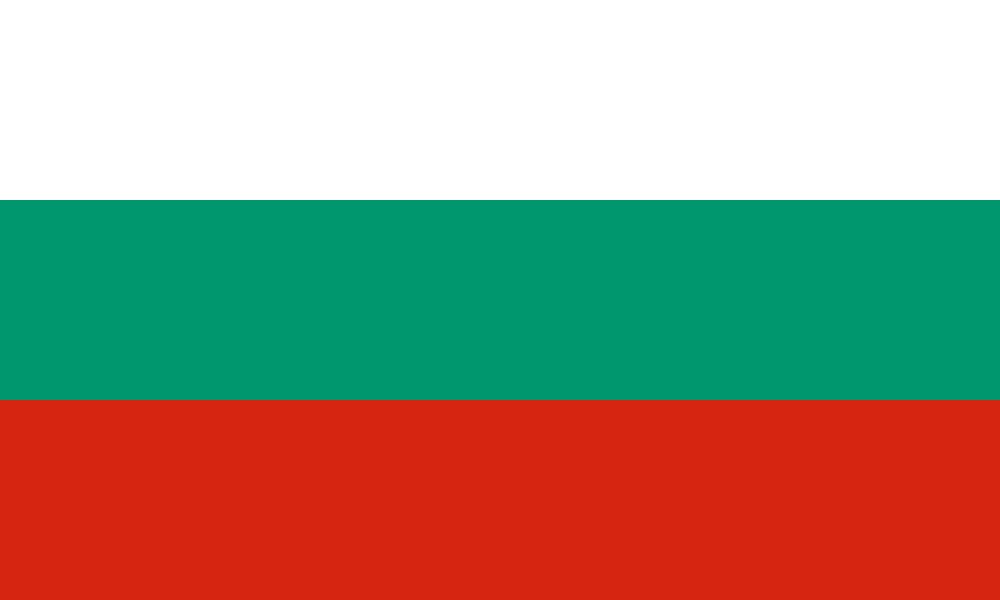
Flag of Bulgaria — Three equal horizontal bands: white (top), green (middle), red (bottom). Ratio 3:5. Adopted by the Constitution of Tarnovo, 16 April 1879.
The white-green-red sequence is fixed by the Constitution of Tarnovo, adopted on 16 April 1879 (Old Style) by the Constituent National Assembly meeting in the old imperial capital of Veliko Tarnovo. It is the first constitution of the newly established Principality of Bulgaria and one of the most liberal constitutions of its time.
No statute fixes the meaning of the colours. Three traditional readings coexist:
| Reading | White | Green | Red |
|---|---|---|---|
| Constitutional (unofficial) | Peace, freedom | Agrarian identity, the land | Courage, the blood of martyrs of the Liberation |
| Landscape | Snow of the Balkan mountains | Forests and fields | Roses and paprika of the fertile plains |
| Pan-Slavic variant | White (as in Russia) | Substituted for the Pan-Slavic blue | Red (as in Russia) |
The Pan-Slavic reading is the most historiographically defended: Bulgaria drew its independence directly from the Russo-Ottoman War of 1877–1878, and the tricolour deliberately signals affiliation with the Slavic family while distinguishing itself by substituting green for blue. This substitution acknowledges Bulgaria’s strong agrarian character in an era when green flags carried recognisable revolutionary and reformist connotations.
1876 — The April Uprising flies a diverse repertoire of green-red-white banners; a green field with a red-and-white cross is common in the rebel bands.
1877–1878 — Volunteer units in the Russo-Ottoman War carry a Samara Flag: white-green-red horizontal, with religious imagery.
16 April 1879 — The Constitution of Tarnovo fixes the tricolour.
1908 — On the declaration of full independence, a royal-style variant with the arms is used for state occasions; the plain tricolour remains the civil flag.
1948–1990 — The state emblem of the People’s Republic is added near the hoist, occupying the white band. Three successive emblems (1948, 1971 and 1971-revised) are used before the flag reverts.
22 November 1990 — Restoration. The Grand National Assembly amends the constitution to remove the state emblem; the plain tricolour returns.
| State | Lion tincture | Field | Distinctive feature |
|---|---|---|---|
| Bulgaria | Or | Gules | Crown; two lion supporters; oak branches |
| Montenegro | Or | Gules | Two-headed eagle main; lion on inescutcheon |
| North Macedonia | Or | Gules | Different tradition (early 20th c. revival) |
| Ohrid Archbishopric (historical) | Or | Gules | Byzantine ecclesiastical use, 14th c. |
Bulgaria is the only Slavic state to substitute green for blue in the Pan-Slavic sequence. Green appears elsewhere only as a subordinate or ecclesiastical charge, never as a principal tincture in a Slavic tricolour.
Since the reform of 1999, Bulgaria is divided into 28 provinces (oblasti), each named for its principal city. Most carry arms drawn from the medieval heraldry of the historic Bulgarian regions and towns:
Click on Bulgaria on the interactive map above to browse the emblems of the twenty-eight provinces.
It compresses medieval and modern layers into a single composition. The crowned golden lion on red is the historical mark of the Second Bulgarian Empire, documented in Western armorials from the 13th century. The historical crown recalls the Bulgarian tsars; the two supporting lions and the oak branches were added in the 19th century after independence. The motto Съединението прави силата commemorates the Bulgarian Unification of 1885.
The earliest surviving Western depiction is in the Wijnbergen Armorial of the 1270s, which shows three golden lions passant on gules. The single crowned rampant lion crystallises in the 19th-century national revival and is codified for the modern Republic by the Law of 4 August 1997.
The 1997 law explicitly names the crown as the historical crown of the Second Empire, not the crown of the House of Saxe-Coburg-Gotha (1878–1946). The choice was contested during drafting; parliament kept the crown by ordinary-majority vote as a symbol of continuity with the medieval Bulgarian state rather than with the deposed monarchy.
The sequence was fixed by the Constitution of Tarnovo on 16 April 1879. It follows the Pan-Slavic vocabulary popularised after 1848 but substitutes green for blue, distinguishing Bulgaria from Russia, Serbia and Slovakia while asserting its agrarian identity.
From 1948 to 22 November 1990, the tricolour carried the state emblem of the People’s Republic near the hoist: a lion within a wheat wreath, surmounted by a red star, with a ribbon dated 681 (foundation of the First Bulgarian Empire) and 1944. The plain tricolour was restored by constitutional amendment in November 1990.
Last reviewed by the Emblema Mundi editorial team on 5 July 2026.