Country
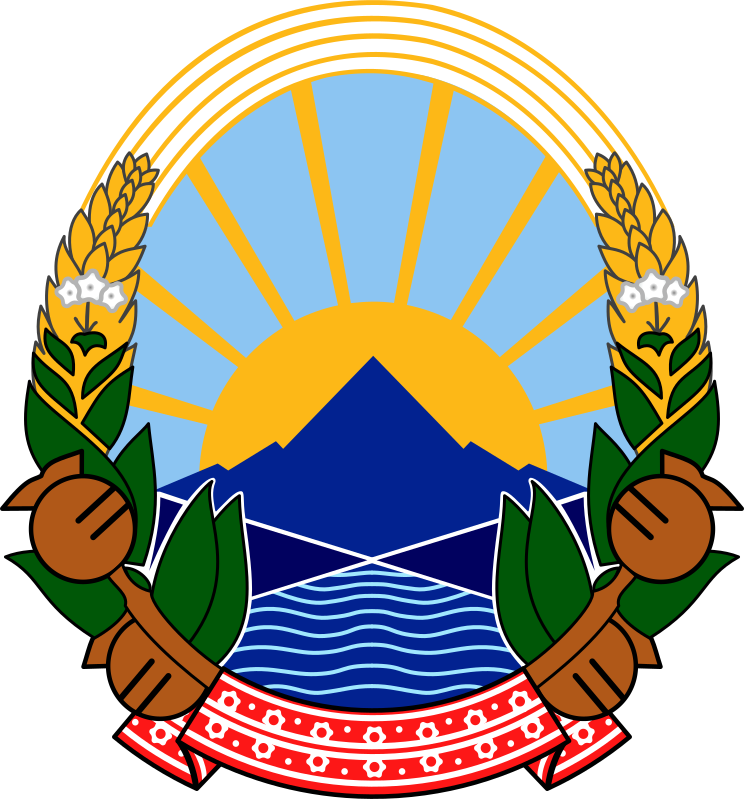
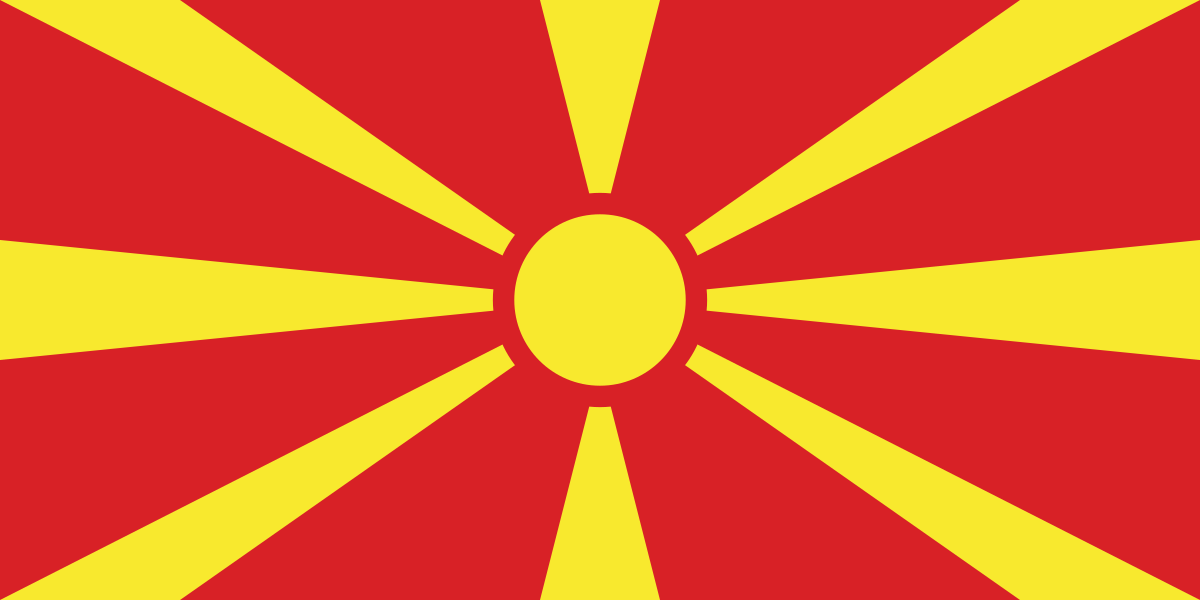
North Macedonia’s national symbols tell a story of contested identity. The national emblem — garlands of wheat, tobacco, and poppies framing a mountain, a lake, and a sunrise — is a Soviet-era composition inherited from the People’s Republic of Macedonia in 1946, stripped of its socialist star only in 2009. The flag — a yellow sun with eight broadening rays on a red field — was designed by Miroslav Grčev in 1995 to replace the controversial Vergina Sun, whose use had provoked a diplomatic crisis and trade embargo from Greece. Behind both modern symbols lies an older heraldic tradition: the Macedonian lion — Gules, a lion rampant queue forchée Or — documented in European armorials since the 16th century, proposed but never adopted as the state coat of arms after independence.
Flag
Not available
Coat of Arms
Not available
| Official name | Republika Severna Makedonija / Република Северна Македонија |
|---|---|
| National emblem | Wheat, tobacco, poppies; mountain, lake, sunrise (Yugoslav-derived) |
| Star removed | 16 November 2009 |
| Historic lion | Gules, a lion rampant queue forchée Or crowned Or (not adopted) |
| National flag | Red field, yellow sun with eight broadening rays |
| Flag adopted | 5 October 1995 (replaced Vergina Sun) |
| Flag designer | Miroslav Grčev |
| Capital | Skopje |
| Government | Unitary parliamentary republic |
| Name change | Prespa Agreement, 2018 (Republic of Macedonia → North Macedonia) |
National Emblem of North Macedonia — Wheat, tobacco, poppies, mountain, lake, sunrise
The national emblem of North Macedonia is not a coat of arms in the heraldic sense — it has no shield and follows no rules of blazon. It is a state emblem modelled on the Yugoslav pattern, adopted when the republic became part of Tito’s federation in 1946.
A genuine heraldic tradition exists for Macedonia: a red lion rampant with a forked tail on gold, documented in European armorial collections from the 16th to 18th centuries:
Gules, a lion rampant queue forchée Or, crowned Or.
After independence in 1991, Miroslav Grčev proposed replacing the Soviet-style emblem with a golden lion on a red shield, but the proposal was not adopted by parliament. The lion remains a popular national symbol, used informally in sports and cultural contexts.
Flag of North Macedonia — Eight-rayed sun by Miroslav Grčev, 5 October 1995
The national flag is a red field bearing a stylised yellow sun with eight broadening rays extending from the centre to the edges of the flag.
After declaring independence on 8 September 1991, Macedonia adopted a flag featuring the Vergina Sun — a sixteen-rayed golden sun discovered at the ancient Macedonian royal burial site in Vergina, Greece. The Greek government saw this as misappropriation of a Hellenic symbol and a direct claim on the legacy of Philip II of Macedon. Greece imposed a trade embargo and lodged a trademark claim with the World Intellectual Property Organization.
To resolve the crisis, the Macedonian government commissioned Miroslav Grčev to design a new flag. His final proposal — the eight-rayed sun extending to the edges of the flag — was adopted by parliament on 5 October 1995. The sun represents the “new sun of Liberty” referenced in the national anthem Denes nad Makedonija (“Today over Macedonia”). The embargo was lifted shortly after.
In 2018, the Prespa Agreement between Macedonia and Greece resolved the decades-long naming dispute. The country was renamed the Republic of North Macedonia (Republika Severna Makedonija), paving the way for NATO accession in 2020 and EU candidacy. The flag and emblem remained unchanged.
North Macedonia’s heraldic heritage is shaped by its Ottoman past, its Yugoslav period, and its post-independence identity debates. The Macedonian lion — attested in foreign heraldic collections since the 16th century — represents the oldest genuinely heraldic symbol associated with the region, though it was never officially adopted as the state coat of arms.
At the municipal level, many cities maintain coats of arms reflecting their diverse heritage: Skopje bears arms featuring the Kale Fortress and the Stone Bridge, while Ohrid’s arms evoke the famous lake and the mediaeval Church of St John. The blend of Byzantine, Ottoman, and Slavic influences makes Macedonian civic symbolism distinctive in the Balkans.
No. The national emblem is not a heraldic coat of arms — it has no shield, no blazon, and does not follow traditional heraldic rules. It is a state emblem derived from the Yugoslav-era design of 1946, featuring wheat garlands, tobacco, poppies, a mountain, a lake, and a sunrise. The socialist five-pointed star was removed in 2009.
After independence in 1991, Macedonia adopted a flag featuring the Vergina Sun — a sixteen-rayed golden sun from the ancient Macedonian royal burial site in Greece. Greece saw this as misappropriation of a Hellenic symbol and imposed a trade embargo. The dispute was resolved in 1995 when Macedonia replaced the Vergina Sun with the current eight-rayed sun design by Miroslav Grčev.
The current flag was designed by Miroslav Grčev and adopted on 5 October 1995. It features a stylised yellow sun with eight broadening rays on a red field. The sun represents the “new sun of Liberty” referenced in the national anthem Denes nad Makedonija.
A red lion rampant on a golden field (Gules, a lion rampant queue forchée Or crowned Or) has been associated with Macedonia in European heraldic collections since the 16th century. After independence, Miroslav Grčev proposed it as the state coat of arms, but the proposal was not adopted by parliament.
On 16 November 2009, the Macedonian parliament voted (80–18) to remove the red five-pointed star from the national emblem. The star, inherited from the 1946 People’s Republic of Macedonia, was seen as an outdated symbol of the communist era.
Last reviewed by the Emblema Mundi editorial team on 2026-06-24.