Country
Crna Gora — the “Black Mountain” — bears one of the most striking coats of arms in the Balkans: a golden crowned double-headed eagle clutching a sceptre and a globus cruciger, with a lion passant on a green-and-blue shield at its heart. This heraldic composition weaves together Byzantine imperial tradition and the legacy of the Petrović-Njegoš dynasty, which governed Montenegro from 1696 as prince-bishops (vladike) and later as secular kings. The national flag — a red field bordered in gold — carries the same eagle and was adopted on 13 July 2004, two years before the country’s independence from Serbia. Designed by Radoslav Rotković, these symbols consciously reasserted Montenegro’s mediaeval and royal heritage over the Pan-Slavic designs of the Yugoslav era.
Flag
Not available
Coat of Arms
Not available
| Official name | Crna Gora / Црна Гора |
|---|---|
| Coat of arms | Golden crowned double-headed eagle, sceptre & orb, lion passant on chest |
| Arms adopted | 12 July 2004 (Law on State Symbols); Constitution 2 October 2007 |
| Designer | Radoslav Rotković (2004) |
| National flag | Red field, gold border, coat of arms in centre |
| Flag adopted | 13 July 2004; standardised 16 September 2004 |
| Capital | Podgorica (administrative) / Cetinje (Old Royal Capital) |
| Government | Unitary parliamentary republic |
| Head of State | Jakov Milатовиć (since 2023) |
| Historic dynasty | Petrović-Njegoš (1696–1918) |
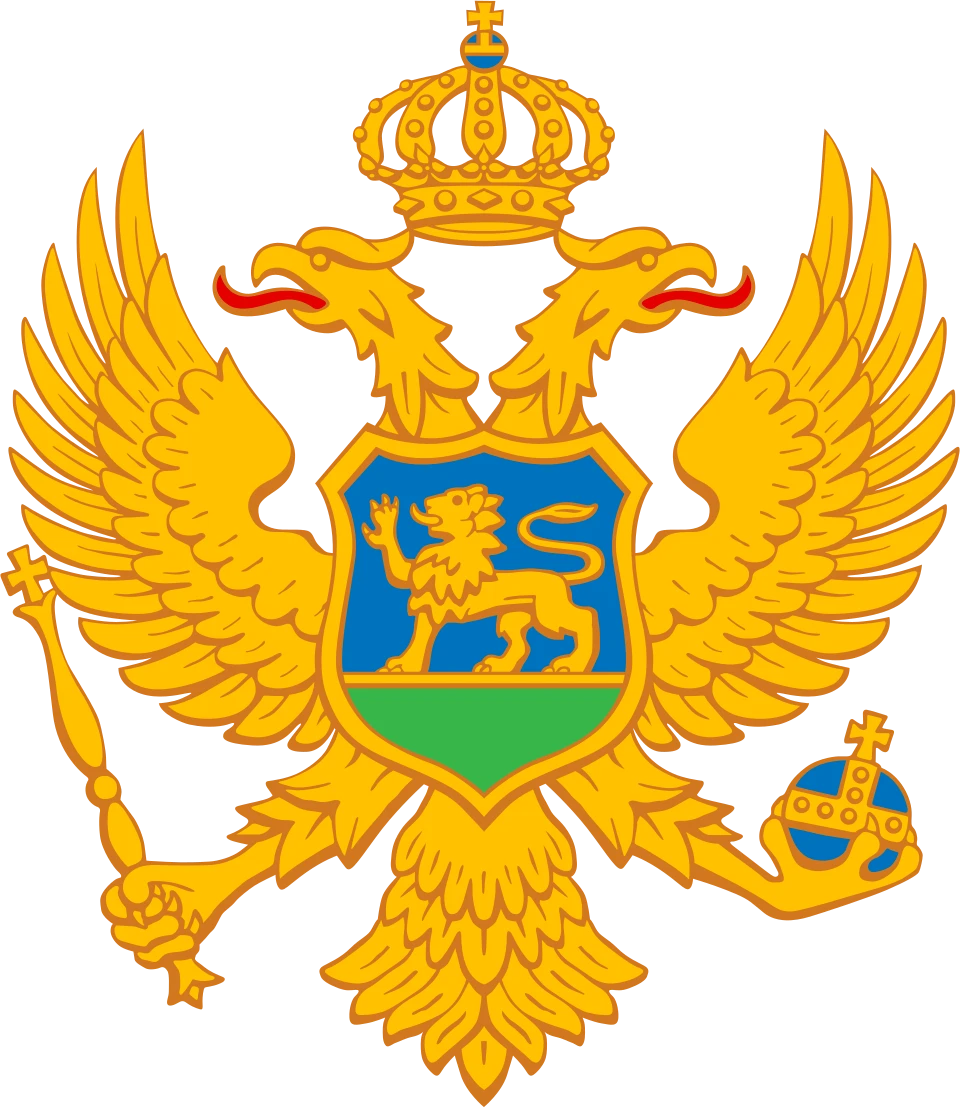
Coat of Arms of Montenegro — Golden double-headed eagle, sceptre, orb, and lion passant
The official blazon, as defined by the Law on State Symbols and the Statehood Day of Montenegro (12 July 2004), describes:
A golden crowned double-headed eagle, raising his wings in flight, with a sceptre in the right and a globus cruciger in the left talon, on red. On the chest of the eagle lays a shield with a golden lion passant. The lion is on a green field with a blue background.
The two-headed eagle is a charge of Byzantine and ultimately ancient Roman origin, symbolising the unity — or the intimate connection — between church and state. In Montenegrin context, this duality was embodied by the vladike (prince-bishops) of the Petrović-Njegoš dynasty, who were simultaneously spiritual and temporal rulers.
The current layout was modelled on the imperial arms of Russia, reflecting the close ecclesiastical, dynastic, and political ties between the Petrović-Njegoš house and the Russian Empire in the 19th century. Both share the Byzantine eagle tradition, but Montenegro’s version is distinctively golden on red and bears a lion rather than St George.
The golden lion passant (walking lion) on a green field with blue sky was added by Vladika Sava Petrović in the 18th century. In mediaeval bestiaries, the lion was said to breathe life into its stillborn cubs after three days — a symbol of the resurrection of Christ. Applied to Montenegro, it represents the nation’s enduring sovereignty and capacity for spiritual and political rebirth, even through centuries of Ottoman pressure.
The dynasty’s heraldry evolved through several rulers:
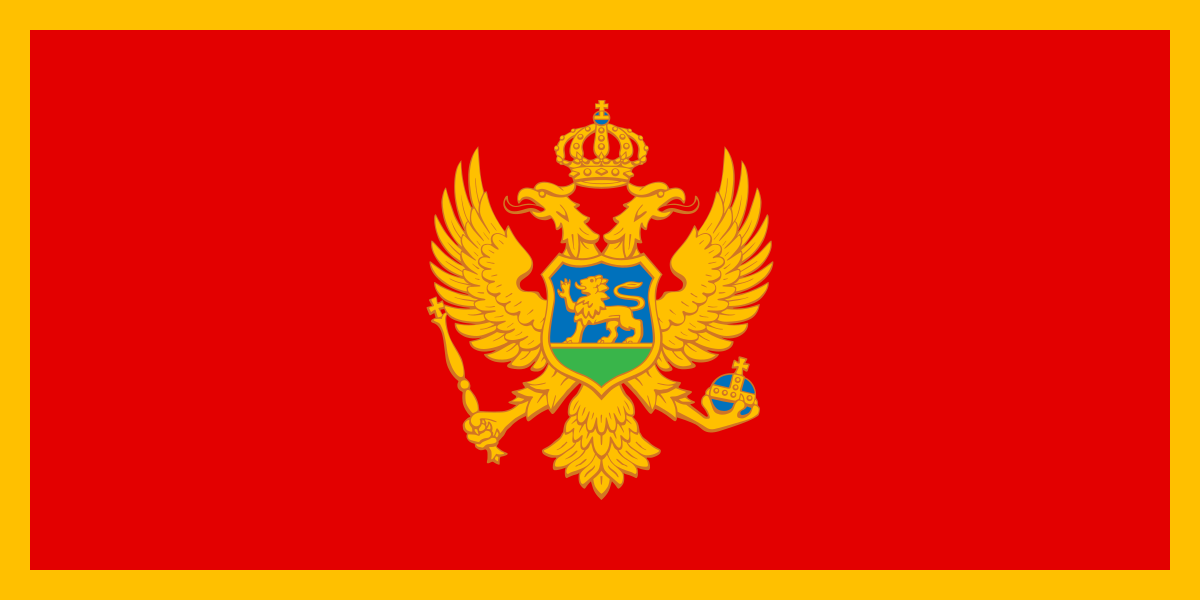
Flag of Montenegro — Adopted 13 July 2004, based on the royal banner
The national flag of Montenegro (zastava Crne Gore) is a red field framed by a gold border, with the coat of arms centred. It is one of only two sovereign state flags in Europe that feature an inner border (the other being Sri Lanka’s flag in Asia).
On 13 July 2004, the Assembly of the Republic of Montenegro passed the Law on State Symbols and the Day of the Statehood of Montenegro, establishing a new flag based on the royal banner of the Petrović-Njegoš dynasty. The precise specifications were standardised on 16 September 2004. At that time, Montenegro was still a constituent republic within the State Union of Serbia and Montenegro.
Following the independence referendum of 21 May 2006, Montenegro became a sovereign state on 3 June 2006. The flag was retained unchanged and enshrined in Article 4 of the Constitution of Montenegro, adopted on 22 October 2007.
The red recalls the colour of the Montenegrin royal house and evokes the blood shed in centuries of resistance. The gold border represents sovereignty and the legacy of statehood. The coat of arms at the centre ties the flag directly to the Petrović-Njegoš heritage, asserting mediaeval and dynastic continuity over the Pan-Slavic tricolours used during the Yugoslav period.
Montenegro’s heraldic tradition is inseparable from its ecclesiastical history. For centuries, the prince-bishops of Cetinje served as both spiritual leaders and heads of state, and the coat of arms reflected this dual authority. The double-headed eagle — received through the Orthodox Christian connection to Byzantium and later reinforced by ties to Russia — was the natural choice for a polity where church and state were one.
Beyond the national arms, Montenegrin heraldic identity is shaped by tribal and clan traditions. The country’s historic plemena (tribes) — such as the Njeguši, Ceklini, Piperi, Kuči, and Vasojevići — maintained distinct identities, though these were expressed more through oral tradition, banners, and battle standards than through formal heraldic blazons in the Western European sense.
The town of Cetinje, the Old Royal Capital, remains the symbolic heart of Montenegrin statehood. The Cetinje Monastery and the Biljarda (Njegoš’s residence) house artefacts that document the evolution of the eagle emblem from its earliest ecclesiastical forms to the royal coat of arms of King Nikola I.
The coat of arms features a golden crowned double-headed eagle on red, holding a sceptre and globus cruciger. On its chest lies a shield with a golden lion passant on a green field with a blue background. The double-headed eagle symbolises the unity of church and state, inherited from the Byzantine tradition, while the lion passant is associated with the resurrection of Christ and the enduring sovereignty of Montenegro.
The current coat of arms was designed by Montenegrin artist Radoslav Rotković. It was officially adopted by the Parliament on 12 July 2004, while Montenegro was still part of the State Union of Serbia and Montenegro, and constitutionally sanctioned on 2 October 2007.
The layout of Montenegro’s coat of arms was modelled on the imperial arms of Russia, reflecting close ecclesiastical, dynastic, and political ties between the ruling Petrović-Njegoš dynasty and the Russian Empire in the 19th century. Both share the Byzantine double-headed eagle tradition, but Montenegro’s eagle is distinctively golden on red and bears a lion passant rather than St George.
The flag was officially adopted on 13 July 2004 and standardised on 16 September 2004. It was retained after Montenegro’s independence from Serbia in 2006, and mandated by Article 4 of the Constitution of Montenegro adopted in 2007. The design — a red field with gold border bearing the coat of arms — is based on the royal banner of the Petrović-Njegoš dynasty.
The golden lion passant (walking lion) on a green field with blue background was added to the eagle’s breast by Vladika Sava Petrović in the 18th century. It is traditionally associated with the resurrection of Christ — in mediaeval bestiaries, the lion was said to breathe life into its stillborn cubs — symbolising Montenegro’s enduring sovereignty and spiritual rebirth.
Last reviewed by the Emblema Mundi editorial team on 2026-06-22.