Country · South America
Venezuela is the origin of a whole family of flags. The yellow, blue and red tricolour was created by the precursor Francisco de Miranda, who first raised it in 1806; the flags of Colombia and Ecuador descend from it too. In the blue band an arc of eight stars shines, and on the coat of arms a white horse gallops — the emblem of independence and liberty.
Click on a country to learn more
| Country | Bolivarian Republic of Venezuela |
|---|---|
| Tricolour first raised | 3 August 1806, by Francisco de Miranda (La Vela de Coro) |
| Flag adopted | 9 July 1811 |
| Stars | Eight (seven in 1817 + Guayana; formalised in 2006) |
| Current reform of the symbols | 2006 |
| Colours | Yellow, blue, red |
| Territorial divisions | 23 states, the Capital District and the Federal Dependencies |
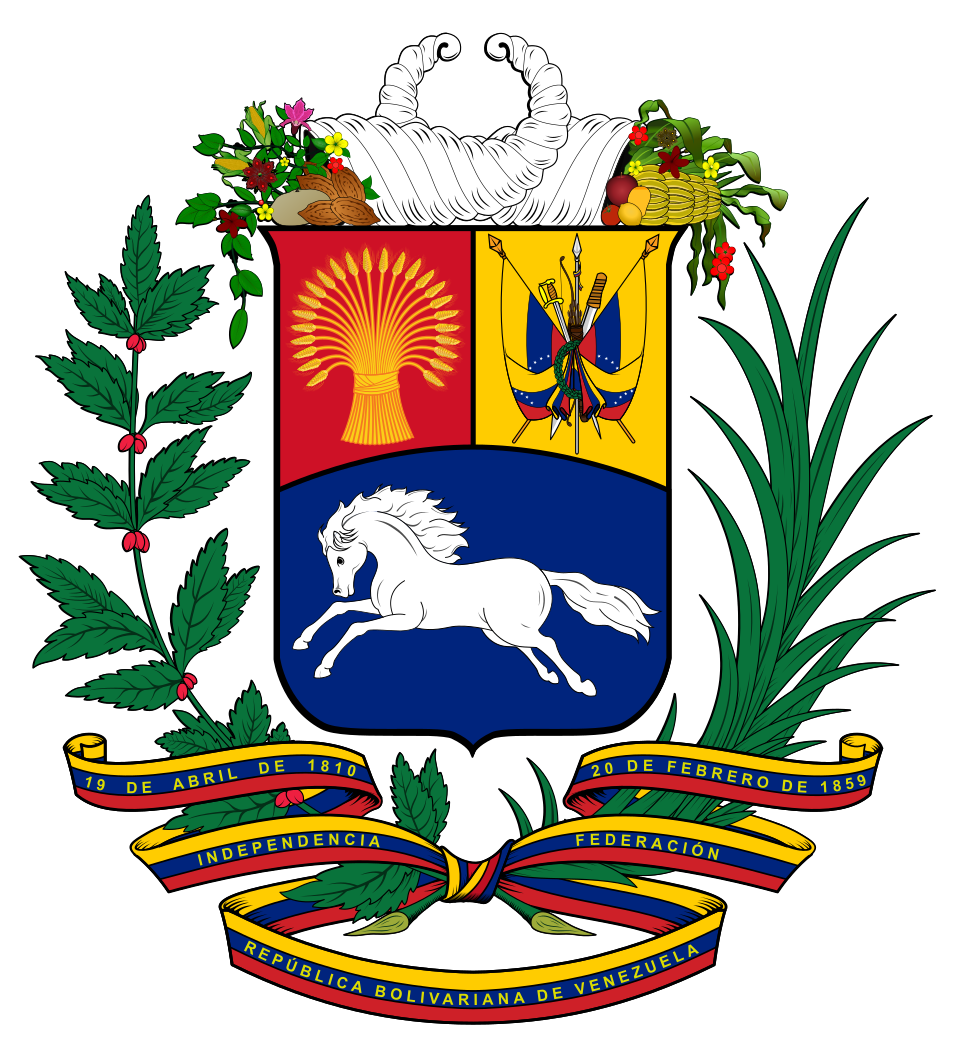
Coat of Arms — Three quarters: a wheat sheaf, weapons with two flags and laurel, and a white galloping horse; cornucopias, olive and palm; the dates of 1810 and 1859.
A shield of three quarters. In the dexter quarter, gules (red), a sheaf of wheat with as many stalks as the Republic has states, symbol of union and wealth. In the sinister quarter, or (yellow), a trophy of arms and two national flags entwined, crowned with laurel, in token of victory. In the base quarter, azure (blue), a white untamed horse at the gallop, emblem of independence and liberty. For crest, two entwined cornucopias; for supporters, an olive branch and a palm bound with a tricolour ribbon. On the ribbon are read the dates 19 April 1810 — Independence and 20 February 1859 — Federation, and at the centre República Bolivariana de Venezuela.
Each quarter distils an idea of the Republic: the sheaf gathers as many stalks as there are states, for the federal union; the arms and flags with laurel celebrate the victories of independence; and the white horse, free and riderless, embodies the liberty that was won.
The current version comes from the Law of the Flag, Anthem and Coat of Arms of 2006. Under the heraldist Fabio Cassani Pironti, the arms were redrawn and the horse was set to gallop facing left, in a more dynamic and freer pose than before. The change was much debated, but the set of charges — sheaf, arms, horse, cornucopias — was kept intact.
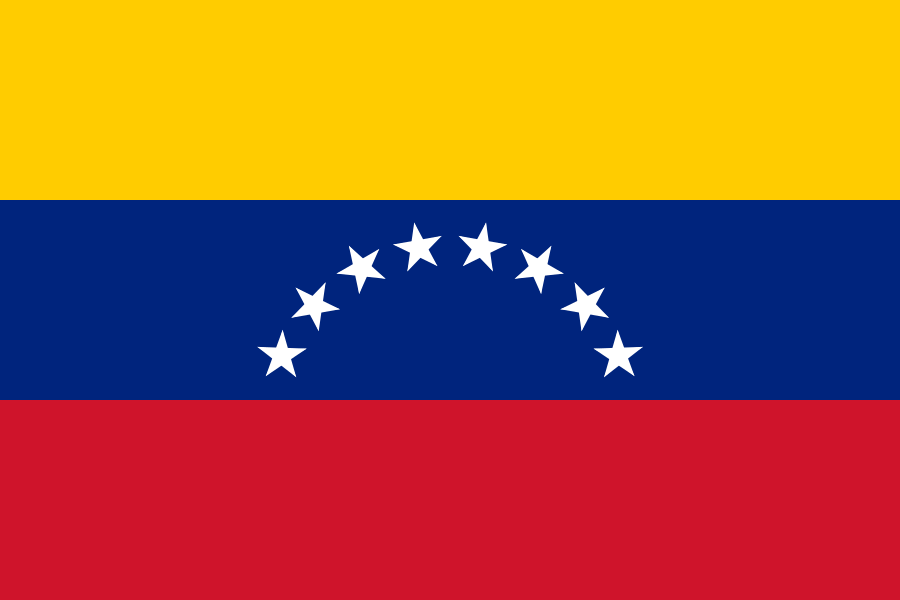
Flag — A yellow, blue and red tricolour with an arc of eight white stars on the blue band.
The flag of Venezuela is the matrix of a whole continental family. The yellow, blue and red tricolour was conceived by Francisco de Miranda, who first raised it on 3 August 1806 at La Vela de Coro during his expedition; the Sovereign Congress adopted it as the national pavilion on 9 July 1811. Carried by Bolivar into the Andean campaigns, it gave rise to the flags of Colombia and Ecuador as well.
Miranda explained the colours in his journal: yellow for the wealth of the American continent, blue for the sea that separates it from tyrannical Europe, and red for the courage and blood of those who would fight for independence.
In 1811 the flag bore no stars. On 17 May 1817 seven were added, one for each province that signed the Act of Independence: Barcelona, Barinas, Caracas, Cumana, Margarita, Merida and Trujillo. On 20 November 1817, Simon Bolivar decreed an eighth star for the liberation of the Province of Guayana. That eighth star, long omitted, was restored and formalised by the 2006 law, which fixed the present arc of eight.
Venezuela is the starting point of what vexillologists call the Bolivarian family of South American heraldry. Miranda's tricolour — deliberately foreign to the Spanish colonial vocabulary, with no lions or castles — was the first of a line: from it were born, in direct descent, the flags of Colombia and Ecuador, sisters of the Venezuelan.
Against the Sun of May of the Rio de la Plata, Venezuela's own contribution is twofold: the colours of Miranda, which fixed a continental palette, and the white horse of the arms, a symbol of untamed liberty that no other republic of the continent adopted as a central emblem.
Venezuela is a federal republic made up of 23 states, the Capital District and the Federal Dependencies. Each state has its own coat of arms and flag, most of them adopted in the twentieth century.
The states of Venezuela can be explored one by one on the interactive map on this page.
The yellow, blue and red tricolour was created by the precursor Francisco de Miranda, who first raised it on 3 August 1806 at La Vela de Coro. The Sovereign Congress adopted it as the national flag on 9 July 1811. The flags of Colombia and Ecuador descend from it too.
It has eight white stars set in an arc. On 17 May 1817 seven were added, one for each province that signed the declaration of independence (Barcelona, Barinas, Caracas, Cumana, Margarita, Merida and Trujillo); on 20 November 1817 Simon Bolivar decreed an eighth for the liberation of Guayana. The 2006 law formalised the current eight.
The white galloping horse in the blue quarter is the emblem of independence and liberty. Since the 2006 reform it gallops and faces to the left, in a freer and more dynamic pose than before.
By Miranda's reading, yellow stands for the wealth of the American continent, blue for the sea that separates it from tyrannical Europe, and red for the courage and blood of those who fought for independence.
The ribbon of the arms bears two founding dates: 19 April 1810, the start of the independence process, and 20 February 1859, the beginning of the Federal War; at the centre it reads República Bolivariana de Venezuela.
Last reviewed by the Emblema Mundi editorial team on 21 September 2026.