US City
Few cities are as bound to two colours as Pittsburgh is to black and gold. They come from its flag — a black-gold-black banner adopted in 1899, carrying the city’s coat of arms — and the arms in turn come from William Pitt, the British statesman for whom Fort Pitt and then the city were named. The colours have travelled far past the flag: Pittsburgh is the only city in the United States whose major sports teams all wear the same two, the black and gold of its own emblem. Here is where they come from.
Click on a country to learn more
| City | Pittsburgh, Pennsylvania; named for William Pitt, 1st Earl of Chatham |
|---|---|
| Flag adopted | 1899 |
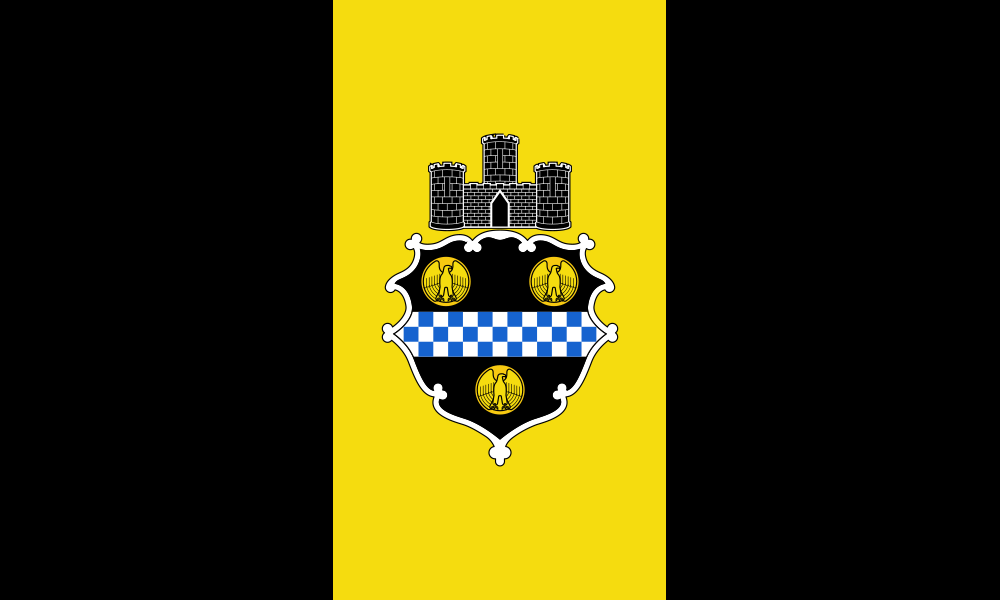
| Flag design | Vertical bands of black, gold and black, with the city arms on the gold |
| City colours | Black and gold (set in the Code of Ordinances) |
| Coat of arms adopted | By ordinance, 1925 |
| Blazon | On a field sable, a fess chequy argent and azure, between three bezants bearing eagles rising, Or; for crest, a black triple-towered castle masoned argent |
| Arms derived from | The arms of William Pitt, 1st Earl of Chatham |
| Motto | Benigno Numine — “by the favour of Heaven” (adopted 1816, restored 1950) |
Flag of Pittsburgh — black, gold and black in three vertical bands, with the city’s coat of arms on the central gold. Adopted 1899.
Pittsburgh adopted its flag in 1899: three vertical bands, black at the hoist and fly and gold between them, with the city’s coat of arms set in the centre on the gold. The two colours are the city’s own, black and gold, and the city’s Code of Ordinances sets them down as official — though, as is common with old civic colours, the ordinance records them without explaining where they came from. The answer is on the flag itself: they are the colours of the arms it carries.
Where flags like Chicago’s or Washington’s reduce a city to a few bold shapes, Pittsburgh’s does the opposite: it frames a full coat of arms, crest and all, in a band of gold. It is a heraldic banner rather than a modern flag, and to read it you have to read the arms — which carry the whole story of the city’s name.
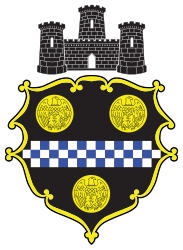
Arms of Pittsburgh — a black shield, a checkered fess and three gold bezants bearing eagles, under a triple-towered castle, adapted from the arms of William Pitt.
The name comes first. In 1758 British forces took the forks of the Ohio from the French and built Fort Pitt, naming it for William Pitt, 1st Earl of Chatham, the statesman then directing Britain’s war; the town that grew around it became Pittsburgh. When the city came to design its arms, it went to the source and adapted Pitt’s own family arms. Pittsburgh adopted them formally by ordinance in 1925.
On a field sable, a fess chequy argent and azure, between three bezants bearing eagles rising with wings displayed and inverted, Or. For crest, sable, a triple-towered castle masoned argent.
In plainer words: a black shield crossed by a checkered band of silver and blue, with three gold roundels — bezants — each charged with a rising eagle; and above the shield, for a crest, a black castle with three towers. The checkered band is Pitt’s; the castle recalls the fort from which the city grew. The black of the field and the gold of the bezants are the two colours that became the city’s own.
The checkered band is not decoration but a pun. It alludes to the Exchequer, the English royal treasury, whose accounts were once reckoned on a chequered cloth like a chessboard, counters of money moved from square to square — which is where the word itself comes from, through the old French eschequier, a chessboard. The first Pitt to bear these arms, John Pitt (died 1602), held office in the Exchequer, and the chequy fess records his trade in money; the heraldic writer Mark Antony Lower noted the allusion. The three bezants say the same thing again: a bezant is a gold roundel named for the gold coins of Byzantium. Beneath the fort and the earl’s name, the Pittsburgh arms are at heart a counting-house shield — the reckoning-cloth of the treasury and three gold coins.
With the arms came a motto, also inherited from the Earl of Chatham:
BENIGNO NUMINE — “by the favour of Heaven.”
Pittsburgh took the words when it was chartered as a city in 1816, and restored them to its official seals in 1950. The seal of the city is essentially these arms in a ring of lettering — the same emblem that stands on the flag.
What makes Pittsburgh unusual is not that it has civic colours, but how completely the city took them up. Pittsburgh is the only city in the United States whose major professional sports teams all wear the same primary colours — the black and gold of the city flag and arms. The Pirates in baseball, the Steelers in football, the Penguins in hockey and the Riverhounds in soccer all carry them; the football team has worn black and gold since it was founded in 1933.
The result is a city whose emblem escaped its flagpole. Most people who wear Pittsburgh’s black and gold have never looked closely at the coat of arms behind them, but the colours they cheer in are, at one remove, the colours of an eighteenth-century English earl — carried from Pitt’s shield to a frontier fort, to a city flag, and finally onto the jerseys of four professional teams.
They are the city’s official colours, taken from its coat of arms — a black shield strewn with gold — which is based on the arms of William Pitt, the city’s namesake. The Code of Ordinances sets them down as the city colours.
From the arms of William Pitt, 1st Earl of Chatham, for whom Fort Pitt and the city were named. Pittsburgh adopted the arms by ordinance in 1925: a black shield with a checkered silver-and-blue band and three gold bezants bearing eagles, under a black triple-towered castle.
It is Latin for “by the favour of Heaven.” The motto came from the Earl of Chatham’s arms; Pittsburgh adopted it on becoming a city in 1816 and restored it to its seals in 1950.
In 1899. It is a vertical band of black, gold and black with the city’s coat of arms on the central gold; the arms themselves were formally adopted by ordinance in 1925.
In tribute to the city flag. Pittsburgh is the only U.S. city whose major professional teams — the Steelers, Pirates, Penguins and Riverhounds — all share the same primary colours, the black and gold of the city’s emblem.
Last reviewed by the Emblema Mundi editorial team on 16 September 2026.