US City
Philadelphia is one of the few American cities with real coat of arms — shield, crest, supporters and motto. Its flag is the blue and gold of the Swedes who settled the Delaware before William Penn. And its motto is a pun: Philadelphia maneto, “let brotherly love continue” — or, read the other way, “let Philadelphia endure”.
Click on a country to learn more
| City | Philadelphia, Pennsylvania |
|---|---|
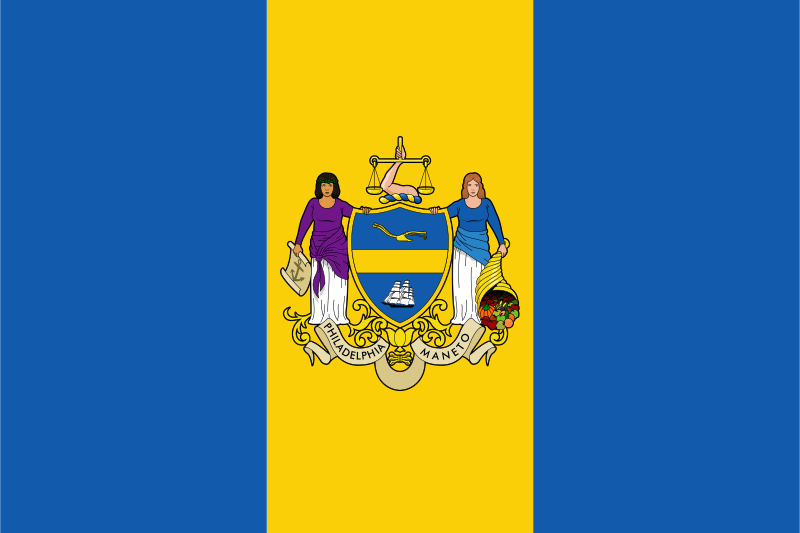
| Flag | Azure, gold and azure in vertical bands, the city arms on the gold; adopted 27 March 1895 |
| Flag designer | Dr. Henry C. McCook |
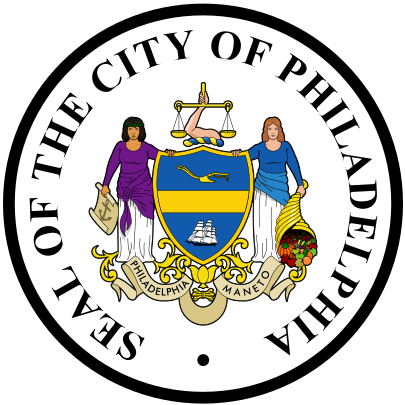
| Arms | Azure, a fess or between a plough and a ship under full sail |
| Arms fixed | 1874, by Colonel Frank Marx Etting |
| Motto | Philadelphia maneto — “Let brotherly love continue” |
Flag of Philadelphia — divided vertically in three equal parts, azure, golden yellow and azure, with the city arms on the gold. Blue and gold for the Swedish settlement of the Delaware. Adopted 27 March 1895.
The ordinance describes it in heraldic terms: divided vertically in three equal parts, the first and third azure blue, the middle pale golden yellow, with the city’s arms on the yellow. It was adopted on 27 March 1895, on a design by Dr. Henry C. McCook. An earlier Philadelphia flag bearing the city arms had been made in 1873 for the Vienna Exposition.
Blue and gold are not the colours of Pennsylvania, nor of the United States. They are the colours of Sweden, and they commemorate the Swedish colonists who settled on the Delaware before William Penn arrived. The flag of the city Penn founded begins with the people who were there first.
Seal of Philadelphia — azure, a fess or between a plough and a ship under full sail; for crest an arm holding the scales of justice; for supporters Peace, with a scroll charged with an anchor, and Plenty, with a cornucopia; and the motto Philadelphia maneto.
At the centre of the seal is a full achievement of arms, blazoned like a European coat:
Azure, a fess or between a plough in chief and a ship under full sail in base proper.
The two charges are older than the city arms. They come from the seals of the two original counties, Chester and Philadelphia, each of which set its own device above William Penn’s arms: the farmland inland, the port on the river, united on one shield by the gold band between them.
The first city arms, adopted in 1789, already had Peace and Plenty holding the shield — Peace with a scroll showing Penn’s plan of the city, Plenty with her cornucopia. Six decades of redrawing wore them down: by the 1850s the two figures had, in the words of one historian, sat themselves on the ground, propping up the shield with their elbows.
In 1874 Colonel Frank Marx Etting put them back on their feet, facing forward, replaced Penn’s plan on Peace’s scroll with an anchor, and added the motto. The councils adopted his version, which is very nearly the one in use today.
The motto is Etting’s, and it is a pun. It renders Hebrews 13:1, “Let brotherly love continue”, in Latin — but Latin has no common noun for brotherly love, so Etting kept the Greek one: philadelphia, the very word the city is named after. Half Greek, half Latin, the motto therefore reads two ways at once: “let brotherly love continue”, and “let Philadelphia endure”.
The blue and gold commemorate the Swedish colonists who settled on the Delaware before William Penn founded Philadelphia. They are the colours of Sweden.
“Let brotherly love continue”, from Hebrews 13:1. Because the Greek word for brotherly love is philadelphia, the motto also reads “let Philadelphia endure”.
A blue shield with a gold band between a plough and a ship under full sail, an arm holding the scales of justice above it, Peace and Plenty as supporters, and the motto Philadelphia maneto below.
Dr. Henry C. McCook. The flag was adopted on 27 March 1895.
A note on method. Both emblems are described from the ordinance and the published blazon, not from the drawing.
Last reviewed by the Emblema Mundi editorial team on 30 September 2026.