US City
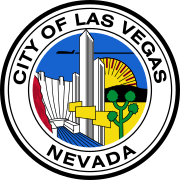
Most civic seals picture what a city is proud of. The seal of Las Vegas pictures what it lives on: three hotel towers with lit marquees, set beside the Hoover Dam as though the two were the same kind of public work — and, overhead, a jet airliner, one of the very few aircraft on any civic emblem.
Click on a country to learn more
| City | Las Vegas, Nevada |
|---|---|
| Seal | 1966, by Richard Thompson — three towers, the Hoover Dam, a Joshua tree, a sun and a jet |
| Flag | Royal blue with a silver diagonal stripe, the seal near the hoist; 3:5 |
| Flag adopted | 2 October 1968 |
| Flag designer | Kenneth A. Bouton |
| NAVA 2004 survey | 93rd of 150 United States city flags |
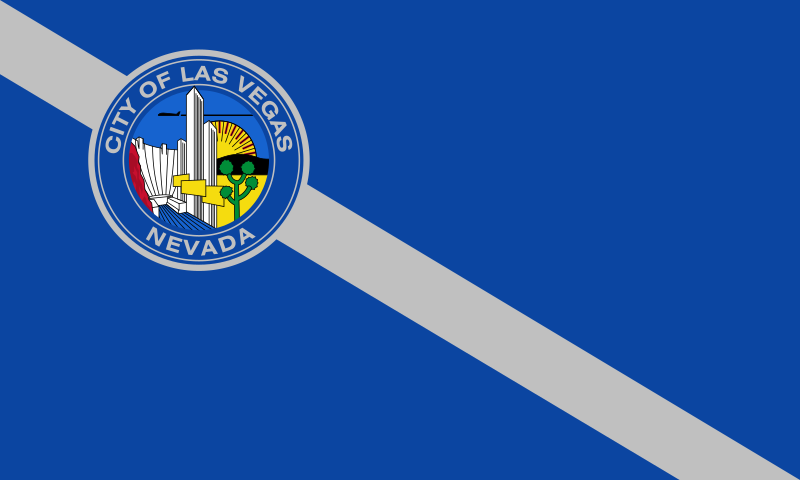
Flag of Las Vegas — a royal blue field with a silver diagonal stripe, the city seal near the hoist. Royal blue for the clear skies of Nevada and silver for the Silver State; proportions 3:5. Adopted 2 October 1968.
A field of royal blue, crossed by a silver diagonal stripe running from the upper hoist to the lower fly, with the city seal near the hoist. Proportions 3:5. It was designed by Kenneth A. Bouton, of the city manager’s office, and adopted on 2 October 1968.
The blue stands for the clear skies of Nevada, the silver for the Silver State, Nevada’s nickname. Blue and silver were adopted as the city’s official colours on the same day as the flag.
The diagonal is an uncommon device on American city flags, and it gives this one a shape that reads from any distance. The seal on top of it does not: three towers, a dam, a mountain, a tree, a sun and an aircraft need to be seen close up. The published descriptions also disagree on where exactly the seal sits — in the canton, breaking the stripe, or centred on the stripe.
Seal of Las Vegas — three tall silvery buildings with yellow marquees, the Hoover Dam in white with the blue water of the Colorado below it, Sunrise Mountain in brown, a green Joshua tree, a yellow sun with orange rays, and a jet aircraft trailing a contrail. The rim reads City Of Las Vegas and Nevada.
The seal was adopted in 1966 and is credited to Richard Thompson. It is a landscape, and every item in it is there for a reason:
The rim reads “City Of Las Vegas” and “Nevada”. There is no motto.
Seals of this period are full of ploughs, anvils, ships and cornucopias — respectable, productive things. Las Vegas put hotels with illuminated marquees at the exact centre of its seal and set a dam beside them as though the two were the same kind of public work. The irony is that the most famous of those hotels are not in the city at all: the Strip lies outside the city limits, in unincorporated Paradise and Winchester.
Aircraft almost never appear on civic emblems, because most American cities fixed their seals before aviation existed and never redrew them. Las Vegas adopted its seal in 1966, at the height of the jet age, with nothing to inherit — so it drew what the city depends on: people arriving by air. That single charge dates the seal more precisely than any number could.
Las vegas is Spanish for “the meadows”, after the springs that once watered the valley. The seal shows a Joshua tree, bare mountains and a sun: there is no meadow anywhere on it.
Three tall silvery buildings with yellow marquees, standing for tourism; the Hoover Dam with the Colorado River below it; Sunrise Mountain; a Joshua tree; a yellow sun; and a jet aircraft trailing a contrail. The rim reads “City Of Las Vegas” and “Nevada”.
It stands for the importance of civil and military air traffic to the region. Aircraft are rare on civic emblems; this one dates the seal to the jet age of the mid-1960s.
Royal blue for the clear skies of Nevada and silver for the Silver State. Both were adopted as the city’s official colours on 2 October 1968, with the flag.
Kenneth A. Bouton, of the city manager’s office. The flag was adopted on 2 October 1968.
A note on method. Both emblems are described from the published descriptions, not from the drawing. No source identifies the three towers as particular hotels, and this page does not; the two published descriptions of the flag disagree on the position of the seal, and both are given.
Last reviewed by the Emblema Mundi editorial team on 30 September 2026.