Michigan · United States
Few cities wear their history as plainly as Detroit. Its flag is quartered for the three powers that have flown over the strait — France, Britain and the United States — while its seal remembers a single catastrophe: the fire of 1805 that burned the town to the ground. From that ruin came the words a priest set down and the city took for its own: Speramus meliora; resurget cineribus — "We hope for better things; it shall rise from the ashes."
Click on a country to learn more
| State | Michigan |
|---|---|
| Nicknames | Motor City; Motown; the Renaissance City |
| Founded | 1701 (Fort Pontchartrain du Détroit) |
| Name | From French détroit, "strait" |
| Seal adopted | 1827 |
| Flag designed / adopted | 1907 / 1948 |
| Motto | Speramus meliora; resurget cineribus |
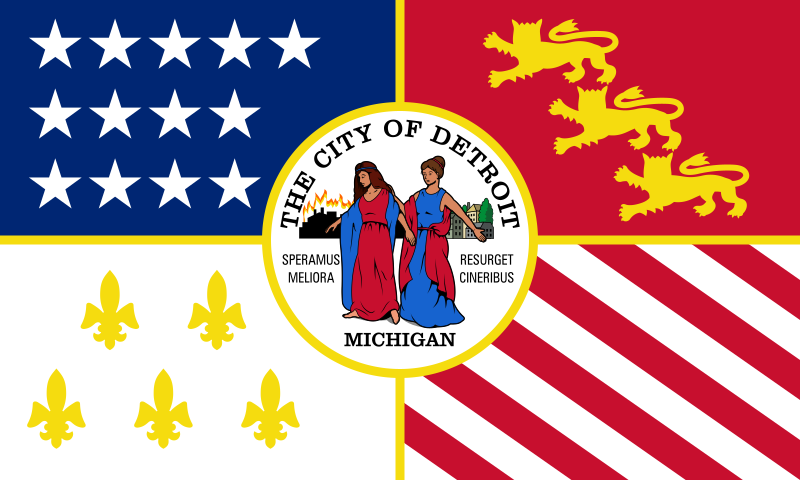
Flag of Detroit — France, Britain and the United States quartered around the city seal
The flag is a small history lesson. It is quartered, and each quarter carries the arms of a nation that once held the city: five gold fleurs-de-lis on white for France, echoing the royal standard; three gold lions on red for Great Britain, echoing the royal arms of England; and, for the United States, the thirteen stars on blue and the thirteen red-and-white stripes of the original colonies. At the centre, tying the quarters together, sits the city seal.
The design was drawn by David E. Heineman in 1907, but the city did not make it official until 1948. Its proportion is 3:5.
Detroit's name is French — le détroit, "the strait" — for the river that links Lake Huron and Lake Erie. The French came first: in 1701 Antoine de la Mothe Cadillac founded Fort Pontchartrain du Détroit, and for six decades the fleurs-de-lis flew over the post. In 1760, during the Seven Years' War, the fort passed to Great Britain, whose lions ruled until the Americans finally took possession in 1796, two decades after independence.
That three-fold succession — French, British, American — is exactly what the flag's quarters set out to record. It is one of the few American city flags to tell its whole colonial story in heraldry, and its layered design is often noted (and debated) by vexillologists for that ambition.
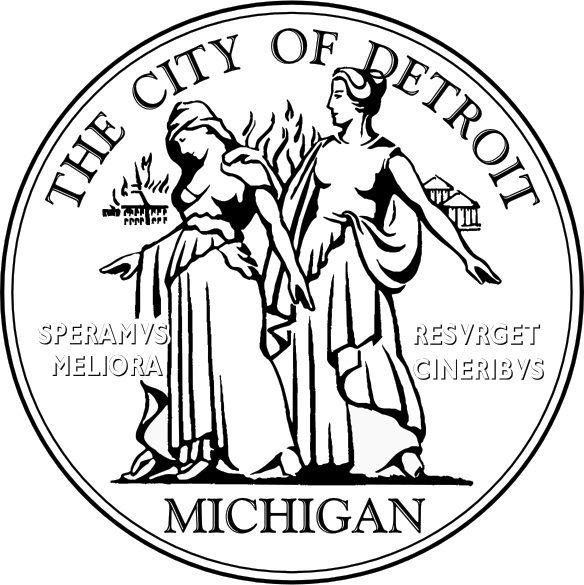
Seal of Detroit — the burning city and the city reborn, with the mottoes of 1805
On 11 June 1805, a fire — begun, it is said, by a spark from a baker's pipe — swept through Detroit and destroyed almost every building in the town. In the face of the ruin, the French priest Father Gabriel Richard set down a line of Latin that has defined the city ever since: Speramus meliora; resurget cineribus — "We hope for better things; it shall rise from the ashes."
The seal makes that sentence into a picture. Two female figures stand before the river: one turns away in grief toward the burning city on the left, while the other consoles her and gestures to the city rebuilt on the right. The two halves of the motto run above and below. The seal was designed by the artist J. O. Lewis and adopted on 26 March 1827, and it is this seal that sits at the heart of the flag — so that the city's promise of rebirth appears twice over in its emblems.
Each quarter recalls a nation that ruled Detroit: five gold fleurs-de-lis on white for France, which founded the settlement in 1701; three gold lions on red for Great Britain, which held it from 1760 to 1796; and the thirteen stars and thirteen stripes of the United States. The city seal sits in the centre.
Detroit's motto is "Speramus meliora; resurget cineribus," Latin for "We hope for better things; it shall rise from the ashes." It appears on the city seal.
The seal shows two female figures. One weeps as she looks at Detroit in flames — a reference to the Great Fire of 1805 — while the other consoles her and points to the city being rebuilt. It captures the city's destruction and rebirth.
Father Gabriel Richard, a French Catholic priest, wrote the motto after the Great Fire of 11 June 1805, which destroyed almost the entire town. His words of hope became the city's motto and inspired the seal adopted in 1827.
The seal was adopted on 26 March 1827, designed by the artist J. O. Lewis to commemorate the Great Fire of 1805. The flag was designed by David E. Heineman in 1907 and officially adopted by the city in 1948.
Last reviewed by the Emblema Mundi editorial team on September 17, 2026.