US State Capital
Boston has two official emblems, and one is contained inside the other. The city seal — a harbour view credited to the painter John Ritto Penniman, adopted in 1823, a year after Boston stopped being a town — carries the Latin motto Sicut Patribus Sit Deus Nobis, taken from the First Book of Kings. The city flag is that same seal set on a field of Continental blue, established by an ordinance that took four years to pass and was approved on 30 January 1917. It is among the most thoroughly documented, and most heavily criticised, municipal flags in the United States.
Click on a country to learn more
| City | Boston, capital of the Commonwealth of Massachusetts |
|---|---|
| Became a city | An Act establishing the City of Boston, passed 23 February 1822, accepted by the town's voters 4 March 1822; first city government sworn in 1 May 1822 |
| Seal adopted | 1823 (the Boston Municipal Register dates the order to 2 January 1823); redrawn 1827 |
| Seal attributed to | John Ritto Penniman (c. 1782–1841), painter, of Boston |
| Motto | Sicut Patribus Sit Deus Nobis — "God be with us as He was with our fathers" (1 Kings 8:57) |
| Inscription | Bostonia Condita A.D. 1630 · Civitatis Regimine Donata A.D. 1822 |
| Flag ordinance | Introduced 16 January 1914; passed by the City Council 29 January 1917; approved 30 January 1917 |
| Flag proportions | 7:10 (five feet by three and a half in the ordinance) |
| Official city colours | Continental blue and Continental buff — named, never defined |
| Municipal standard | Silk, buff fringe, Trimountain on the reverse — apparently never manufactured |
| NAVA 2004 survey | 133rd of 150 United States city flags (2.71 / 10) |
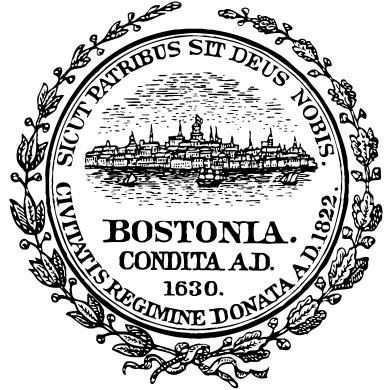
Seal of Boston — a view of the City, including the Massachusetts State House, with ships in the harbor in the foreground (official description, City of Boston).
Boston governed itself by town meeting for almost two centuries. That ended with An Act establishing the City of Boston, passed by the Massachusetts legislature on 23 February 1822 and accepted by the town's voters on 4 March. The first city government took office on 1 May under Mayor John Phillips. A corporation needs a seal, and within months the new city had one.
The reference document kept by the Boston City Council states that the seal was "designed c. 1822, adopted in 1823, and slightly modified in 1827 by changing font, adding clouds, and re-formatting the motto." It names the designer as John R. Penniman, "New England's most famous flag painter" — John Ritto Penniman (c. 1782–1841). The Boston Municipal Register places the adopting order on 2 January 1823. The city's own published account phrases the sequence differently: "adopted in 1823, first appeared publicly in 1827, and was made official in 1914" — the year of the revised ordinances into which Boston's emblems were written.
The official description of the design is spare: the seal "consists of a view of the City, including the Massachusetts State House, with ships in the harbor in the foreground." NAVA's American City Flags reads the ships as a reference to the maritime commerce on which Boston grew. One point is easily missed: as adopted, the seal has no colours of its own. The blue, white and buff in which it is almost always seen come from the flag ordinance of 1917.
SICUT PATRIBUS SIT DEUS NOBIS — "God be with us as He was with our fathers."
The motto, in the city's own translation, comes from the First Book of Kings, chapter 8, verse 57, spoken by Solomon at the dedication of the Temple. Two dates complete the legend: Bostonia Condita A.D. 1630, the founding of Boston under Governor John Winthrop, and Civitatis Regimine Donata A.D. 1822, the charter. The City Council document renders the second phrase as "City-Status Granted by the Authority of the State in 1822", NAVA as the more literal "Presented with the government of a body politic in the year of Our Lord 1822".
Where the words sit is disputed. Boston.gov gives one continuous legend; the City Council document mentions only the motto above and the 1822 phrase below; NAVA describes Bostonia / Condita A.D. / 1630 in three lines inside the disc, with the motto and the 1822 phrase on a buff ring around it. The disagreement reflects a seal redrawn more than once — in 1827, and again for the flag in 1916.
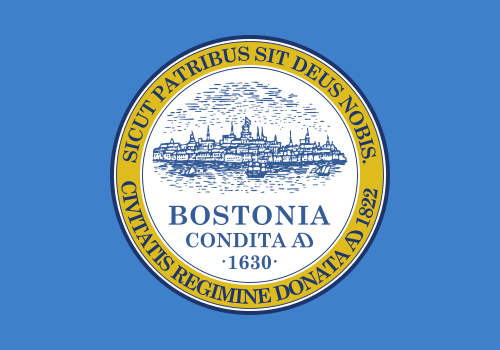
Flag of Boston — the body of the flag blue, with the official city seal in the center, and two rings of white encircling the seal (ordinance of 1917). Proportions 7:10.
Boston had no official flag until the twentieth century, and the push came from outside City Hall: on 31 August 1913 the city's Columbus Day Committee called for designs for a flag to be carried in the parade of 12 October. Entries closed on 12 September, eleven were shortlisted, and two of them were merged into one design — blue, with the city seal on the obverse and the Trimountain on the reverse. Flags on that pattern were raised for the 1913 parade and served unofficially for years.
On 16 January 1914 Mayor John F. "Honey Fitz" Fitzgerald sent the City Council a draft ordinance. It then sat. The Boston Arts Commission, which had to approve the artwork, hired the local artist Albert "Bert" Poole to draw definitive cartoons of the seal and of the Trimountain; his work was done on 20 July 1916. The Council passed the ordinance on 29 January 1917, and the printed text carries the endorsement Approved January 30, 1917 — which is why NAVA and Flags of the World date the flag to the 30th while the city's own summary says the 29th.
Who designed it is a question no source settles. NAVA records simply Designer: Unknown. The design is a committee product of the 1913 competition, drawn in final form by Poole. And on 31 May 1943 the Boston Globe credited the flag to Edward J. Leary, city messenger from 1896 to 1943 — the officer the ordinance makes custodian of the city's flags.
The body of the Standard shall be blue, as specified, with the official city seal embroidered in the center; and two rings of white shall encircle the seal. The reverse of the municipal standard shall bear a representation of the Trimountain. The city flag shall have no reverse except the seal showing through the bunting […]. The municipal standard shall have a fringe of Continental buff; the city flag to be without fringe.
That is chapter 8 of the Revised Ordinances of 1914. The silk standard is to measure five feet by three and a half — the ratio of 7:10 NAVA lists as the official proportions. Section 2 makes Continental blue and Continental buff the city's official colours; section 3 orders the flag flown on City Hall; section 5 bars commercial use and section 6 sets a fine of up to twenty dollars, still the figure the city quotes; section 7 makes the city messenger custodian of the city's flags.
The ordinance creates two objects: a bunting flag for buildings, and a silk standard with a buff fringe for parades. Only the flag exists. NAVA states that the standard was apparently never manufactured, no report, example, illustration or photograph of it having been found; Dave Martucci, who has worked on Boston's flag history for decades, publishes only an acknowledged reconstruction of the Trimountain reverse. The Trimountain — the three-peaked hill of the Shawmut peninsula (Beacon Hill, Mount Vernon and Pemberton), which survives in the name of Tremont Street — is the one element of Boston's official vexillology nobody has ever seen.
Beyond the colours and the seal in the centre, NAVA notes, the ordinance never really defines the flag — and it never defines the colours either. "Continental blue" and "Continental buff" are named after the uniforms of Boston soldiers in the Revolutionary War, and no shade was ever specified. Flags flown in the city have ranged from sky blue to near navy, City Hall itself showing two visibly different blues on two sides of the building, and the coloured flags in the Council chamber are fringed in gold rather than buff. Martucci, working from the colour plate printed in the ordinances of about 1918, puts the intended shades at roughly RGB 70-121-182 for the blue and 240-220-130 for the buff — while stating plainly that these are not the shades in common use.
The design has not aged well in professional eyes. In the North American Vexillological Association's 2004 survey of 150 United States city flags, Boston placed 133rd, scoring 2.71 out of 10: a seal carrying two lines of Latin cannot be read on moving cloth at fifty feet — the fault nicknamed a "seal on a bedsheet". Six cities that finished below Boston in 2004 have since replaced their flags. Boston has not, and as of 2019 the city said it had no plans to.
Having no official flag did not mean having none. As in many American cities, the seal on a white field served: the Bard brothers' 1876 painting of the steamship J. Putnam Bradlee shows the vessel wearing a Boston flag with an oval seal almost filling a white field, and in 1887 the Allen & Ginter cigarette company of Richmond issued a card showing the seal framed by piles of books. Whether either was ever really flown is unknown; NAVA notes that no evidence has appeared to verify or refute the cigarette-card design.
The earliest flag documented as representing the city dates from 1907, for Old Home Week. Its device was a stylised group of three hills — the Trimountain again — with bands above and below for the ocean and the rivers, issued both as a flag and as a long swallow-tailed "bannerette". The municipal departments took it in their own field colours: red for fire, blue for police, yellow for sanitation and health, green for parks and water.
Its colours are a small lesson in sourcing. Martucci first published the three hills in blue and white, on the strength of a Boston Globe article of 23 June 1907 in which five words were illegible. Obtaining a clean copy in 2019, he found the missing words — "This appropriate green emblem, with" — and corrected his own account: the hills were green.
The Latin Sicut Patribus Sit Deus Nobis is rendered by the City of Boston as "God be with us as He was with our fathers". It comes from the First Book of Kings, chapter 8, verse 57, spoken by Solomon at the dedication of the Temple.
The City Council's own reference document names John Ritto Penniman (c. 1782–1841), a Boston painter, and dates the design to about 1822. The seal was adopted in 1823 and slightly modified in 1827 by a change of lettering, the addition of clouds and a re-setting of the motto.
No single designer is agreed upon. NAVA records the designer as unknown. The design came out of the Columbus Day Committee's competition of 1913, in which two of eleven finalist entries were merged; the Boston Arts Commission then hired the local artist Albert "Bert" Poole to draw the definitive artwork, finished on 20 July 1916. A Boston Globe article of 31 May 1943 credited the city messenger Edward J. Leary with the design.
The ordinance reached the City Council on 16 January 1914 and was passed on 29 January 1917 according to the Council's own reference document; the printed ordinance carries the endorsement "Approved January 30, 1917", the date used by most vexillological sources.
The Trimountain, or Trimount, is the three-peaked hill — Beacon Hill, Mount Vernon and Pemberton — that stood on the Shawmut peninsula and gave Tremont Street its name. The 1917 ordinance requires the reverse of the silk municipal standard to bear a representation of it, but no photograph, illustration or surviving example of that reverse is known, and the standard appears never to have been made.
Because it places a detailed municipal seal, Latin lettering and all, on a plain coloured field — the pattern known as a "seal on a bedsheet", unreadable at flag-flying distance. In NAVA's 2004 survey of 150 United States city flags, Boston placed 133rd with a score of 2.71 out of 10.
Last reviewed by the Emblema Mundi editorial team on 13 September 2026.