US City
This flag was never meant to be a flag. It was drawn in 1967, by the rules and language of heraldry, as the seal of a local museum. The town adopted it three years later — and in 2019, when St. Michaels called a contest to replace it, the old flag entered and won.
Click on a country to learn more
| Town | St. Michaels, Talbot County, Maryland |
|---|---|
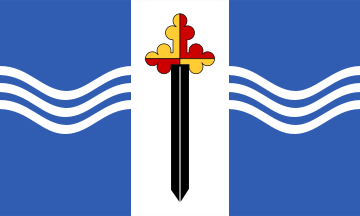
| Flag | Blue with white waves; a central white stripe bearing the sword of the Archangel Michael, its scabbard in the colours of Maryland |
| Designer | Ian C. MacCallum, 1967 |
| Adopted | 1970; re-adopted unmodified in June 2019 |
| Copyright | St. Michaels Museum at St. Mary’s Square |
Flag of St. Michaels — a blue field with white wavy lines, and a central white stripe bearing the sword of the Archangel Michael, its scabbard in the colours of the Maryland flag. The waves are the spit of land between the Miles River and San Domingo Creek; the blue recalls the sailors’ wish for “fair wind and blue water”. Drawn 1967, adopted 1970.
A blue field crossed by white wavy lines, with a white stripe down the centre bearing a sword whose scabbard is in the colours of the Maryland flag.
The town takes its name from a parish founded on the Miles River in 1672 and dedicated to Saint Michael the Archangel. The sword is his attribute — the weapon he carries in every depiction. Heraldry calls this attributive arms: a saint’s emblem is taken from the object he is always shown holding, as Saint Peter has his keys and Saint Andrew his saltire. A town named after a saint can skip the civic inventory of ships and ploughs and simply borrow its patron’s sign.
The design was drawn in 1967 by Ian C. MacCallum, in strict accord with the rules and language of heraldry, and not for the town at all: it was the seal of the St. Mary’s Square Museum. The Commissioners of the Town of St. Michaels adopted it as the town flag in 1970.
A seal turned into a flag usually fails, because seals are made to be read close up. This one works because it was drawn heraldically from the start — flat colours, few charges, no lettering, no scene — which are exactly the rules that make a device readable at a distance.
In 2019 the town held a contest for a new flag and put the finalists to a vote of residents. The winner was the flag the town already had, unmodified, and it was re-adopted as the official flag in June 2019.
The copyright is held by the St. Michaels Museum at St. Mary’s Square, where the design began, not by the town. That is closer to how heraldry has always worked than it may look: arms belong to someone, and a device that anyone may bear identifies nobody.
St. Michaels is known across the country by a nickname: “the town that fooled the British”. It is on the signs, in the guidebooks and in almost everything written about the place. It is also, almost certainly, not quite true — and it is nowhere on the flag.
In 1813 St. Michaels was a shipbuilding town, and a target because of it: its fast schooners were doing real damage to British shipping, among them the Chasseur, later called the Pride of Baltimore. Early on the morning of 10 August 1813, British barges came up the Miles River to shell the town and its harbour fort.
The tale is a lovely one. Brigadier General Perry Benson, commanding the Talbot County militia, had lanterns hoisted into the treetops beyond the town and every other light put out. The British gunners aimed at the lights, fired high, and sent their shot sailing harmlessly over the rooftops.
The town tells the story itself, and then hedges it in as many words: whether true or not. What is not in doubt is the defence. The local militia, the St. Michaels Blues, with a battery at Parrott’s Point and reinforcements from Easton, drove the attack off; a report of the time notes only that several houses were pierced by British fire.
Nothing — and the dates make that the interesting part. The nickname was coined in 1963. The flag was drawn in 1967, four years later, with the legend at the height of its popularity and a ready-made banner slogan to hand. Its designer, working by the rules of heraldry, put on it a saint’s sword, two rivers and the colours of Maryland, and left out the lanterns, the British, the militia and the battle entirely.
Most towns with a flattering story about themselves put it straight onto their emblems. St. Michaels kept its best tale for the tourists, and gave its flag the one thing that was certainly true: where the town stands, and who it is named after.
St. Michaels was incorporated in 1804, and its charter gives the town — “The Commissioners of St. Michaels” — the right to have and use a common seal, without saying what it shows. No published description of the seal could be found either, so this page does not describe it: reading an emblem off a picture is how errors enter an atlas.
No published description of the seal of St. Michaels on record yet.
Know of one — a charter section, an ordinance, a museum or archive page? Tell us on Discord.
A blue field with white wavy lines and a central white stripe bearing the sword of the Archangel Michael, its scabbard in the colours of the Maryland flag. The waves stand for the spit of land between the Miles River and San Domingo Creek.
It is the sword of the Archangel Michael, the town’s namesake, through the parish founded on the Miles River in 1672. The sword is his traditional attribute.
Ian C. MacCallum, in 1967, as the seal of the St. Mary’s Square Museum, drawn by the rules of heraldry. The town adopted it as its flag in 1970.
The St. Michaels Museum at St. Mary’s Square holds the copyright, not the town.
Probably not with lanterns. The story is that lights were hung in the treetops on 10 August 1813 so British gunners fired over the town, but the attack came at daybreak, no account of the time mentions lanterns, and the nickname “the town that fooled the British” dates from 1963. The defence itself was real: the local militia drove the attack off.
A note on method. The flag is described from the published descriptions, not from the drawing. The town seal is not described: it exists and is used, but no published account of its design was found. The lantern story is reported as folklore, with the evidence against it, as the town’s own history page does.
Last reviewed by the Emblema Mundi editorial team on 30 September 2026.