Maryland · United States
Baltimore wears the black and gold of the Calvert family, the barons for whom the city and the state of Maryland are named. At the heart of both its flag and its seal stands the Battle Monument — a memorial to the men who defended the city in September 1814, in the same battle that gave the United States its national anthem, "The Star-Spangled Banner."
Click on a country to learn more
| State | Maryland |
|---|---|
| Nicknames | The Monumental City; Charm City |
| Named after | Cecil Calvert, 2nd Baron Baltimore |
| Flag adopted | 11 February 1915 |
| Seal adopted | 1827 |
| Colours | Black and gold (Calvert) |
| NAVA flag ranking (2004) | 18th of 150 city flags |
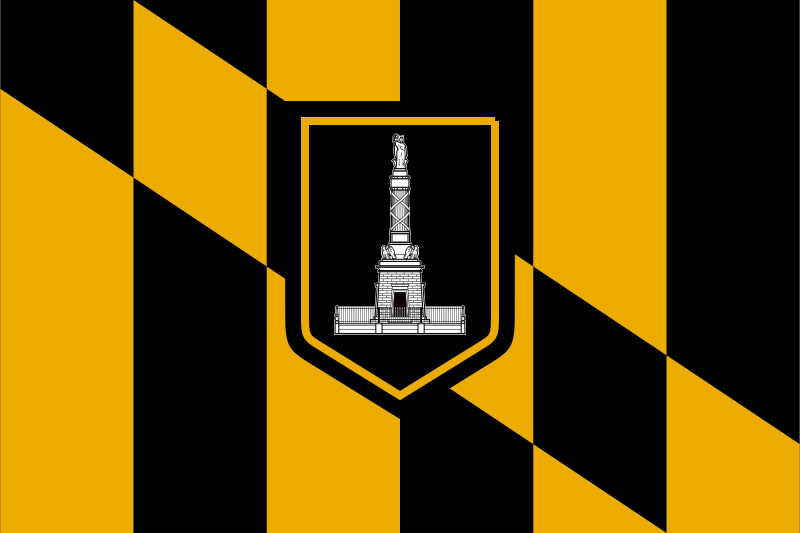
Flag of Baltimore — the Calvert black and gold, with the Battle Monument at its heart
Paly of six Or and sable, a bend counterchanged; on an inescutcheon sable, within an orle Or, a representation of Baltimore's Battle Monument argent.
The field is the black-and-gold paly-bendy of the Calvert family — the same pattern that fills two quarters of the Maryland state flag. Laid over it, on a small black shield ringed by a gold border, is a silver drawing of the Battle Monument, the memorial that stands at the centre of the city's seal as well. Flag and seal thus share a single emblem, so that the city speaks with one heraldic voice.
The flag was adopted on 11 February 1915, from a design worked out by a municipal committee that included Judge Henry Stockbridge, city librarian Wilbur F. Coyle, Carroll Lucas and the historian Hester Dorsey Richardson. In the North American Vexillological Association's 2004 survey of 150 American city flags, Baltimore's placed 18th.
The monument on Baltimore's emblems is no abstraction. In September 1814, during the War of 1812, a British army and fleet moved on the city. They were held at the Battle of North Point on land and, at sea, by the guns of Fort McHenry, which the British bombarded through the night of 13–14 September 1814. When dawn came and the fort's great garrison flag was still flying, a young lawyer named Francis Scott Key — watching from a truce ship in the harbour — was moved to write the poem that became "The Star-Spangled Banner," the national anthem of the United States. Baltimore's flag and seal commemorate that very battle.
The Battle Monument itself was begun in 1815 and finished in 1822, to a design by the French émigré architect Maximilian Godefroy. It was among the first monuments in America to name the ordinary soldiers and sailors who fell, rather than only their commanders — and it so impressed President John Quincy Adams, visiting in 1827, that he toasted Baltimore as "The Monumental City," a nickname it still carries.
The city's colours are inherited, not invented. George Calvert, 1st Baron Baltimore, and his heirs founded and governed the colony of Maryland, and their family arms — the gold-and-black paly-bendy counterchanged — became the colony's badge. Maryland is named for Queen Henrietta Maria; the city of Baltimore is named for the Calverts' Irish barony. So when Baltimore flies black and gold, it is flying the livery of the noble house that gave both the city and the state their names.
The same colours run through the famous Maryland state flag, where the Calvert quarters alternate with the black-and-white Crossland cross. Baltimore keeps only the Calvert half — and adds the Battle Monument to make the emblem its own. (Maryland's beloved blue crab, it is worth noting, is a table and tourism emblem, not a heraldic charge: it appears on neither the flag nor the seal.)
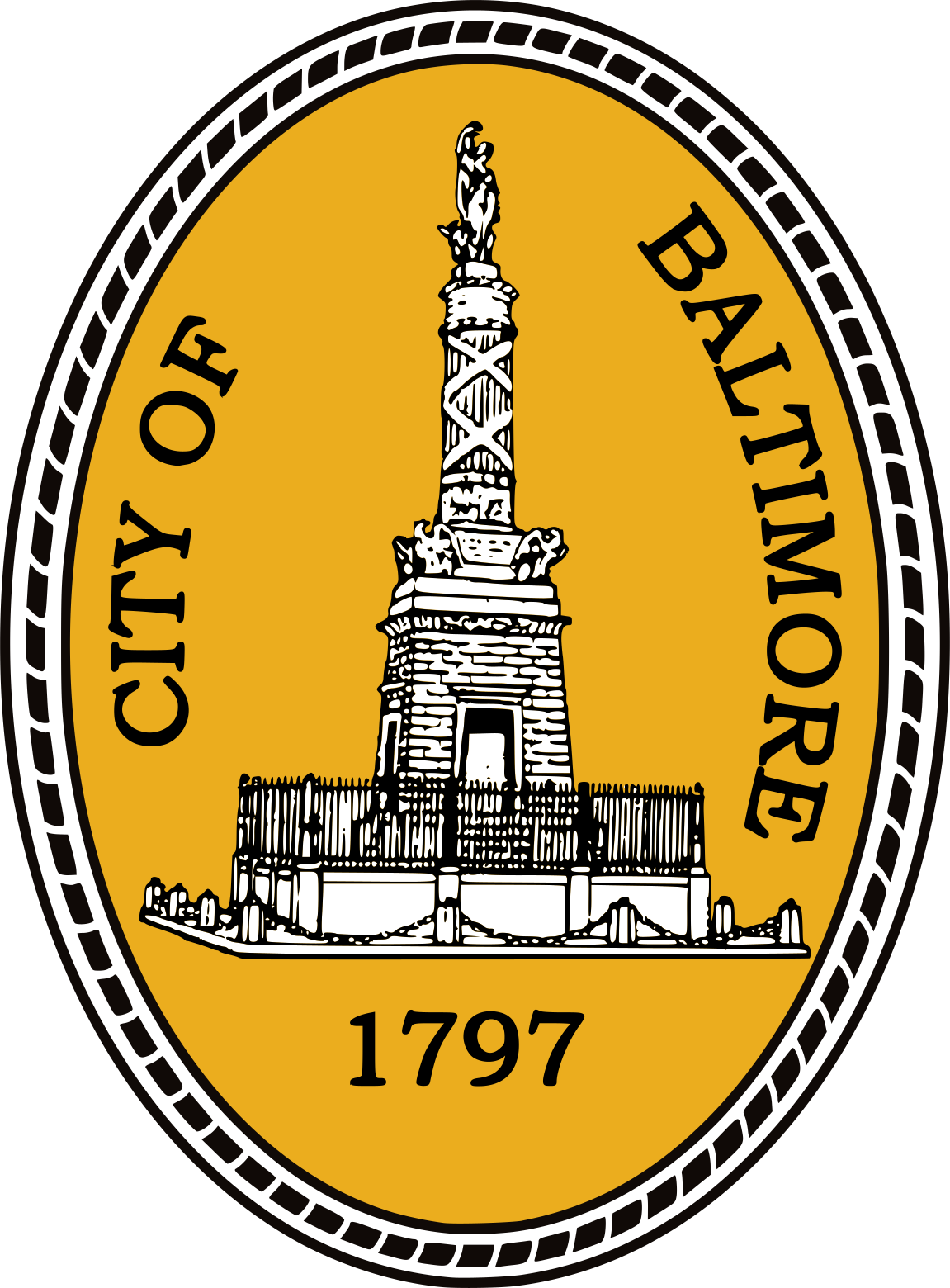
Seal of Baltimore — the Battle Monument within the legend "City of Baltimore," dated 1797
The seal is an upright ellipse. At its centre rises the same Battle Monument; around it runs the legend CITY OF BALTIMORE, and below the monument sits the date 1797, the year the city's government was organised. Like the flag, the seal is drawn in the black and gold of the Calverts.
The seal was adopted in 1827 — the same year John Quincy Adams christened the city "Monumental" — and it has represented the municipal government ever since, embossed on charters and official documents. In the 2010s the city added a modern round logo, a simplified Battle Monument between black-and-gold Calvert chevrons, for everyday use alongside the traditional seal.
Both are built around the Battle Monument, the War of 1812 memorial in central Baltimore. It stands at the heart of the flag and at the centre of the seal, making it the city's defining emblem.
Black and gold are the colours of the Calvert family — George Calvert, 1st Baron Baltimore, for whom the city is named. The same Calvert paly-bendy pattern forms part of the Maryland state flag.
The Battle Monument (1815–1822), designed by the French émigré architect Maximilian Godefroy, honours those who died defending Baltimore in September 1814. It was one of the first American monuments to name the ordinary fallen, and gave Baltimore its nickname, "The Monumental City."
During the defence of Baltimore, the British bombarded Fort McHenry on 13–14 September 1814. Watching the fort's flag still flying at dawn, Francis Scott Key wrote the poem that became "The Star-Spangled Banner," the United States' national anthem. Baltimore's flag and seal commemorate that very battle.
The flag was adopted on 11 February 1915, from a design by a committee that included Judge Henry Stockbridge, Wilbur F. Coyle, Carroll Lucas and Hester Dorsey Richardson. A 2004 NAVA survey ranked it the 18th-best of 150 American city flags.
Last reviewed by the Emblema Mundi editorial team on September 17, 2026.