US City
New Orleans has one of the most recognisable civic emblems in the United States: the fleur-de-lis, the old flower of the French crown, worn across the city on flags, jerseys and skin. It sits three times over on the city flag — three gold blooms on a white field between a red bar and a blue one — a design chosen from nearly four hundred entries and adopted on 5 January 1918, exactly two centuries after the French founded the city. The seal is older and stranger, an 1852 allegory of a reclining figure saluting the rising sun. Here is what each of them means.
Click on a country to learn more
| City | New Orleans, Louisiana; founded by the French in 1718 |
|---|---|
| Flag adopted | 5 January 1918, for the city’s bicentennial |
| Flag chosen from | Nearly 400 entries to the Citizen’s Flag Committee |
| Flag designers | Bernard Barry (colour scheme) and Gustave Couret (the fleurs-de-lis) |
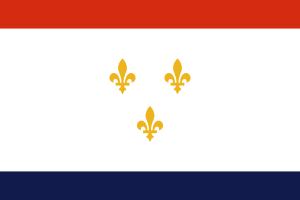
| Flag design | A white field between a red bar above and a blue bar below (a “Spanish fess”), with three gold fleurs-de-lis |
| Colours | White — justice and government; blue — liberty; red — fraternity |
| Seal adopted | 1852; redrawn several times, most recently in 2018 |
| Motto | None on record |
Flag of New Orleans — three gold fleurs-de-lis on a white field, between a red bar and a blue bar. The wide white centre between two narrow bands is what heraldry calls a Spanish fess.
New Orleans went two hundred years without an official flag. The one it finally chose was made for the anniversary itself: as the city prepared to mark two centuries since its founding by the French in 1718, a Citizen’s Flag Committee invited designs, received close to four hundred, and the City Council adopted the winner on 5 January 1918.
The design that carried the day joined two ideas from two men. Bernard Barry, an engraver at the jewellers A. B. Griswold and Co., proposed the red-white-and-blue colour scheme; Gustave Couret, a draftsman with the architects Diboll, Owen and Goldstein, proposed the three fleurs-de-lis. The Council put the two together and named the result the city flag.
The flag is a broad white field, five times the width of the two narrow bars that frame it — a red bar along the top and a blue bar along the bottom, an arrangement heralds call a Spanish fess, a quiet nod to the Spanish decades in the city’s history. The city ordinance gives the colours plain meanings: white for justice and government, blue for liberty, red for fraternity — the three ideas, and the three colours, of the flag of France. The three gold fleurs-de-lis in the centre stand, in the ordinance’s words, for New Orleans under those same principles of government, liberty and fraternity. The design has not been changed since 1918.
The flower on the flag is far older than the flag. The fleur-de-lis — a stylised lily — was the emblem of the French crown for eight centuries, and it came to Louisiana with the French: the colony was claimed for Louis XIV and named for him, and New Orleans, founded in 1718, was named for Philippe, Duke of Orléans, then regent of France. The flower has marked the city ever since, through French rule, Spanish rule, and everything after.
In the twentieth century it became something more than heritage. The New Orleans Saints took the gold fleur-de-lis as their emblem when the football club was founded in 1967, putting it on helmets seen across the country. And after Hurricane Katrina in 2005, the fleur-de-lis was taken up as the sign of the city’s survival and return — painted on ruined walls, printed on relief shirts, tattooed on arms — until it had become, more than the flag or the seal, the true emblem of New Orleans.
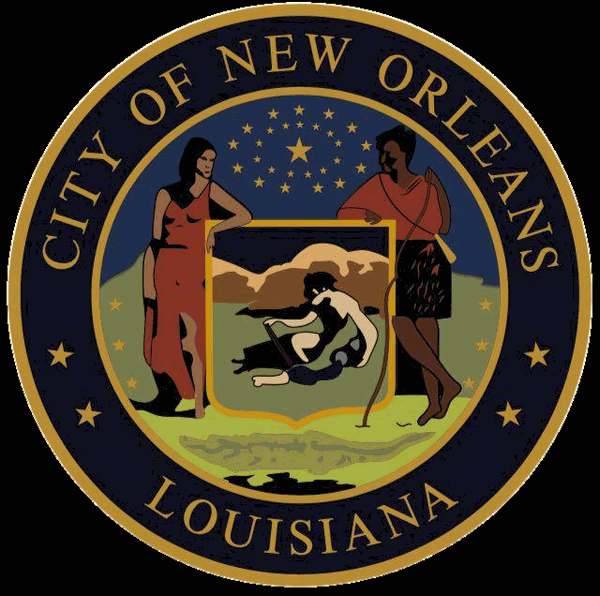
Seal of New Orleans — a reclining figure saluting the rising sun, flanked by two Native American figures, with stars above and an alligator below, ringed by the words “City of New Orleans.”
The seal is much older than the flag. It was adopted in 1852, the year the city’s three quarrelsome municipalities were reunited under a single government; Mayor A. D. Crossman was authorised that June to have a seal engraved, and it was cut and printed for sixteen dollars.
The design is a crowded allegory of the young river city. A reclining figure salutes a rising sun, with mountains and the sea behind; two Native American figures, described in a 1938 city guide as a brave and a maiden, stand on either side of a shield; twenty-five stars are grouped above, and an alligator lies below, all ringed by the words City of New Orleans. What each element was meant to say was never fully written down — even the city’s own accounts note that an explanation of the symbolism is lacking.
Unlike the flag, the seal has been altered more than once over the years, its figures, colours and form all revised. The most recent change came in 2018, when one of the two supporting figures was redrawn with darker skin, in a deliberately more inclusive version of an image first cut in the 1850s.
They stand for New Orleans under the three principles the flag’s colours name — government, liberty and fraternity. The fleur-de-lis is the old emblem of the French crown, marking the city’s founding as a French colony in 1718.
By the city ordinance, white stands for justice and government, blue for liberty and red for fraternity — the same three ideas, and the same three colours, as the flag of France.
It was adopted on 5 January 1918, chosen from nearly four hundred entries to a bicentennial flag committee. Bernard Barry proposed the colour scheme and Gustave Couret the three fleurs-de-lis; the Council combined them.
Because the city was founded by the French in 1718 and named for the Duke of Orléans, and the fleur-de-lis is the emblem of the French crown. It is on the 1918 flag, has been the New Orleans Saints’ emblem since 1967, and became a citywide sign of recovery after Hurricane Katrina in 2005.
First adopted in 1852, it shows a reclining figure saluting the rising sun, two Native American figures flanking a shield, twenty-five stars above and an alligator below, ringed by the words “City of New Orleans.” It has been redrawn several times, most recently in 2018.
Last reviewed by the Emblema Mundi editorial team on 13 September 2026.