US City
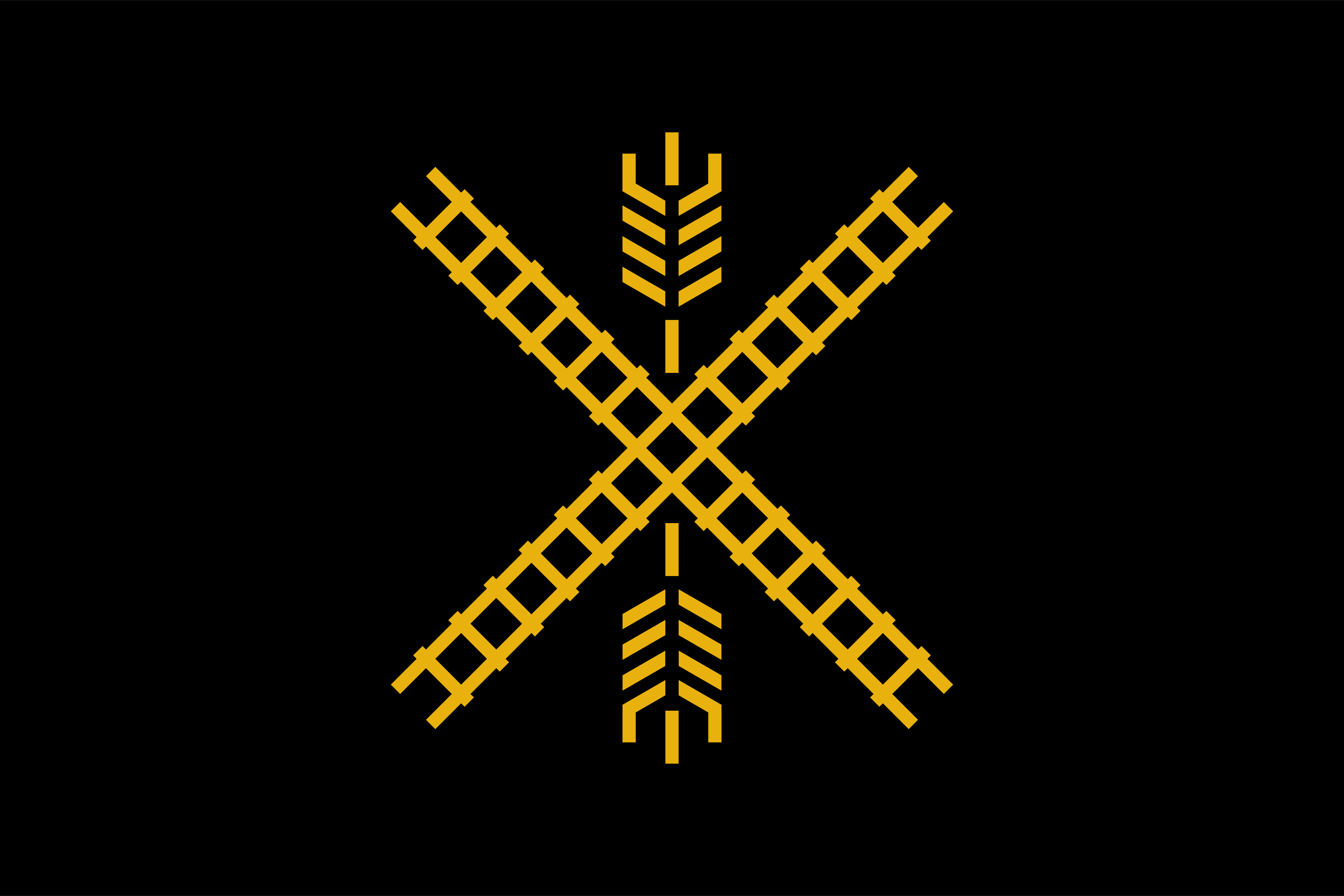
Newton calls its flag “trains and grains”: crossed railroad tracks and wheat, in gold on black. It looks like two subjects side by side. It is really one story: the railway came first, and it brought the settlers who brought the wheat.
Click on a country to learn more
| City | Newton, Kansas |
|---|---|
| Flag | Crossed railroad tracks and wheat, in gold on black |
| Designer | Brandon Eck, 2017 |
| Adopted | 13 October 2020, by the Newton City Commission |
| Colours | Black for the railroad, gold for wheat |
| NAVA 2023 survey | Grade A, among the top 25 city flags adopted in the previous eight years |
Flag of Newton — crossed railroad tracks and stalks of wheat, in gold on a black field. Black for the railroad, gold for wheat, the two industries that have shaped Newton since its founding. Designed by Brandon Eck; adopted 13 October 2020.
Crossed railroad tracks and stalks of wheat, in gold on a black field. There is no seal, no lettering and no date.
Railroad and wheat are, in the city’s words, the two industries that have shaped Newton since its founding, and the crossing stands for Newton as a crossroads, a place where cultures meet to make a community. Black and gold are also the colours of Newton High School.
The two charges are not two separate subjects. The Atchison, Topeka and Santa Fe Railway reached Newton in 1871, and the town was laid out on its line — it is even named after Newton, Massachusetts, home of some of the railway’s stockholders. For a few years it was the railhead where Texas cattle from the Chisholm Trail were loaded.
The railway also owned land, and needed farmers to buy it. In the 1870s it drew thousands of Mennonites, German-speaking settlers from the Russian Empire, with the help of Bernhard Warkentin, a Mennonite miller working with the Santa Fe as an immigration agent. They brought with them hard winter wheat seed, remembered as Turkey Red: sown in autumn, it used the Kansas winter moisture better than the spring wheat grown before, and it made Kansas a wheat state.
So the flag reads in order. The rails came first; the wheat came by the rails.
The design was drawn in 2017 by Brandon Eck, a native of Newton, won the public competition of the Newton Flag Project, and was adopted by the City Commission on 13 October 2020. The city states that it is not copyrighted: anyone may use, copy, modify and share it.
No published description of a city seal of Newton could be found, so none is described here: reading an emblem off a picture is how errors enter an atlas.
No published description of the seal of Newton on record yet.
Know of one — an ordinance, a code section, a city archive page? Tell us on Discord.
The crossed railroad tracks and the wheat stand for the two industries that have shaped Newton since its founding. Black represents the railroad and gold represents wheat; the crossing stands for Newton as a crossroads where cultures meet.
It is the nickname for its two charges, the railroad and the wheat. The two are linked: the Santa Fe railway brought the Mennonite settlers who introduced hard winter wheat to the area in the 1870s.
Brandon Eck, a native of Newton, in 2017. The design won the Newton Flag Project competition and was adopted by the City Commission on 13 October 2020.
Yes. The city states that the flag is not copyrighted: anyone may use, copy, modify and share it.
A note on method. The flag is described from the city’s own published description, not from the drawing. No city seal is described, because no published description of one was found.
Last reviewed by the Emblema Mundi editorial team on 30 September 2026.