US City
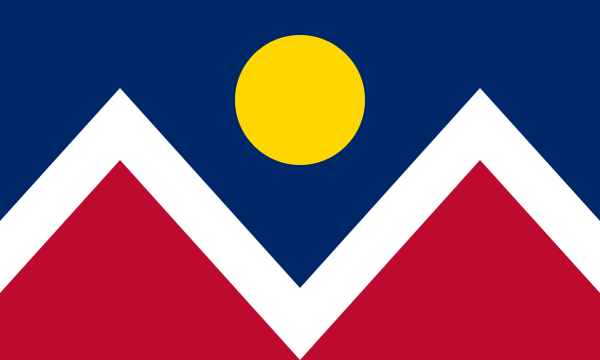
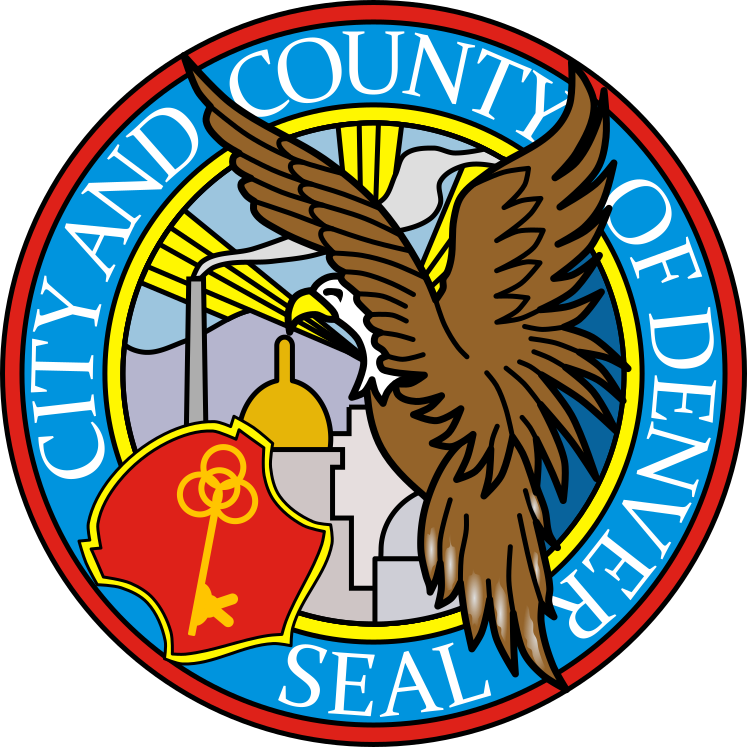
Denver’s seal and flag show the same thing: the sun over the mountains. The seal of 1901 draws it the way a painter would — the Front Range, the setting sun and its rays, the Capitol dome. The flag of 1926, the work of a high-school student, says it with four shapes: a gold disc, a white zigzag, blue above and red below.
Click on a country to learn more
| City | Denver, Colorado — state capital |
|---|---|
| Flag | Blue above, red below, divided by a white zigzag, a gold disc at the centre; adopted 1926 |
| Flag designer | Margaret Overbeck, a student at North High School |
| Seal | 1901, by Henry Read — an eagle, a shield with a key, the Capitol dome, mountains and the setting sun |
| Key on the seal | Denver as the key to the Rocky Mountains |
| NAVA 2004 survey | 3rd of 150 United States city flags |
Flag of Denver — blue above and red below, divided by a wide white zigzag, with a gold disc at the centre of the blue. The sky, the mountains, the red earth that gave Colorado its name, and the sun and gold of its hills. Adopted 1926.
A dark blue field above, red below, divided by a wide white zigzag shaped like an outspread M, with a gold disc in the centre of the blue.
The flag came out of a contest sponsored by the Sons of the American Revolution with the city council, and judged by the Denver Art Commission. The winner was Margaret Overbeck, a student at North High School, and her design became the city flag in 1926.
Seal of the City and County of Denver — an eagle with outstretched wings, below it an ornamental shield bearing a key, above the shield a smokestack, the dome of the State Capitol and other buildings, mountains behind and the setting sun. Designed by Henry Read, 1901.
The municipal code describes the corporate seal of the City and County of Denver in a single sentence:
A device in circular form, with an eagle with outstretched wings occupying the upper and right-hand portion of the field; below and in the left an ornamental shield bearing upon it a key; above the shield a smokestack, the dome of the State Capitol and other buildings, with mountains forming a background and partly concealed, and the setting sun with radiating beams of light.
The ring around it reads City and County of Denver and Seal. It was designed by the Denver artist Henry Read in 1901.
Put the two emblems side by side and they describe the same place. The seal of 1901 paints it: the Front Range in the background, the sun setting behind it with its rays across the sky. The flag of 1926 keeps the same view and throws away everything that cannot be seen from a distance — the mountains become one white line, the sun one gold disc, the sky and the earth two fields of colour. It is the difference between a seal, made to be read up close on a document, and a flag, made to be read across a street.
The gold disc stands for the sun and the gold in Colorado’s hills, and sits at the centre as Denver sits at the centre of the state. The blue is the sky, the white zigzag the mountains, and the red the red earth that gave Colorado its name.
Margaret Overbeck, a student at North High School, whose design won a city flag contest and was adopted in 1926.
An eagle with outstretched wings, an ornamental shield bearing a key, a smokestack, the dome of the State Capitol and other buildings, mountains in the background and the setting sun, within a ring reading City and County of Denver and Seal.
It presents Denver as the key to the Rocky Mountains, and stands for the hospitality the city offers its visitors.
A note on method. Both emblems are described from the municipal code and the published descriptions, not from the drawing. Some accounts treat the smokestack and the mountains as elements of earlier renderings of the seal; this page follows the wording of the code, which still includes them.
Last reviewed by the Emblema Mundi editorial team on 30 September 2026.