Autonomous Community
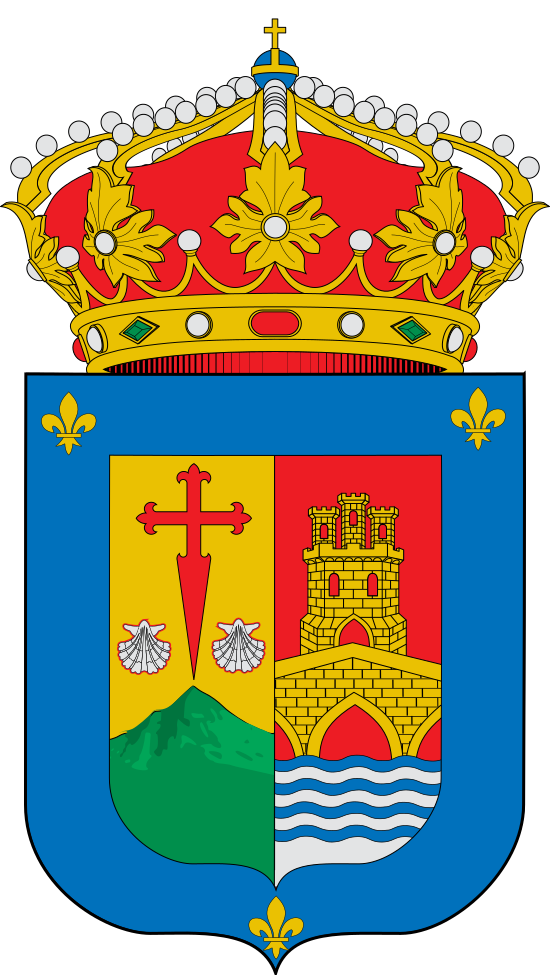
La Rioja is a small autonomous community in northern Spain, one of the country's single-province regions. Bordered by the Ebro River to the north, it is internationally renowned as Spain's most celebrated wine-producing region. Formerly the Province of Logroño, it became its own autonomous community in 1982, taking the name La Rioja from the Río Oja, a tributary of the Najerilla river. Its emblems look instead to the Camino de Santiago and the river Ebro: a red Cross of Santiago rising over Mount Laturce between two pilgrims' shells, beside a golden castle set on a river-bridge.
Flag
Not available
Coat of Arms
Not available
| Autonomous Community | La Rioja |
|---|---|
| Capital | Logroño |
| Area | 5,045 km² |
| Official language | Spanish |
| Statute of Autonomy | 1982 |
| Location | Northern Spain, Ebro valley |
Coat of Arms — official arms of La Rioja, set by Law 4/1985
Party per pale, ensigned with a closed royal crown. Dexter, on a field Or, the red Cross of Santiago rising over Mount Laturce, flanked by two silver pilgrims' scallop shells; sinister, on a field gules, a gold castle of three towers upon a bridge, beneath which flows a river argent. Within a bordure charged with three fleurs-de-lis.
The two halves of the shield tell two stories. The dexter (gold) half belongs to the Camino de Santiago: the red Cross of Santiago rises over Mount Laturce — the traditional site of the legendary Battle of Clavijo, where Saint James was said to have appeared — while the two silver veneras (pilgrims' scallop shells) stand for the countless pilgrims who cross La Rioja on the road to Santiago de Compostela.
The sinister (red) half carries the region's own device: a golden castle on a bridge spanning a silver river. The castle is the recurring emblem of La Rioja — nearly every one of its historic judicial districts bears one — and the bridge and river evoke the Ebro and its crossings. The shield is framed by a bordure of three fleurs-de-lis and topped by the closed royal crown.
The arms were fixed by the Riojan law of identity signs (Ley 4/1985), though the design had already been used by the Province of Logroño since 1957. La Rioja became a single-province autonomous community by its Statute of Autonomy of 1982; there is no castle of Castile, lion of León or chains of Navarre in its arms — the shield speaks instead of the pilgrim road and the Ebro.
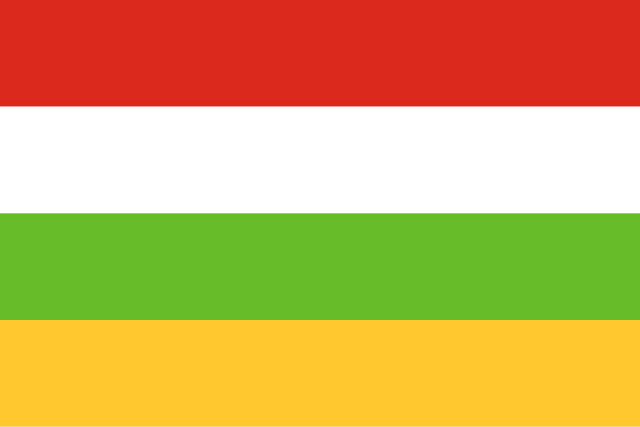
Flag of La Rioja — four horizontal bands: red, white, green, yellow, with coat of arms
The flag of La Rioja consists of four equal horizontal bands — red at the top, then white, green, and yellow at the bottom — with the coat of arms of La Rioja shown in the centre of the flag.
It was first sanctioned in 1979 by the governing body of the then Province of Logroño and formalized by the Statute of Autonomy of La Rioja of 1982, which specifies the four bands of equal size.
The precise symbolic meaning of the four colors is not officially codified, though they are sometimes associated with the historical counties and natural landscapes of the region, as well as with its viticultural wealth (green for vineyards, yellow for grain, red for wine, white for clarity).
The flag of La Rioja has four equal horizontal bands in red (top), white, green, and yellow (bottom), with the coat of arms shown in the centre of the flag. It was formalized by the Statute of Autonomy of 1982.
The four colors — red, white, green, and yellow — are specified by the Statute of Autonomy. Their precise symbolic origins are debated; they are informally linked to the region's landscapes and agricultural identity as Spain's premier wine-producing region.
The shield is party per pale under a closed royal crown. The gold half shows the red Cross of Santiago over Mount Laturce between two pilgrims' scallop shells; the red half shows a gold castle on a bridge over a silver river. A bordure carries three fleurs-de-lis. The design was fixed by the Riojan law of identity signs (Ley 4/1985).
The flag was first sanctioned in 1979 by the governing body of the Province of Logroño, and officially formalized by the Statute of Autonomy of La Rioja in 1982.
Yes. La Rioja is one of Spain's single-province autonomous communities. Formerly called the Province of Logroño, it became its own autonomous community in 1982, taking its name from the Río Oja that characterizes the region.
Last reviewed by the Emblema Mundi editorial team on September 17, 2026.