Autonomous City
Ciudad de Ceuta is one of Spain's two autonomous cities (ciudades autónomas), on the North-African shore of the Strait of Gibraltar. Though it sits on the African continent, Ceuta is part of Spain and the European Union. Its emblems tell a Portuguese story: taken by Portugal in 1415, the city still bears the arms of Portugal — the five blue quinas within a bordure of gold castles — and flies the white-and-black gyronny of Lisbon. Both were kept unchanged after Ceuta passed to the Spanish Crown in 1668.
Click on a country to learn more
| Status | Autonomous City of Spain |
|---|---|
| Location | Northern Africa, Strait of Gibraltar |
| Statute of Autonomy | 1995 |
| Under Portugal | 1415–1668 |
| Under Spain | Since 1668 (Treaty of Lisbon) |
| Bordering country | Morocco |
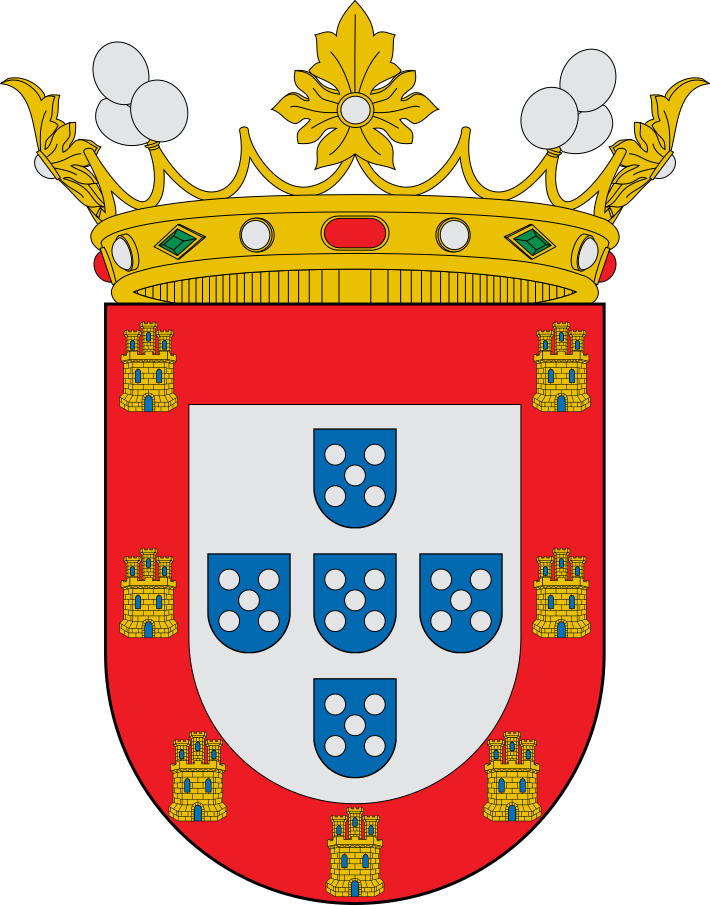
Coat of Arms of Ciudad de Ceuta — the arms of Portugal: five blue quinas within a bordure of gold castles, under a marquis's coronet
Argent, five escutcheons in cross azure, each charged with five plates in saltire (the Portuguese quinas), within a bordure gules charged with seven castles or — two in chief, one in each flank, and three in base. The shield is ensigned with the coronet of a marquis.
The arms of Ceuta are, almost exactly, the arms of the Kingdom of Portugal. The city was taken by King John I of Portugal on 21 August 1415, and it kept its Portuguese arms even after passing to the Spanish Crown in 1668. The five blue escutcheons set in cross — the quinas, each charged with five silver roundels — are the historic emblem of Portugal; the red bordure carries seven golden castles. Ceuta differs from Portugal's shield only in the arrangement of the castles: the one that sits on the chief of Portugal's border is moved down to the point of Ceuta's shield. Above the shield sits not a royal crown but the coronet of a marquis — the rank historically given to the governors of frontier marches such as Ceuta.
Note what is not there. Despite Ceuta's old nickname as the "key of the Strait," no key appears in its heraldry — the castle-and-key arms belong to Gibraltar, across the water, not to Ceuta. Nor is there any castle of Castile: the castles on Ceuta's shield are the Portuguese ones of its bordure.
Ceuta's strategic position on the Strait of Gibraltar made it coveted throughout history. It was conquered by Portugal in 1415 — part of the same era of Atlantic expansion that would open the Age of Discovery — and passed to Spain in 1668, when the Treaty of Lisbon confirmed Spanish sovereignty following Portugal's restoration of independence in 1640. Ceuta's inhabitants had themselves chosen to stay loyal to the Spanish king Felipe IV in 1640. In 1995, Ceuta received its Statute of Autonomy, becoming one of Spain's two autonomous cities.
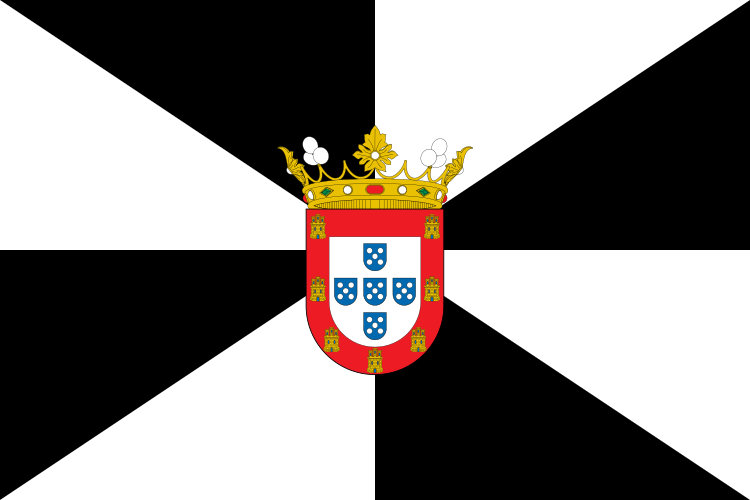
Flag of Ciudad de Ceuta — the white-and-black gyronny of Lisbon, charged with the city's arms
The flag of Ceuta is a gyronny of white and black — a field radiating from the centre in alternating triangular sections — with the municipal coat of arms placed at its heart. This gyronny is identical to the flag of Lisbon, also known as the flag of Saint Vincent, and Ceuta flies it for a precise reason: it was the first flag raised over the city when the Portuguese conquered it in 1415. The civil version of the flag shows only the black-and-white gyronny, without the shield.
Though the design is six centuries old in spirit, the flag was only given official form recently: the current flag of Ceuta was formally adopted on 13 March 1995, the same year the city received its Statute of Autonomy.
Ciudad de Ceuta is a Spanish autonomous city on the northern coast of Africa, facing the Strait of Gibraltar. It is politically part of Spain and the EU, despite being geographically on the African continent. It became an autonomous city in 1995.
The arms of Ceuta are almost identical to the arms of Portugal: five blue escutcheons (the quinas) on a silver field, within a red bordure of seven gold castles, under a marquis's coronet. Ceuta received the Portuguese arms after its conquest by King John I of Portugal in 1415 and kept them even after passing to Spain in 1668. There is no key and no Castilian castle in the arms.
Ceuta is geographically located on the African continent but is politically part of Spain and the European Union, lying on the southern shore of the Strait of Gibraltar.
Ceuta came under Portuguese control in 1415, then passed to Spain in 1668 following the Treaty of Lisbon, when Portugal recognized Spanish sovereignty after its own restoration of independence in 1640.
The flag of Ceuta is a white-and-black gyronny — the same design as the flag of Lisbon (also called the flag of Saint Vincent) — with the city's coat of arms in the centre. It recalls that the Portuguese were the first to raise a flag over Ceuta when they conquered it in 1415. The current flag was officially adopted on 13 March 1995.
Last reviewed by the Emblema Mundi editorial team on September 16, 2026.