Oblast — Federal Subject of Russia
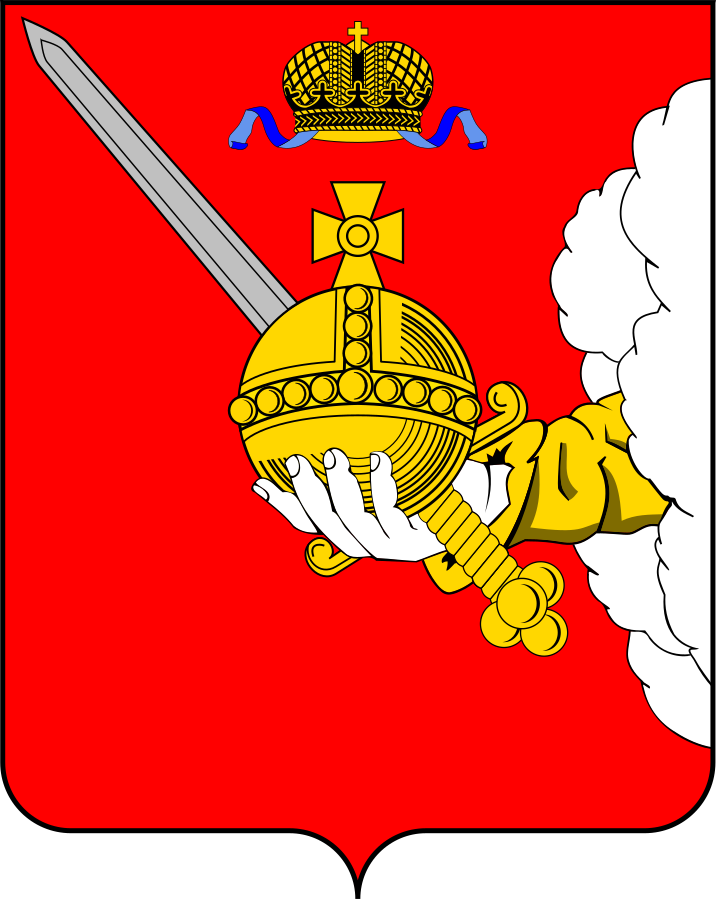
The coat of arms of Vologda Oblast (Герб Вологодской области) shows an armoured arm issuing from a cloud, holding an upright sword, with two crossed staves on a golden field. Derived from the historical arms of the city of Vologda, the emblem reflects a region that was once a pivotal node on Russia’s medieval trade route between Moscow and Arkhangelsk, and home to some of the finest Orthodox monasteries in the north.
Flag
Not available
Coat of Arms
Not available
| Status | Oblast (federal subject of Russia) |
|---|---|
| Capital | Vologda |
| Area | 144,527 km² |
| Founded | 1937 (Vologda Oblast); city of Vologda founded c. 1147 |
| Coat of arms adopted | 1780 (original); restored 26 April 2006 |
| Known for | Vologda lace, Vologda butter, Kirillo-Belozersky Monastery |
Coat of Arms of Vologda Oblast — Coat of Arms of Vologda Oblast — Or, an arm in armour issuing from clouds holding a sword Argent; two crossed staves Or. Restored 26 April 2006.
Or, an arm in armour couped, issuing from clouds in the dexter flank Argent, the hand holding a sword erect Argent, hilted Or; in base two staves in saltire Or.
The arms of Vologda Oblast are derived from the historical arms of the city of Vologda. The armoured arm from a cloud is a common device in Russian provincial heraldry, representing divine or royal authority descending from heaven. The upright sword signifies justice and protection. The two crossed staves at the base evoke the religious and pilgrimage traditions of Vologda, a major centre of Russian Orthodoxy with dozens of monasteries.
| Colour | Heraldic name | Element | Traditional symbolism |
|---|---|---|---|
| Gold | Or | Field, staves, hilt | Prosperity, the golden trade route through Vologda |
| Silver | Argent | Arm, sword, clouds | Divine justice, the power of faith and law |
In the 16th and 17th centuries, Vologda was one of the most important commercial cities of Russia, sitting on the trade route between Moscow and Arkhangelsk — Russia’s main seaport before Saint Petersburg. English merchants of the Muscovy Company maintained warehouses here, and Ivan IV (Ivan the Terrible) considered making Vologda his northern capital, beginning construction of a kremlin. The project was abandoned after bricks fell on the tsar during an inspection, which he took as a bad omen.
The region is dotted with some of the finest examples of Russian Orthodox monastery architecture, above all the Kirillo-Belozersky Monastery (founded 1397), one of the largest monasteries in medieval Russia, where Ivan the Terrible’s sons were tonsured. Vologda is also renowned for Vologda lace — a traditional bobbin lace with floral and geometric patterns, produced since the 17th century.
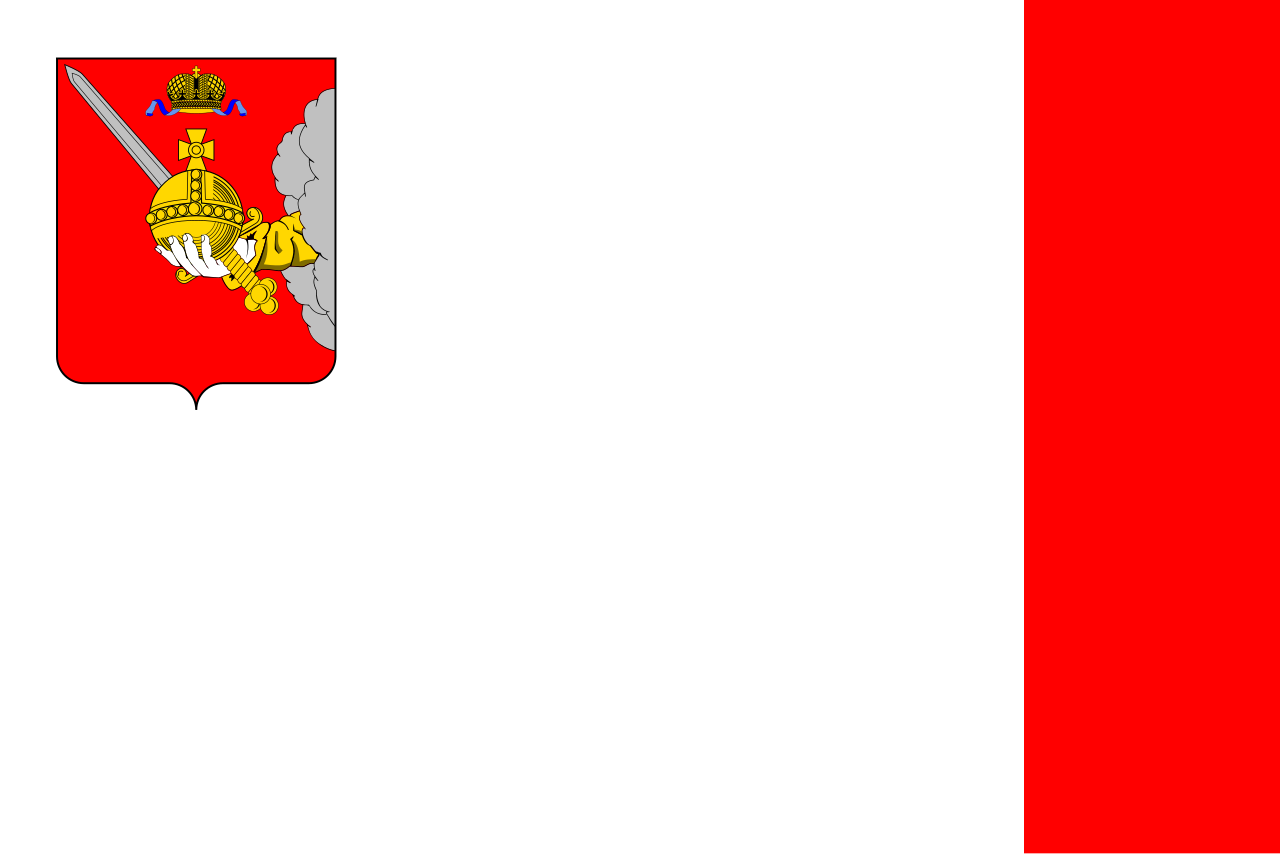
Flag of Vologda Oblast — Flag of Vologda Oblast — Red field bearing the coat of arms in gold. Adopted 26 April 2006.
The flag of Vologda Oblast is a red rectangle bearing the coat of arms — the armoured arm with sword and staves — in gold. Adopted on 26 April 2006, the red field gives a bold, recognisable appearance. The combination of red and gold is traditional in Russian provincial heraldry.
The armoured arm issuing from a cloud is a heraldic motif representing divine or royal authority descending from heaven to dispense justice. The upright sword reinforces this meaning. In the Vologda arms, it expresses the importance of the region as a seat of both religious and political authority in medieval northern Russia.
Ivan IV considered making Vologda his northern capital and began building a kremlin there in the 1560s. He reportedly abandoned the project after a brick fell on him during an inspection, which he interpreted as a divine warning. Had he succeeded, Vologda might have become a major imperial capital.
Vologda lace is a traditional Russian bobbin lace produced in the Vologda region since at least the 17th century. It is characterised by continuous thick thread outlines forming floral and geometric patterns on a mesh ground. It became internationally famous in the 19th century and remains a protected geographical designation.
Founded in 1397 by the monk Kirill (Cyril) of Belozersk on the shore of Lake Siverskoye, it grew into one of the largest monasteries in medieval Russia. It served as a place of exile for political prisoners (including Patriarch Nikon), and Ivan the Terrible sent his sons there to be tonsured.
Yes — Vologda butter (Вологодское масло) is a famous Russian speciality, a high-fat butter with a distinctive nutty flavour. It has been produced since the 19th century and holds a protected denomination of origin in Russia.
Last reviewed by the Emblema Mundi editorial team on 3 July 2026.