Federal City of Russia
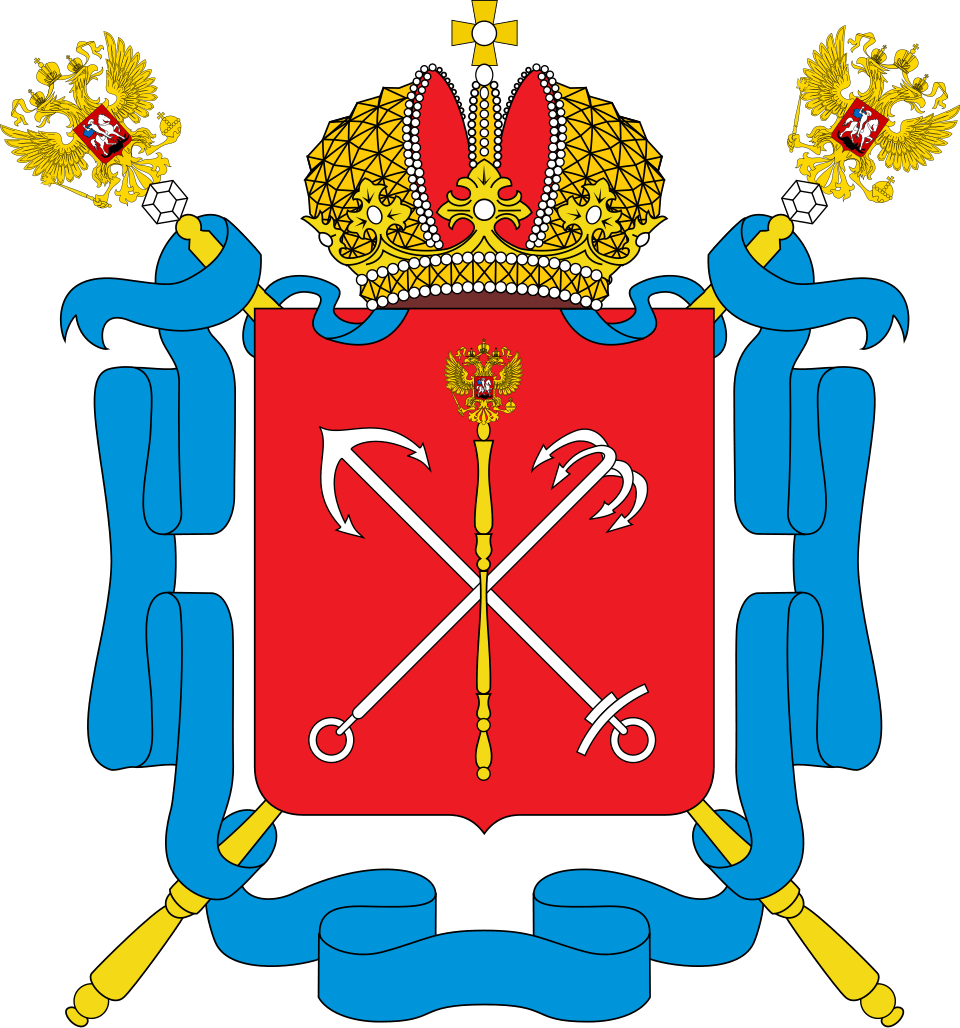
The coat of arms of Saint Petersburg (Герб Санкт-Петербурга) displays on a golden field the imperial sceptre Azure surmounted by a double-headed eagle Sable, with two crossed anchors — gold for river navigation, silver for the sea — in base. The arms encode the city’s dual identity as the seat of imperial power and Russia’s gateway to the Baltic.
Flag
Not available
Coat of Arms
Not available
| Status | Federal city (subject of the Russian Federation) |
|---|---|
| Founded | 27 May 1703 by Pyotr Velikiy |
| Capital | Saint Petersburg (self) |
| Area | 1,439 km² |
| Coat of arms adopted | 1730 (original grant); restored 16 January 1991 |
| Name history | Petrograd (1914–1924), Leningrad (1924–1991), Saint Petersburg (1991–present) |
Coat of Arms of Saint Petersburg — Coat of Arms of Saint Petersburg — Or, a sceptre Azure surmounted by a double-headed eagle Sable; crossed anchors Or and Argent. Granted 1730; restored 16 January 1991.
Or, a sceptre Azure surmounted by a double-headed eagle Sable; in base two anchors in saltire, the dexter Or and the sinister Argent.
The arms of Saint Petersburg are dominated by the imperial sceptre Azure crowned with the Romanov double-headed eagle — symbolising that this city is the seat of imperial power — crossed below by two anchors. The golden field reflects the city’s status as the imperial capital, a city of light and wealth founded on the marshes of the Neva delta.
| Colour | Heraldic name | Element | Traditional symbolism |
|---|---|---|---|
| Gold | Or | Field, gold anchor | Imperial dignity, the wealth of the maritime capital |
| Blue | Azure | Sceptre | Loyalty, the imperial power of the tsars |
| Black | Sable | Double-headed eagle | The Romanov imperial eagle, sovereignty |
| Silver | Argent | Silver anchor | The sea, naval power, purity |
The gold anchor traditionally represents river navigation (the Neva and Russian inland waterways), while the silver anchor represents maritime navigation (the Gulf of Finland and Baltic Sea). Together they express Saint Petersburg’s dual role as Russia’s gateway to the Baltic — the city Pyotr Velikiy built precisely to give Russia its “window to Europe.”
1703. Pyotr Velikiy founds Sankt Peterburg on 27 May, on islands at the mouth of the Neva.
1712. Peter moves the capital from Moscow to Saint Petersburg, making it the seat of the Romanov empire for over two centuries.
1730. The coat of arms is officially granted — sceptre, eagle, and anchors on gold.
1914. At the outbreak of World War I, the city’s German-sounding name is russified to Petrograd.
1924. After Lenin’s death, the city is renamed Leningrad. The historical arms are suppressed.
1941–1944. The Siege of Leningrad — 872 days of German encirclement, one of the deadliest in history, with over one million civilian deaths.
1991. Following a referendum, the city restores the name Saint Petersburg and its historical coat of arms on 16 January 1991.
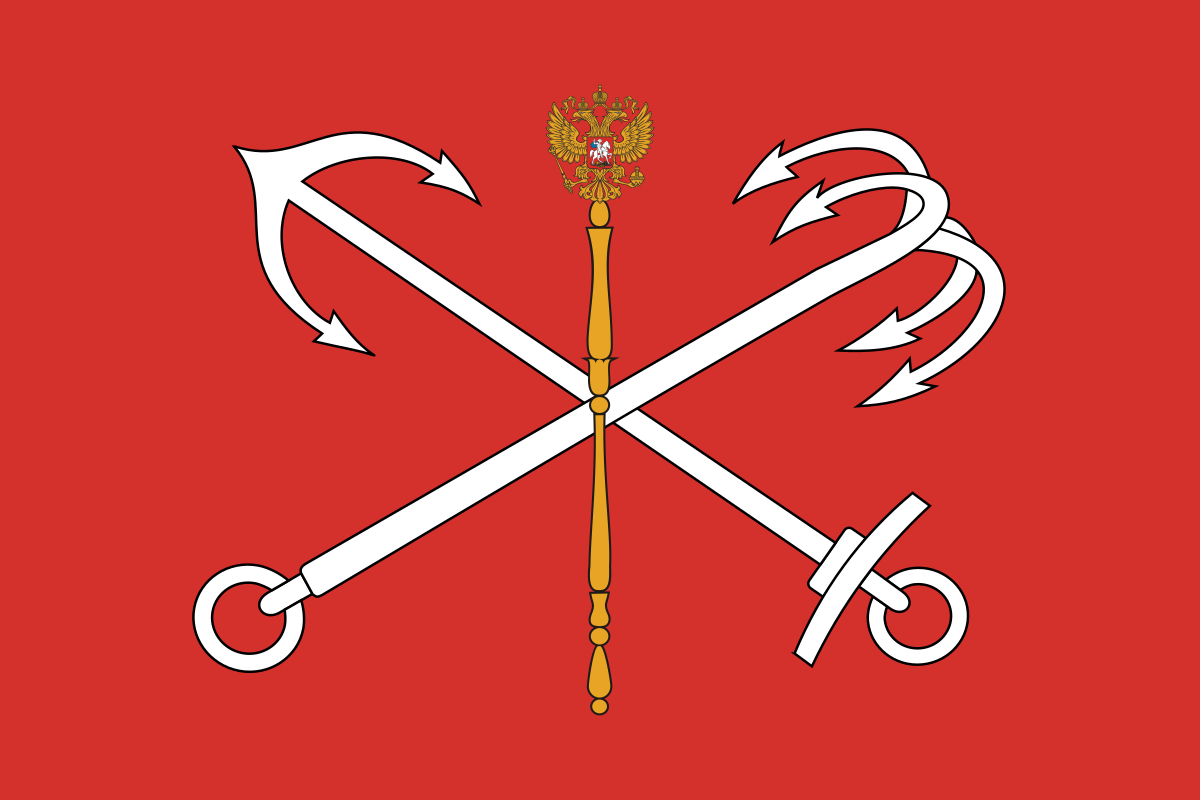
Flag of Saint Petersburg — Flag of Saint Petersburg — Red field bearing the coat of arms. Adopted 6 September 1991.
The flag of Saint Petersburg is a red rectangle bearing the city coat of arms in the centre. The red field recalls the Soviet-era Leningrad banner and connects to the revolutionary heritage of the city (the 1905 uprising, the February and October revolutions of 1917 both erupted here), while the arms restore the pre-Soviet heraldic identity. It was adopted on 6 September 1991, shortly after the city voted to restore its historical name.
The gold anchor represents river navigation (the Neva and Russia's inland waterways), while the silver anchor represents maritime navigation (the Baltic Sea). Together they express Saint Petersburg's role as Russia's maritime gateway to Europe, which was Pyotr Velikiy's explicit purpose in founding the city in 1703.
The sceptre surmounted by the double-headed eagle symbolises that Saint Petersburg was the seat of imperial power — the capital of the Russian Empire from 1712 to 1918. No other Russian city bears the imperial sceptre on its arms, reflecting Saint Petersburg's unique historical status as the Romanov capital.
On 12 June 1991, the citizens of Leningrad voted in a referendum to restore the historical name Saint Petersburg. The change took effect on 6 September 1991, following the failed coup attempt against Gorbachev and the collapse of Soviet power.
From 8 September 1941 to 27 January 1944, the city (then Leningrad) was besieged by German and Finnish forces. Over 872 days, more than one million civilians died, mainly from starvation. The Siege of Leningrad is among the most devastating urban sieges in history. The city was awarded the title of Hero City in 1945.
No. Moscow was the capital of the Tsardom of Russia until 1712, when Pyotr Velikiy moved the capital to his newly built city of Saint Petersburg. The capital remained there until 1918, when the Bolshevik government transferred it back to Moscow, fearing a German advance on Petrograd.
Last reviewed by the Emblema Mundi editorial team on 3 July 2026.