Republic — Federal Subject of Russia
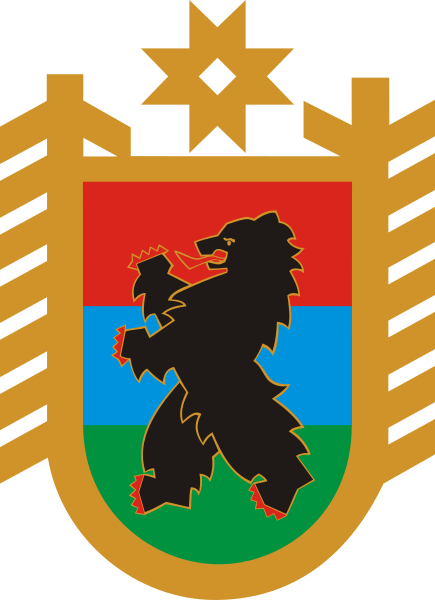
The coat of arms of the Republic of Karelia (Герб Республики Карелия) shows a golden bear rampant on a red field, armed and langued Azure. Restored in 1993 after the dissolution of the Soviet Karelian-Finnish SSR, the arms evoke the vast taiga of this lake-studded republic on the Finnish border and connect it to the pan-Nordic bear tradition.
Flag
Not available
Coat of Arms
Not available
| Status | Republic (federal subject of Russia) |
|---|---|
| Capital | Petrozavodsk |
| Area | 180,520 km² |
| Founded | 1920 (Karelian Labour Commune); republic status 1956 |
| Coat of arms adopted | 6 April 1993 |
| Border | Finland (west), Murmansk Oblast (north), Arkhangelsk Oblast (east) |
Coat of Arms of Republic of Karelia — Coat of Arms of the Republic of Karelia — Gules, a bear rampant Or, armed and langued Azure. Adopted 6 April 1993.
Gules, a bear rampant Or, armed and langued Azure.
The arms of Karelia feature a golden bear rampant on a red field — a reference to the vast taiga wilderness of this lake-studded republic on the Finnish border. The bear is a pan-Nordic heraldic symbol: it appears on the arms of Finland, Sweden’s historic provinces, and now Karelia, reflecting the shared cultural and ecological identity of the boreal north. The blue claws and tongue (armed and langued Azure) add a colour that evokes the 60,000+ lakes of the republic.
| Colour | Heraldic name | Element | Traditional symbolism |
|---|---|---|---|
| Red | Gules | Field | Courage, the blood of those who defended Karelia |
| Gold | Or | Bear | Strength, the wilderness of the northern taiga |
| Blue | Azure | Claws, tongue | The lakes and rivers — Karelia has over 60,000 lakes |
Karelia has been a contested borderland for centuries. Under Swedish and then Finnish rule for much of its history, it was divided between Finland and Russia by the Treaty of Tartu (1920), then largely annexed by the USSR after the Winter War (1939–1940) and the Continuation War (1941–1944). The Finnish-speaking Karelians were evacuated to Finland; the Soviet republic was repopulated with Russians and other Soviet peoples. The republic’s bear coat of arms — shared in spirit with Finland’s own bear arms — reflects this unresolved historical duality.
Karelia is the homeland of the Kalevala, the Finnish national epic compiled by Elias Lönnrot in 1835 from oral poetry collected in the Karelian forests. The epic made Karelia the symbolic heartland of Finnish national identity. The Kalevala’s landscapes — the lakes, the forests, the bear — are encoded in the republic’s arms.
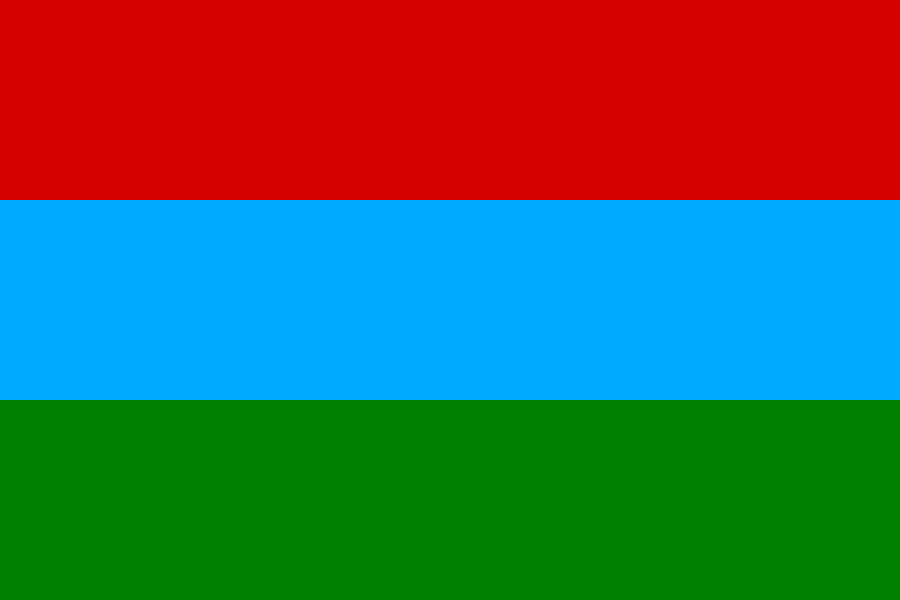
Flag of Republic of Karelia — Flag of the Republic of Karelia — Blue, red and green horizontal tricolour. Adopted 14 March 1993.
The flag of the Republic of Karelia consists of three equal horizontal bands: blue (top), red (middle), and green (bottom). Adopted on 14 March 1993, the colours are interpreted as: blue for the sky and the lakes of Karelia, red for the blood of those who defended the republic, and green for the boreal forests that cover more than half the territory.
The golden bear on a red field symbolises the strength and wildness of Karelia's vast taiga forests. The bear is also a pan-Nordic symbol — it appears on the arms of Finland and several Scandinavian provinces — reflecting Karelia's cultural ties to the Finnish world.
Karelia is today divided between Russia (the Republic of Karelia and Leningrad Oblast) and Finland (North Karelia and South Karelia regions). The majority of historical Karelia, including the Karelian Isthmus and Lake Ladoga, was annexed by the USSR after the Winter War (1939–1940) and has remained Russian territory since.
The Kalevala is the Finnish national epic, compiled by Elias Lönnrot in 1835 from oral folk poetry he collected in the forests and villages of Karelia. It made Karelia the symbolic birthplace of Finnish cultural identity. The landscapes of the epic — the great lakes, the forests, the bears — are the landscapes of Karelia.
After the Winter War (1939–1940), when the USSR occupied most of Finnish Karelia, approximately 420,000 Finnish Karelians were evacuated to Finland rather than live under Soviet rule. A second evacuation of about 430,000 people followed the Continuation War (1941–1944). The Finnish Karelian community has maintained a distinct identity in Finland ever since.
Blue, red, and green — three equal horizontal bands. Blue represents the sky and the republic's 60,000+ lakes, red honours those who died defending Karelia, and green reflects the vast boreal forests covering the majority of the territory.
Last reviewed by the Emblema Mundi editorial team on 3 July 2026.