Oblast — Federal Subject of Russia
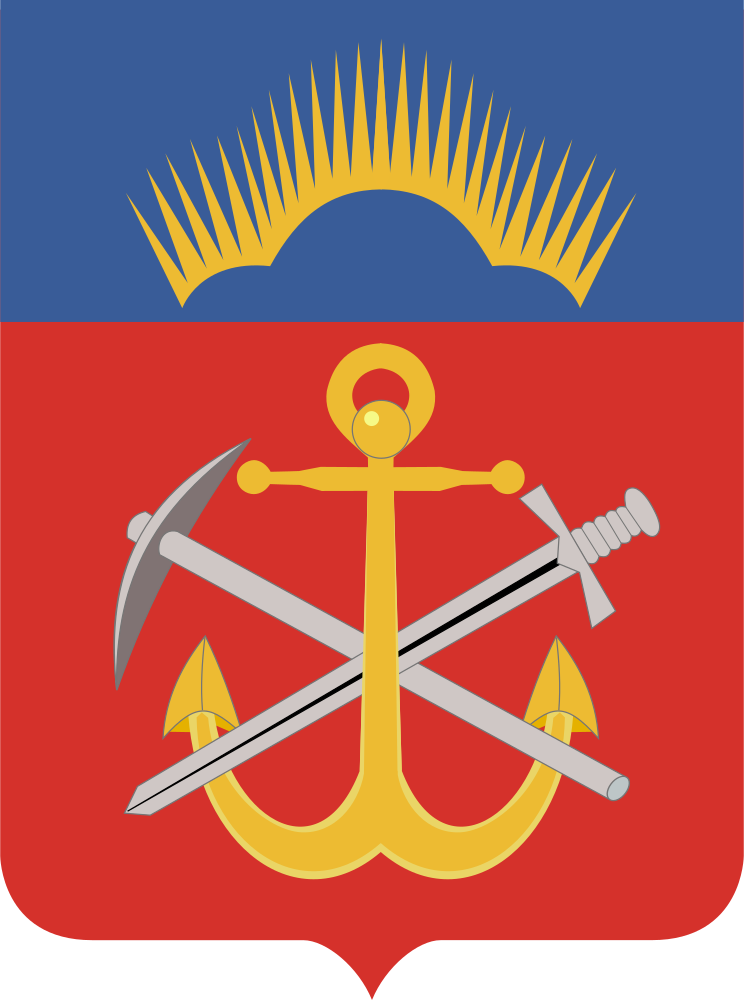
The coat of arms of Murmansk Oblast (Герб Мурманской области) places a white polar bear on a blue field, holding a golden fish — the iconic animal of the Arctic and the symbol of the Barents Sea’s extraordinary fisheries. Murmansk, entirely above the Arctic Circle, is the world’s largest city north of the Polar Circle and the base of Russia’s Northern Fleet.
Flag
Not available
Coat of Arms
Not available
| Status | Oblast (federal subject of Russia) |
|---|---|
| Capital | Murmansk |
| Area | 144,902 km² |
| Founded | 1938 (Murmansk Oblast created) |
| Coat of arms adopted | 14 June 1996 |
| Notable feature | Entirely above the Arctic Circle; Murmansk is the world's largest city north of the Arctic Circle |
Coat of Arms of Murmansk Oblast — Coat of Arms of Murmansk Oblast — Azure, a polar bear Argent holding a fish Or; chief Or with seven waves. Adopted 14 June 1996.
Azure, a polar bear passant Argent, in its dexter forepaw a fish Or; on a chief Or, seven waves wavy alternately Azure and Argent.
The arms of Murmansk Oblast place the polar bear at the centre — the iconic animal of the Arctic, found on the sea ice of the Barents and Kara Seas. The bear holds a golden fish, representing the enormous wealth of the Barents Sea fisheries, one of the most productive in the world. Above, a gold chief bears seven wavy lines alternating blue and silver, evoking the Arctic Ocean and its unceasing tides.
| Colour | Heraldic name | Element | Traditional symbolism |
|---|---|---|---|
| Blue | Azure | Field | The Arctic Ocean, the polar sky, the Barents Sea |
| Silver | Argent | Polar bear, waves | The Arctic ice, purity of the far north |
| Gold | Or | Chief, fish | The fishing wealth of the Barents Sea, prosperity |
The Murmansk Oblast occupies the Kola Peninsula, a wedge of tundra and taiga jutting into the Arctic Ocean between the Barents and White Seas. It is the homeland of the Sami people, indigenous reindeer herders who have lived on the peninsula for millennia. The peninsula also holds the world’s largest deposits of apatite (phosphate ore) and nickel, mined since the Soviet era.
Murmansk, founded in 1916, is the world’s largest city north of the Arctic Circle (population c. 280,000). Its ice-free port — kept open by the warm North Atlantic Current — gives Russia year-round access to the open ocean, making it the home base of Russia’s Northern Fleet and a key node of the Arctic Convoys in World War II, which brought vital Allied supplies through the Barents Sea.
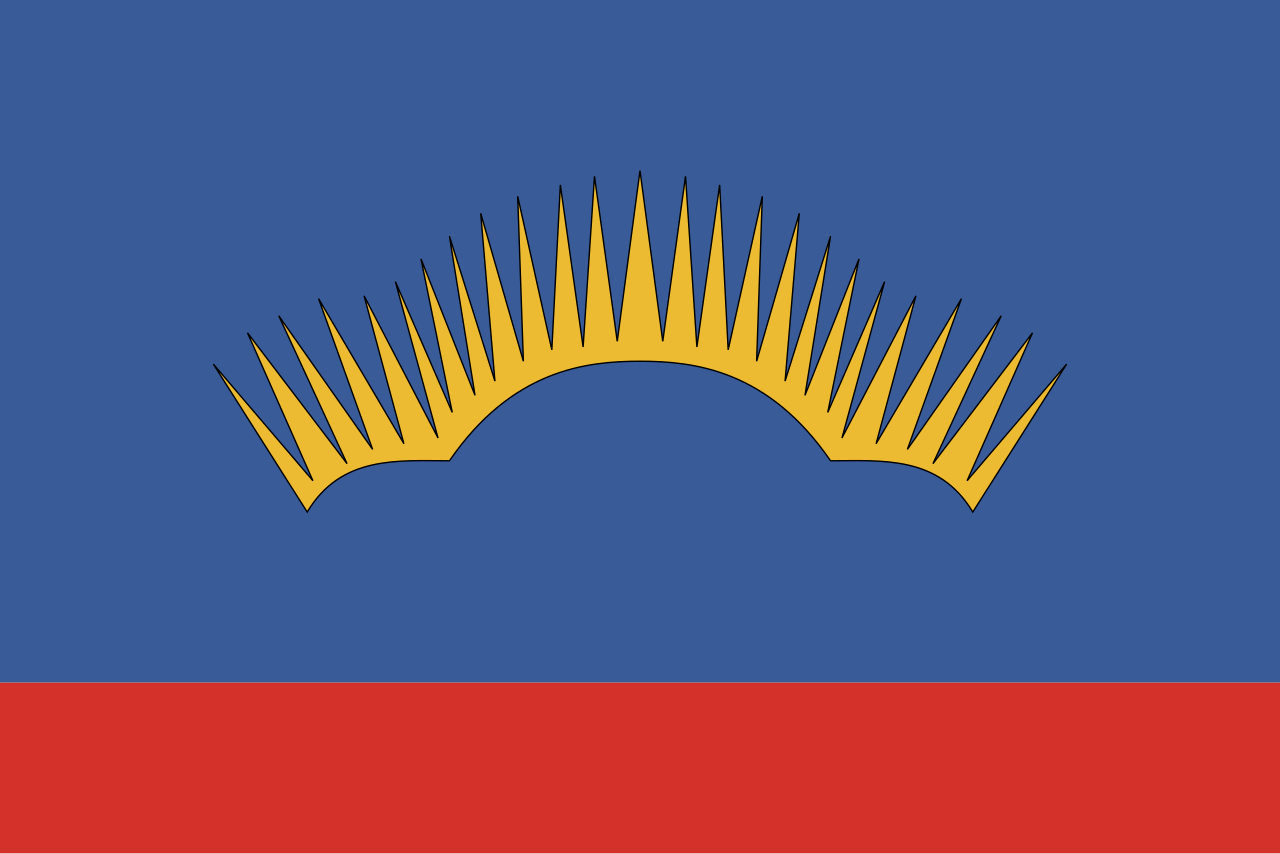
Flag of Murmansk Oblast — Flag of Murmansk Oblast — White field with a blue stripe in the lower third bearing the coat of arms. Adopted 14 June 1996.
The flag of Murmansk Oblast is a white rectangle with a broad blue horizontal stripe in the lower third. The oblast coat of arms is centred on the white field. The white and blue evoke the Arctic ice and ocean. Adopted on 14 June 1996.
The North Atlantic Current (an extension of the Gulf Stream) carries warm water along the Norwegian coast and into the Barents Sea, preventing Murmansk harbour from freezing even in winter. This makes it Russia's most strategically valuable Arctic port and the base of the Northern Fleet.
The polar bear represents the Arctic environment of Murmansk Oblast, which lies entirely north of the Arctic Circle. The fish in the bear's paw represents the vast fisheries of the Barents Sea, one of the world's most productive fishing grounds.
The Arctic Convoys were Allied supply runs from Britain (and the USA) to Murmansk and Arkhangelsk during World War II (1941–1945), delivering tanks, aircraft, food, and raw materials to the Soviet Union. They faced attack from German submarines and aircraft based in Norway. The USSR received about 4 million tonnes of supplies through this route.
The Sami (or Saami) are the indigenous Finno-Ugric people of the Kola Peninsula, related to the Sami of Norway, Sweden, and Finland. They have herded reindeer on the tundra for thousands of years. Today about 1,500–2,000 Kola Sami live in Murmansk Oblast, with a critically endangered language (Kildin Sami).
The Kola Peninsula holds enormous deposits of apatite (phosphate mineral, mined at Apatity), nickel and copper (mined at Monchegorsk and Nikel), iron ore, and rare earth elements. The nickel smelters at Nikel caused severe environmental damage on both sides of the Russian-Norwegian border.
Last reviewed by the Emblema Mundi editorial team on 3 July 2026.