Federal City of Russia
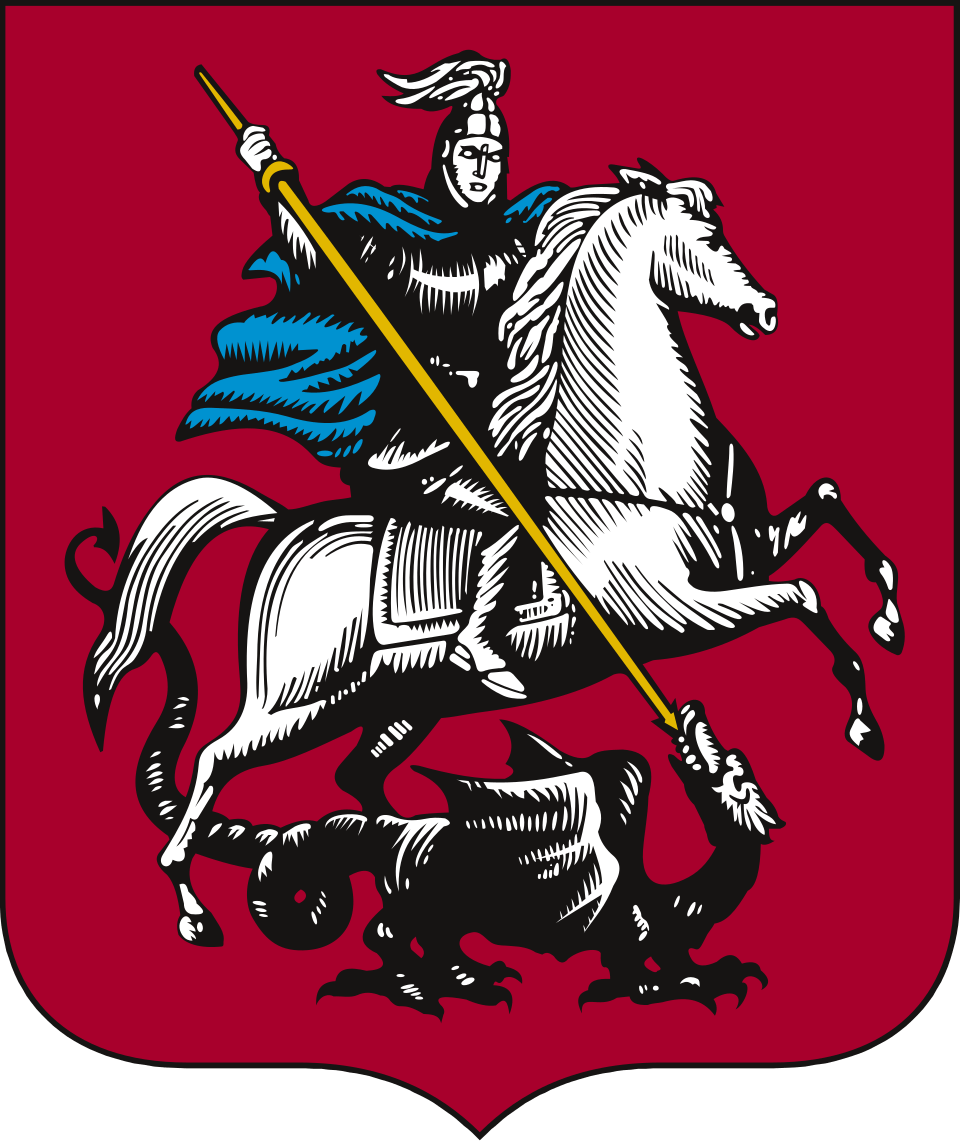
The coat of arms of Moscow (Герб Москвы) is among the oldest civic emblems in Russia: Gules, Saint George Argent on horseback slaying a green serpent with a golden lance, turned sinister. The mounted saint has been the patron of Moscow since the 14th century and his image informed the inescutcheon of the national arms of the Russian Federation.
Flag
Not available
Coat of Arms
Not available
| Status | Federal city (subject of the Russian Federation) |
|---|---|
| Founded | c. 1147 (first chronicle mention) |
| Capital | Moscow (self) |
| Area | 2,511 km² |
| Coat of arms adopted | 1 February 1995 (modern restitution of medieval arms) |
| Patron saint | Saint George the Victorious |
Coat of Arms of Moscow — Coat of Arms of Moscow — Gules, Saint George Argent on horseback, slaying with a lance Or a serpent Vert. Adopted 1 February 1995.
Gules, Saint George Argent armoured, mounted upon a horse Argent caparisoned of the same, slaying with a lance Or a serpent Vert overturned, turned sinister.
The Moscow coat of arms is one of the oldest civic emblems in Russia, predating the Russian state itself. The figure of the mounted saint faces sinister (the viewer’s right) — the reverse of the federal coat of arms, where the horseman faces dexter. This inversion survived the 19th-century Heraldic Reform of Baron Köhne, which standardised the federal figure but left the Moscow arms in their original orientation.
| Colour | Heraldic name | Element | Traditional symbolism |
|---|---|---|---|
| Red | Gules | Field | Sovereignty, courage — the blood of the martyred saint |
| Silver | Argent | Saint George, horse | Purity, victory of good over evil |
| Gold | Or | Lance | Imperial dignity, divine authority |
| Green | Vert | Serpent | The defeated adversary, paganism overcome |
Saint George (Святой Георгий Победоносец) has been the patron of Moscow since at least the reign of Dmitry Donskoy (1359–1389), who defeated the Mongol-Tatar army at the Battle of Kulikovo in 1380. The saint appeared on Muscovite coins and seals throughout the 14th and 15th centuries, becoming inseparable from the city’s identity before Moscow became the capital of a unified Russian state. His image on the coat of arms directly informed the inescutcheon of the national arms of the Russian Federation.
14th century. The yezdets (mounted warrior) appears on Muscovite coins — not yet named as Saint George, but clearly inspired by the hagiographic image.
1497. Ivan III places the horseman on the reverse of his grand seal, paired with the double-headed eagle on the obverse. The two figures thereafter define Russian national heraldry.
1781. Catherine II formally grants Moscow its coat of arms: Saint George on a red field, the first official blazon of the city.
1995. The post-Soviet city government restores the historical arms by decree, with the horseman facing sinister as in the medieval tradition.
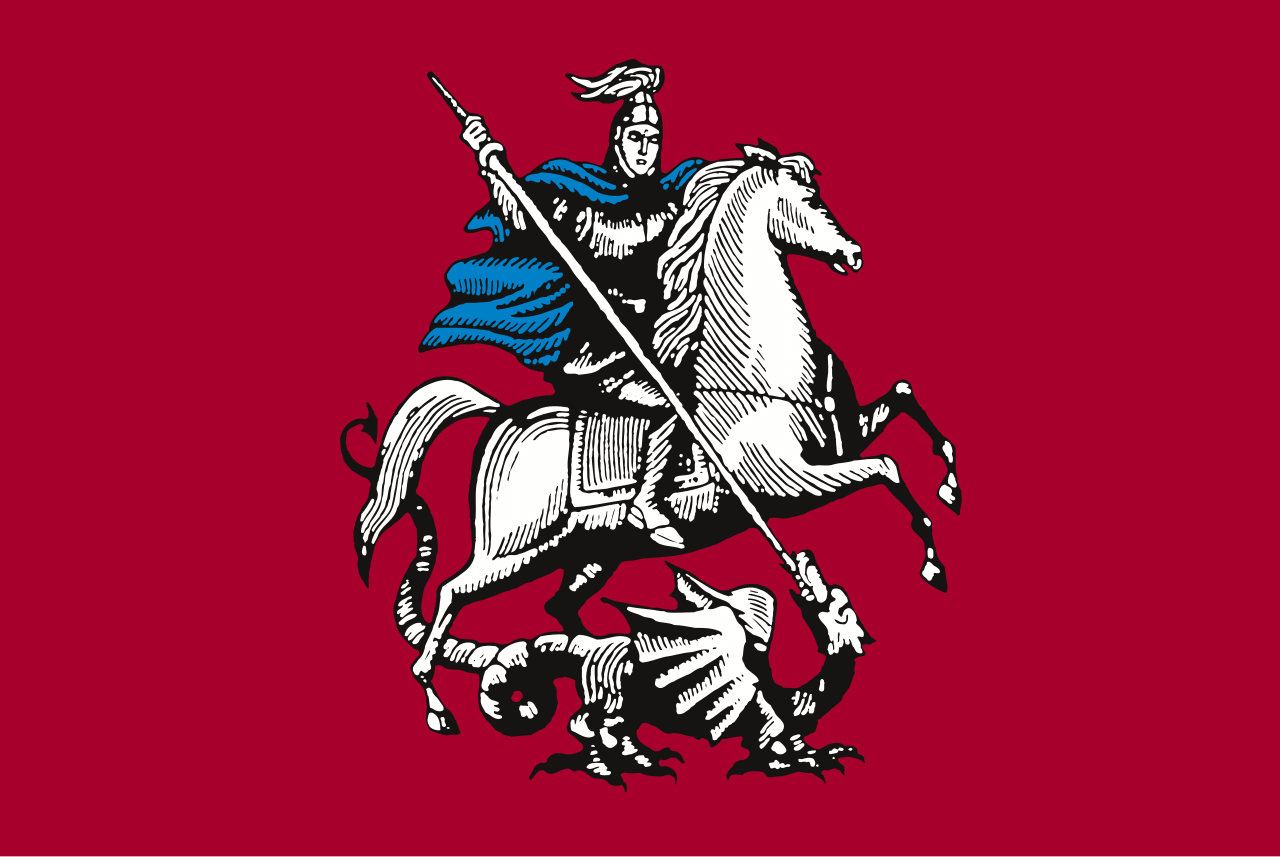
Flag of Moscow — Flag of Moscow — Dark red field bearing the coat of arms of Moscow. Adopted 1 February 1995.
The flag of Moscow is a dark red (temno-krasny) rectangle bearing the coat of arms — Saint George on horseback — in the centre. The proportions are 2:3. It was adopted on 1 February 1995 alongside the restored coat of arms, replacing the Soviet-era red banner with the star and “MOCKBA” lettering. The dark red field echoes the Gules of the heraldic arms rather than the brighter scarlet of the Soviet flag, consciously marking the break with the Communist period.
The arms show Saint George the Victorious (Святой Георгий Победоносец) on horseback, slaying a serpent with a golden lance, on a red (Gules) field. Saint George has been the patron of Moscow since the 14th century and his image appeared on Muscovite coins before the Russian state existed.
On the coat of arms of Moscow, Saint George faces sinister (the viewer's right) — the original medieval orientation. On the federal coat of arms, the horseman faces dexter (the viewer's left), a change introduced by Baron Köhne's heraldic reform of the 1850s. The Moscow arms were exempted from this standardisation and kept their historical direction.
Catherine II granted Moscow its formal coat of arms in 1781, with Saint George on a red field. The arms were suppressed in the Soviet era but restored by decree of the Moscow city government on 1 February 1995.
Yes. Unlike the federal coat of arms, where the horseman is legally described only as "a silver horseman slaying a dragon" without naming Saint George, the Moscow city statute explicitly identifies the figure as Saint George the Victorious (Святой Георгий Победоносец).
The national coat of arms of the Russian Federation (adopted 1993) incorporates a small red inescutcheon on the eagle's breast depicting a horseman slaying a dragon — directly inspired by the traditional Moscow arms. Moscow, as capital and historic heart of the Muscovite state, thus lends its own emblem to the national symbol.
Last reviewed by the Emblema Mundi editorial team on 3 July 2026.