Province
Leinster (Laighin) — Ireland’s eastern and most populous province — bears a coat of arms that echoes the very symbol of the Irish nation: a golden harp. While the national arms of Ireland display the harp on blue, Leinster sets it on green — Vert, a harp Or stringed Argent — a simple change of tincture that distinguishes the province from the state. The harp itself follows the Brian Boru design: the late-mediaeval Gaelic instrument preserved at Trinity College Dublin, with its curved forepillar and straight harmonic curve. Home to Dublin, the capital of the Republic, and to 12 counties stretching from the Wicklow Mountains to the plains of Meath, Leinster is the historic heartland of the Pale and the seat of power from the Uí Dúnlainge kings to the modern Dáil.
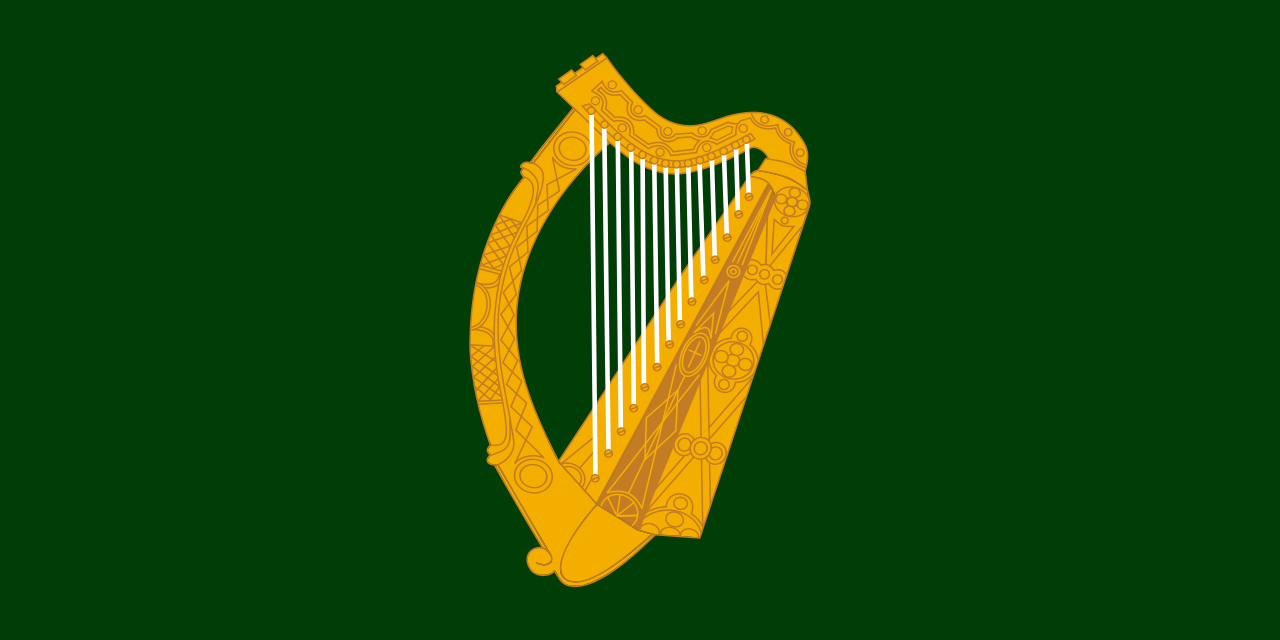
Flag
Not available
Coat of Arms
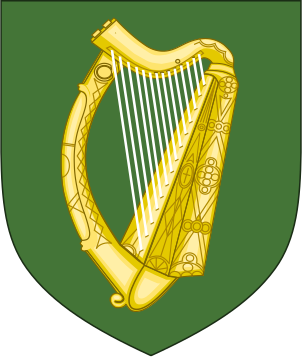
Not available
| Irish name | Cúige Laighean |
|---|---|
| Coat of arms | Golden harp on green field |
| Blazon | Vert, a harp Or stringed Argent |
| Flag | Green field, golden harp |
| Principal city | Dublin (Baile Átha Cliath) |
| Counties | 12 |
| Historic dynasties | Uí Dúnlainge, Uí Cheinnselaig, MacMurrough Kavanagh |
| Area | 19,774 km² |
Coat of Arms of Leinster — Vert, a harp Or stringed Argent
The provincial arms of Leinster are blazoned simply and elegantly:
Vert, a harp Or stringed Argent.
A golden Irish harp with silver strings on a green field — one of the most beautiful charges in Irish heraldry.
The arms of Leinster are believed to have evolved from the national arms of Ireland itself — Azure, a harp Or stringed Argent — with a change of tincture from blue to green. This close relationship makes the Leinster harp simultaneously a provincial emblem and a variant of the nation’s oldest heraldic symbol. The harp has represented Ireland since at least the reign of Henry VIII, when it was first used on Irish coinage in 1534.
The harp depicted on the Leinster arms follows the Brian Boru (or Trinity College) model: a late-mediaeval Gaelic harp preserved at Trinity College Dublin. Though the instrument dates to the 14th or 15th century — centuries after Brian Boru’s death at the Battle of Clontarf in 1014 — it became the standard heraldic model after the establishment of the Irish Free State in 1922. Its distinctive features — a curved forepillar, straight harmonic curve, and 29 strings — are faithfully rendered in both the national and provincial arms.
The assignment of specific arms to Ireland’s four provinces dates to the 17th century, when heraldic attributions were formalised as part of a tradition of representing the island’s regional divisions in quartered national designs. The arms are recorded in the Office of Arms under the Ulster King of Arms (now the Chief Herald of Ireland).
Flag of Leinster — The provincial harp on green
The flag of Leinster is a green field bearing a golden harp — essentially the coat of arms rendered as a banner. It is flown at provincial events, GAA matches, and cultural celebrations, and is one of the four provincial flags that together represent the whole of Ireland.
The green-and-gold combination distinguishes Leinster from the other three provinces: Munster (blue, three crowns), Connacht (blue, eagle and arm with sword), and Ulster (gold, red cross and hand). When the four provincial flags are quartered, they form the Four Provinces flag, a popular symbol of all-Ireland unity in sport and culture.
Leinster comprises 12 counties: Carlow, Dublin, Kildare, Kilkenny, Laois, Longford, Louth, Meath, Offaly, Westmeath, Wexford, and Wicklow. It is the most urbanised of Ireland’s four provinces, dominated by the Dublin metropolitan area.
Historically, Leinster was the kingdom of the Uí Dúnlainge and later the Uí Cheinnselaig dynasties. The MacMurrough Kavanagh kings of Leinster ruled from Ferns in County Wexford until the Norman invasion of 1169 — an event precipitated by the exiled Leinster king Diarmait Mac Murchada, who invited the Cambro-Norman lord Richard de Clare (Strongbow) to Ireland. The Pale — the English-controlled territory around Dublin — defined Leinster’s political character for centuries.
The coat of arms of Leinster is blazoned Vert, a harp Or stringed Argent — a golden Irish harp with silver strings on a green field. It is closely related to the arms of Ireland itself (Azure, a harp Or stringed Argent), differing only in the tincture of the field: green for Leinster, blue for Ireland.
The harp is the oldest and most iconic symbol of Ireland, associated with Gaelic culture since at least the 13th century. Leinster’s provincial arms are believed to have evolved from the national arms of Ireland with a change of tincture, the green field distinguishing the province from the nation.
The Brian Boru harp — also known as the Trinity College harp — is a late-mediaeval Gaelic harp preserved at Trinity College Dublin. Though it dates to the 14th or 15th century (centuries after Brian Boru’s death in 1014), it became the model for the official harp device used in Irish and Leinster heraldry, featuring a curved forepillar and straight harmonic curve.
Leinster comprises 12 counties: Carlow, Dublin, Kildare, Kilkenny, Laois, Longford, Louth, Meath, Offaly, Westmeath, Wexford, and Wicklow. It is the most populous of Ireland’s four provinces, with Dublin as its principal city and the capital of the Republic.
The green (Vert) field is the distinguishing tincture of Leinster among the four Irish provinces. While no single definitive explanation exists, green has been associated with Ireland since at least the 17th century, and in the provincial context it distinguishes Leinster from the national azure field.
Last reviewed by the Emblema Mundi editorial team on 2026-06-23.