Region of France
Picardie was a region of northern France encompassing the departments of Aisne, Oise and Somme. Its coat of arms is a quarterly composition combining the royal French fleurs-de-lis and the red lioncels of Ponthieu, reflecting the region's deep integration into the French royal domain alongside the distinct identity of its medieval coastal county.
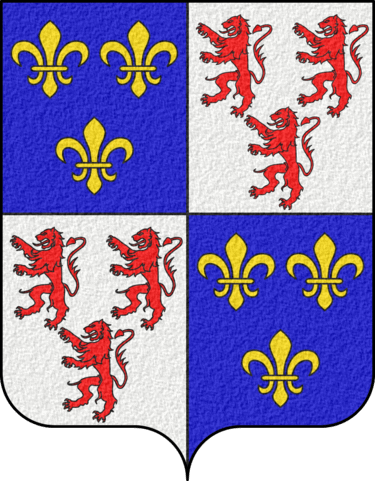
Coat of Arms
Not available
| Status | Former administrative region of France (1972–2015) |
|---|---|
| Current region | Hauts-de-France (since 1 January 2016) |
| Capital | Amiens |
| Departments | Aisne, Oise, Somme |
| Area | 19,399 km² |
| Historic territories | Picardie, Ponthieu, Vermandois, Laonnois |
Coat of Arms — Quarterly: 1st and 4th Azure, three fleurs-de-lis Or; 2nd and 3rd Argent, three lioncels Gules.
Quarterly: 1st and 4th Azure, three fleurs-de-lis Or; 2nd and 3rd Argent, three lioncels Gules.
Picardie as a geographic concept dates to the High Middle Ages, designating the northern French plains between the Seine and the Somme. The county of Ponthieu was one of its principal constituent territories; it passed to England through Eleanor of Castile (wife of Edward I) and was definitively recovered by France in 1360. The administrative region of Picardie was established in 1972 with a coat of arms combining these two strands — royal France and Ponthieu. The region was abolished in 2016 when it merged with Nord-Pas-de-Calais to form Hauts-de-France.
The regional flag reproduced the quarterly coat of arms — blue and gold in the 1st and 4th quarters, silver and red in the 2nd and 3rd. The combination gave the flag a distinctive quartered appearance immediately identifiable with the region.
No separate flag tradition existed before 1972. The arms were designed for the administrative region and appeared on regional council buildings, official stationery and road signage throughout Aisne, Oise and Somme.
Since the merger into Hauts-de-France in 2016, the Picardie arms are no longer used officially, but they remain visible on older signage and are used informally by associations wishing to assert a distinct Picard identity within the new region.
The quarterly arms combine the royal French fleurs-de-lis (blue with gold lilies) and the three red lioncels of the county of Ponthieu (on silver), reflecting Picardie's status as a royal French territory and the medieval heritage of its coastal county.
Ponthieu was a medieval county centred on Abbeville in what is now the Somme department. It was briefly held by the English crown through Eleanor of Castile before returning definitively to France in the 14th century.
Much of Picardie was held directly by the French royal domain from the early Capetian period. The inclusion of the royal French arms (Azure, three fleurs-de-lis Or) affirms this long connection to the crown.
Picardie merged with Nord-Pas-de-Calais on 1 January 2016 to form Hauts-de-France, with Lille as the regional capital.
The region was devastated by the Battle of the Somme (July–November 1916), one of the bloodiest battles in history. Picardie also saw the German Spring Offensive of 1918. Major memorials include Thiepval, Villers-Bretonneux and Notre-Dame de Lorette.
Last reviewed by the Emblema Mundi editorial team on June 29, 2026.