Department of France
Two red hearts linked together, topped with a crown and a cross: the emblem of Vendée is one of the few departmental arms in France that everyone recognises. It began as a brooch worn in Bas-Poitou, became the badge of the insurgents of 1793, and has been the official coat of arms of the department since 1943.
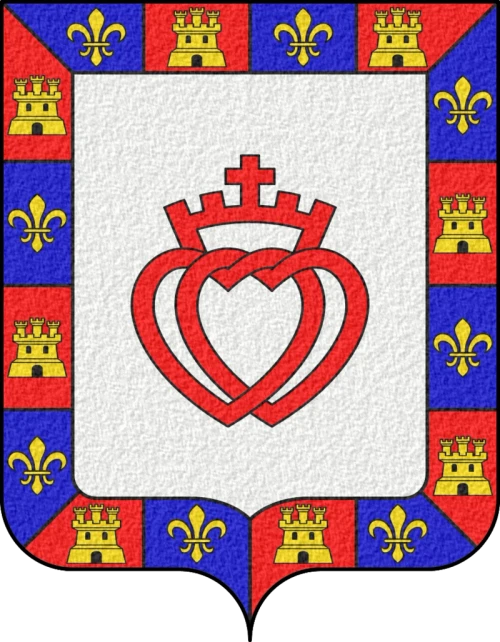
Coat of Arms
Not available
| Status | Department (85) of the Pays de la Loire region |
|---|---|
| Arms | A red double heart, crowned and topped with a cross, on silver; a border of fleurs-de-lis and castles |
| Official since | 20 October 1943 |
| Motto | Utrique fidelis — “Faithful to the one and to the other” |
| Flag | Red and white, divided by the double heart — 1989 |
Coat of arms of Vendée — Argent, a double heart, voided, interlaced, crowned and crossed Gules; a bordure compony Azure and Gules, the Azure pieces charged with a fleur-de-lis Or and the Gules pieces with a castle Or.
Argent, a double heart, voided, interlaced, crowned and crossed Gules; a bordure compony Azure and Gules, the Azure pieces charged with a fleur-de-lis Or and the Gules pieces with a castle Or.
The border stands for Poitou: Vendée is the old Bas-Poitou, the lower half of the province. Lilies on blue and castles on red are the arms of Alphonse of Poitiers, count of Poitou in the thirteenth century — the lilies of France from his father, Louis VIII, and the castles of Castile from his mother, Blanche of Castile.
Many French departments are shown with arms that were never formally adopted. Vendée is an exception. The design came out of a competition launched in January 1943 by Jacques de Maupeou, editor of the Revue du Bas-Poitou, to give Vendée an emblem for the 150th anniversary of the rising of 1793. The department took the project up officially, and the State’s Commission of Seals and Arms approved it at its sitting of 20 October 1943.
Before it was a coat of arms, the heart was a piece of jewellery. In Bas-Poitou men fastened their collars with an openwork heart-shaped pin; women then took it up and wore it as a brooch. One heart, not yet two: it stood for love and fidelity, and the crown above it for marriage, which “crowns” love.
The second source is religious. Devotion to the Sacred Heart of Jesus had been spreading since the seventeenth century, and in 1793 the insurgents of the Vendée took it as their emblem, as a sign of protection and of loyalty to Catholicism. It was a heart of plain red cloth, topped with a cross, sewn on the left of the jacket as a rallying sign. Cathelineau, general of the insurgents, wore it; it marked the “Whites” against the republican “Blues”.
The heart became double at the beginning of the nineteenth century. Three readings are given, and they do not exclude one another: the Sacred Hearts of Jesus and Mary; the union of man and woman, inherited from the brooch; and a double loyalty, to the King and to the Church. The coat of arms of 1943 fixed that form — two hearts, a crown, a cross — and the same heart reappears today in the arms of Pays de la Loire.
The motto of Vendée is Utrique fidelis: “Faithful to the one and to the other” — to God and to the King, by implication. It was approved with the arms on 20 October 1943, at the request of the department’s general council.
The motto says in Latin what the charge says in drawing: two hearts, two loyalties. It is rare for a motto and a shield to repeat each other so exactly.
The department’s flag was adopted on 18 September 1989, together with a new logo. It is a rectangle in proportions 5:6, divided into a red part and a white part by a red Vendée heart. The visual identity is the work of the designer Michel Disle.
In it the heart leaves the shield. The border of Poitou and the silver field are gone; only the outline of the two hearts with their crown and cross remains, large enough to cut the flag in two. The department has redrawn its logo several times since — in 2007, and again in 2015 — but always around the same double heart.
Three meanings are given: the Sacred Hearts of Jesus and Mary, the union of man and woman, and a double loyalty to the King and to the Church. The crown comes from the old heart-shaped brooch of Bas-Poitou, the cross from the Sacred Heart badge of 1793.
Yes. It came out of a competition launched in January 1943 by the Revue du Bas-Poitou and was approved by the State’s Commission of Seals and Arms on 20 October 1943.
Utrique fidelis, “Faithful to the one and to the other” — understood as God and the King. It was approved with the arms in 1943.
The border stands for Poitou, of which Vendée was the lower part. Lilies on blue and castles on red are the arms of Alphonse of Poitiers, count of Poitou, son of Louis VIII of France and Blanche of Castile.
A rectangle in proportions 5:6, divided into a red part and a white part by a red Vendée heart. It was adopted on 18 September 1989 with the department’s logo, designed by Michel Disle.
The arms are described from the published blazon and the texts above, not from the drawing.
Last reviewed by the Emblema Mundi editorial team on 30 September 2026.