Region of France
Nord-Pas-de-Calais was a region of northern France bordering Belgium and the English Channel, historically part of the medieval county of Flanders and the county of Artois. Its coat of arms bears the iconic black lion of Flanders on gold — one of the most recognisable heraldic charges in European history, shared with the Flemish region of Belgium.
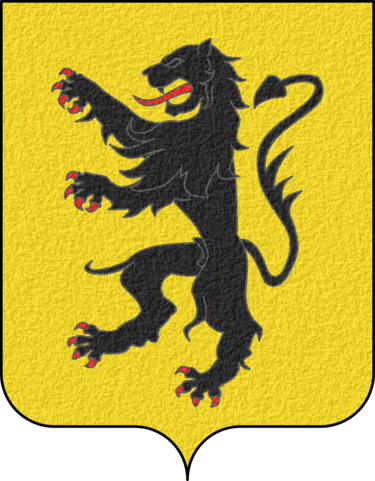
Coat of Arms
Not available
| Status | Former administrative region of France (1972–2015) |
|---|---|
| Current region | Hauts-de-France (since 1 January 2016) |
| Capital | Lille |
| Departments | Nord, Pas-de-Calais |
| Area | 12,414 km² |
| Historic territories | Flandre française, Artois, Boulonnais, Cambrésis |
Coat of Arms — Or, a lion Sable armed and langued Gules.
Or, a lion Sable armed and langued Gules.
The black lion on gold has been the arms of Flanders since the late 12th century, making it one of the oldest continuously used heraldic arms in Europe. The county of Flanders straddled what are now northern France and Belgium. The French portion — known as Flandre française — was progressively acquired by the French crown through wars and treaties between the 13th and 17th centuries. The Artois and Boulonnais territories were incorporated separately. When the administrative region of Nord-Pas-de-Calais was created in 1972, the lion of Flanders was retained as its emblem, honouring the dominant medieval heritage of the territory.
The regional flag displayed the black lion on gold, matching the blazon exactly. The stark bicolour design — black and gold — is visually powerful and historically evocative of Flemish identity.
The lion of Flanders has been used as a banner since the medieval period. In Belgium, the black lion on gold became the flag of the Flemish Community. In France, it was formalised as the regional emblem when Nord-Pas-de-Calais was established as an administrative region in 1972.
Since the merger into Hauts-de-France in 2016, the lion of Flanders continues to be used to represent the northern sub-regional identity. It appears at football matches, cultural events and in civic contexts throughout the Nord and Pas-de-Calais departments.
The arms display a black (Sable) lion with red claws and tongue on gold — the lion of Flanders, one of the oldest heraldic charges in Europe, tracing to the counts of Flanders of the late 12th century.
The black lion on gold appears in Flemish heraldry from around 1190 and is associated with the counts of Flanders. It is today also the emblem of the Flemish region of Belgium.
Much of Nord-Pas-de-Calais was historically part of the county of Flanders, which straddled the current French-Belgian border. The French part (Flandre française) retained the Flemish lion as its heraldic emblem after becoming French.
On 1 January 2016, Nord-Pas-de-Calais merged with Picardie to form Hauts-de-France, with Lille as its capital.
The region was a major centre of the French industrial revolution (coal, textiles, steel) and was heavily fought over in both World Wars — notably at Arras, Vimy Ridge, Dunkirk and the Somme battlefields just to the south.
Last reviewed by the Emblema Mundi editorial team on June 29, 2026.