Region of France
Lorraine was a region of northeastern France with a rich history as an independent duchy for more than eight centuries. Its coat of arms — a golden bend charged with three silver alerions on red — is one of the oldest in France, attested as early as 1183 on the seal of Simon II, Duke of Lorraine.
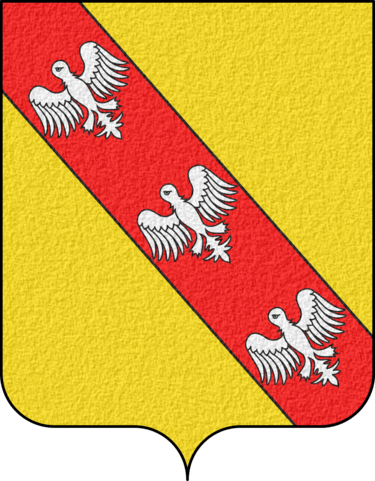
Coat of Arms
Not available
| Status | Former administrative region of France (1972–2015) |
|---|---|
| Current region | Grand Est (since 1 January 2016) |
| Capital | Metz |
| Departments | Meurthe-et-Moselle, Meuse, Moselle, Vosges |
| Area | 23,547 km² |
| Historic territories | Duchy of Lorraine, Bishopric of Metz, Bishopric of Verdun |
Coat of Arms — Or, a bend Gules charged with three alerions Argent.
Or, a bend Gules charged with three alerions Argent.
The arms appear on the seal of Simon II, Duke of Lorraine, in 1183 — making them among the earliest dated heraldic arms in France. They were borne continuously by all subsequent dukes of Lorraine until the duchy's definitive incorporation into France in 1766. According to late-medieval legend, the alerions commemorated a feat of Godefroy de Bouillon, who allegedly killed three birds with a single arrow during the First Crusade's capture of Jerusalem in 1099 — a tale invented to legitimise the ducal lineage through a crusading hero, though historically unfounded. The modern administrative region adopted these medieval arms unchanged in 1972.
The regional flag reproduced the coat of arms on a white or gold field. The combination of gold, red and silver gave the emblem a bold, immediately recognisable appearance. The Cross of Lorraine (a double-barred cross) was also widely used as an informal regional symbol alongside the heraldic arms.
The Cross of Lorraine was adopted by General de Gaulle in 1940 as the emblem of the Free French Forces, giving this Lorraine symbol worldwide recognition. It derives from the Patriarchal Cross used by the Archbishops of Trier and became associated with the duchy through the d'Anjou-Vaudémont branch of the ducal family.
Since Lorraine's merger into Grand Est in 2016, the Cross of Lorraine and the alerions arms continue to be used informally to assert regional identity, particularly in contexts relating to the World Wars, in which Lorraine — and above all Verdun — played a central role.
The arms show a golden field with a red bend bearing three silver alerions (limbless eagles). They have been the arms of the Duchy of Lorraine since at least 1183 and are among the oldest continuously used heraldic arms in France.
An alerion is a heraldic bird resembling a small eagle but without beak or feet, displayed with its body spread. Three silver alerions on a red bend are the defining feature of Lorraine's arms.
Medieval legend held that the alerions were won by Godefroy de Bouillon, who allegedly killed three birds with one arrow at the siege of Jerusalem in 1099, earning the kingship of the city. This tale is legendary rather than historical.
The Duchy of Lorraine passed definitively to France in 1766 upon the death of Stanislas Leszczynski, former King of Poland, who had held it for life. His son-in-law Louis XV then received it for the French crown.
On 1 January 2016, Lorraine merged with Alsace and Champagne-Ardenne to form the new administrative region of Grand Est.
Last reviewed by the Emblema Mundi editorial team on June 29, 2026.