Region of France
Franche-Comté (the "Free County") is a former administrative region of eastern France, bordering Switzerland. Its capital was Besançon. In 2016 it was merged with Burgundy to form Bourgogne-Franche-Comté. The region's heraldry carries a remarkable layering of history: it was successively held by the Counts of Burgundy, the House of Habsburg, and finally France, and its golden lion on blue remains one of the most striking emblems of French regional heraldry.
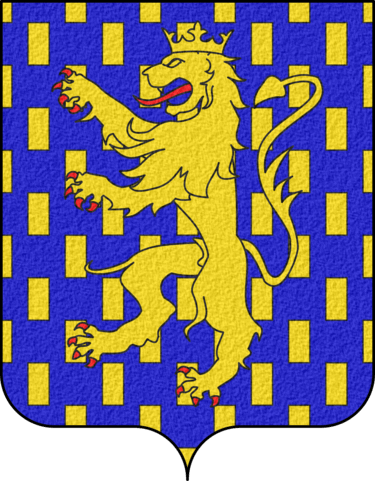
Coat of Arms
Not available
| Former region | Franche-Comté (existed until 2015) |
|---|---|
| Now part of | Bourgogne-Franche-Comté (since 2016) |
| Former capital | Besançon |
| Area | 16,202 km² |
| Departments | Doubs, Haute-Saône, Jura, Territoire de Belfort |
| Notable cities | Besançon, Belfort, Montbéliard, Vesoul, Lons-le-Saunier |
| Historic identity | Free County (Comté Libre); long under Habsburg rule (1556–1674) |
| Incorporated into France | 1678 (Treaty of Nijmegen) |
Coat of Arms — Azure semy of billets Or, a lion of the same, armed and langued Gules.
Azure semy of billets Or, a lion of the same, armed and langued Gules.
The County of Burgundy (later called the "Free County" — Franche-Comté) was a distinct political entity from the Duchy of Burgundy. Its arms with the golden lion on a blue field scattered with billets were established by the 13th century. The county passed through the hands of the Hohenstaufen, then the Capetian House of Burgundy, before falling to the Habsburg dynasty in 1477 following the death of Charles le Téméraire. For nearly two centuries Franche-Comté formed part of the Spanish Habsburg territories — a period of remarkable cultural flourishing — before Louis XIV conquered it definitively and it was ceded to France by the Treaty of Nijmegen in 1678. Despite this long foreign dominion, the county's distinctive lion arms were retained and never replaced by French royal charges.
The flag of Franche-Comté reproduces the heraldic arms: a blue field strewn with gold billets and bearing a rampant golden lion with red tongue and claws. The visual richness of the billeted field distinguishes it from simpler regional banners and reflects the territory's Burgundian heritage.
The arms from which the flag derives date to the medieval County of Burgundy. They appear consistently in 13th-century rolls of arms and seals, predating the region's long attachment to the Habsburgs. The survival of these arms through French conquest and centralisation is a testament to their deep-rooted local identity.
Although Franche-Comté was merged into Bourgogne-Franche-Comté in 2016, its arms continue to be used by local cultural bodies, watchmaking guilds (the Jura is a major centre of Swiss and French horology), and heritage organisations. Besançon, as a UNESCO Creative City of Music and home of the international music competition founded in 1951, continues to identify with the regional emblem.
"Franche-Comté" translates literally as "Free County." The name reflects the territory's historical claim to independence from the Duchy of Burgundy and its tradition of relative autonomy. The exact origin of the term is debated but appears in documents from the 12th century onward.
The arms — a golden lion on a blue field scattered with gold billets — are inherited from the medieval Counts of Burgundy who ruled the county. The lion symbolises power and sovereignty; the billets and blue field are characteristic of the County of Burgundy heraldic tradition, distinct from the Duchy of Burgundy.
Franche-Comté was definitively incorporated into France in 1678, following Louis XIV's military campaigns and the Treaty of Nijmegen. Before that, it had been under Habsburg (Spanish) rule since 1556, with a brief French interlude during Louis XIV's first conquest (1668–1674).
No. As of 1 January 2016, Franche-Comté was merged with the Burgundy region to form the new administrative region of Bourgogne-Franche-Comté, with Dijon as its capital. The merged region retains the lion in its combined coat of arms.
The region is internationally renowned for its watchmaking tradition (concentrated in the Doubs department, near the Swiss border), its Comté cheese (a PDO cheese aged in the Jura mountains), and the historic fortifications of Besançon designed by Vauban — now a UNESCO World Heritage Site.
Last reviewed by the Emblema Mundi editorial team on June 29, 2026.