Region of France
Corse (Corsica) is a French territorial collectivity and island in the Mediterranean Sea, lying south-east of the French mainland and north of Sardinia. With Ajaccio as its capital — and as the birthplace of Napoléon Bonaparte — Corsica holds a unique place in European history. Its emblem, the celebrated Moor's head (testa mora), is one of the most ancient and distinctive regional symbols in France.
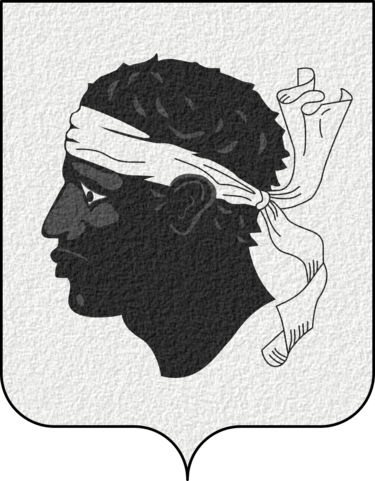
Coat of Arms
Not available
| Official name | Collectivité de Corse |
|---|---|
| Capital | Ajaccio |
| Area | 8,680 km² |
| Population | approx. 340,000 |
| Departments | Haute-Corse, Corse-du-Sud |
| Notable cities | Ajaccio, Bastia, Corte, Bonifacio |
| Famous for | Birthplace of Napoléon Bonaparte, maquis scrubland, Mediterranean culture |
| Status since 2018 | Single territorial collectivity replacing the two former departments |
Coat of Arms — Argent, a Moor's head Sable, wreathed Argent, the bandeau above the eyes.
Argent, a Moor's head Sable, wreathed Argent, the bandeau placed above the eyes.
The Moor's head has been associated with Corsica since at least the 15th century, appearing on coins minted under Aragonese rule. The emblem became the symbol of the short-lived République Corse (Corsican Republic, 1755–1769) under Pasquale Paoli, who adopted it as the national flag. Paoli placed the bandeau above the eyes, transforming what had been a blindfolded figure into one that could "see" — a powerful symbol of Corsican sovereignty and enlightenment. When Genoa ceded Corsica to France in 1768, and the island was definitively incorporated in 1769, the emblem survived and was formally recognised as the regional symbol of Corse.
The flag of Corse is white with a black Moor's head in profile facing the hoist, wearing a white bandeau above the eyes. The design is among the most distinctive regional flags in Europe: the high-contrast black-on-white composition and the striking anthropomorphic charge make it instantly recognisable.
The flag was adopted by Pasquale Paoli's Corsican Republic in 1755, though the Moor's head had appeared on Corsican seals and coins for centuries before. The repositioning of the headband above the eyes was Paoli's innovation, and it has been retained ever since. The flag was used continuously by Corsican independence movements and cultural associations even during periods of French centralisation.
The Moor's head flag flies alongside the French tricolour throughout Corsica and is a central emblem of Corsican cultural identity. It appears on the Corsican Territorial Assembly's publications, regional road signs, and is prominently displayed during local festivals. The symbol is equally used — and sometimes contested — by Corsican autonomist and nationalist political movements.
The Moor's head (testa mora) is one of the oldest heraldic charges associated with Corsica, appearing on Aragonese coins and seals from the 15th century. It is generally interpreted as a symbol of Corsican identity and, since Pasquale Paoli's reforms, of freedom — the bandeau raised above the eyes representing a liberated people no longer blindfolded.
Pasquale Paoli (1725–1807) was the leader of the Corsican Republic (1755–1769). He adopted the Moor's head as the national emblem and repositioned the headband above the eyes to symbolise Corsican sovereignty. He is regarded as the "Father of the Nation" by many Corsicans and his constitutional republic was one of the earliest in Europe.
Corsica is a French collectivité territoriale unique (single territorial collectivity), a status granted in 2018 by merging the former Collectivité territoriale de Corse with the two departmental councils of Haute-Corse and Corse-du-Sud. It has more autonomous powers than a standard French region but remains part of the French Republic.
Yes. Napoléon Bonaparte was born on 15 August 1769 in Ajaccio, the capital of Corsica — just one year after France acquired the island from Genoa. Ajaccio honours his memory with the Maison Bonaparte museum and numerous monuments.
In the current official version of the Corsican flag, the Moor's head faces the hoist (left side). This orientation is not universal in heraldry; historically the head faced dexter. The current orientation became standard in modern reproductions of the flag and is now codified in official Corsican institutional usage.
Last reviewed by the Emblema Mundi editorial team on June 29, 2026.