Region of France
Bourgogne (Burgundy) is one of France's most storied historic regions, home to the great Valois dukes whose power rivaled the French crown itself. Its coat of arms — a complex quarterly design combining the fleurs-de-lis of France with the ancient diagonal stripes of old Burgundy — embodies the ambitions of Philippe le Hardi, Philippe le Bon, and Charles le Téméraire, who built a state spanning from the Rhine to the North Sea.
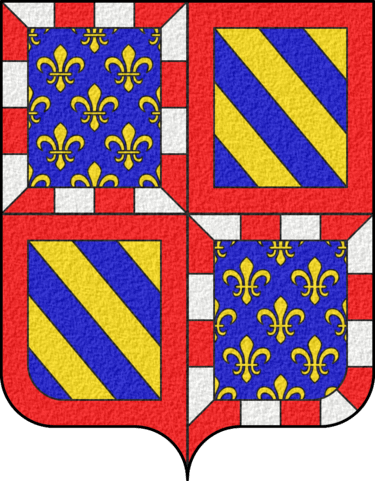
Coat of Arms
Not available
| Region | Bourgogne (now part of Bourgogne-Franche-Comté) |
|---|---|
| Capital | Dijon |
| Blazon | Quarterly: 1st and 4th Azure semy-de-lis Or with a bordure compony Argent and Gules; 2nd and 3rd bendy of six Or and Azure with a bordure Gules |
| Tinctures | Azure (blue), Or (gold), Argent (silver), Gules (red) |
Coat of Arms of Bourgogne — Quarterly: France ancient with compony bordure; ancient Burgundy with Gules bordure
Quarterly: 1st and 4th Azure semy-de-lis Or with a bordure compony Argent and Gules; 2nd and 3rd bendy of six Or and Azure with a bordure Gules.
The Duchy of Bourgogne came under the Valois branch of the French royal family in 1363 when King Jean II of France granted it to his son Philippe le Hardi. Over the following century, the Valois dukes accumulated territories across the Low Countries, Artois, and Franche-Comté, creating a state wealthier than France itself. Jean sans Peur, Philippe le Bon, and Charles le Téméraire each expanded the duchy's power and prestige. When Charles le Téméraire died at the Battle of Nancy in 1477, his daughter Marie de Bourgogne inherited the northern territories, which passed to the Habsburgs through her marriage to Maximilien d'Autriche. The Duchy of Burgundy proper was reintegrated into France by Louis XI.
The traditional banner of Bourgogne is a banner of arms derived from the quarterly coat: blue and gold (Azure and Or) are the dominant heraldic colors. The Burgundy cross — a red saltire (diagonal cross) on a white field with a red border, known as the "Cross of Burgundy" — is a distinct flag associated with the Duchy and used historically by Spanish and Austrian Habsburg forces who inherited Burgundian traditions.
The Cross of Burgundy was adopted as a military standard by the Burgundian dukes and became the battle flag of the Spanish Empire following the Habsburg inheritance of the Burgundian Netherlands. It remains the flag of several Spanish regions and communities that were once under Burgundian-Habsburg rule.
The modern region of Bourgogne-Franche-Comté uses a simplified emblem inspired by the historic arms. The traditional Bourgogne quarterly coat remains the defining heraldic symbol of the Dijon region and is widely used in viticulture, gastronomy, and tourism, making it one of the most recognized French regional arms internationally.
The coat of arms of Bourgogne is blazoned: Quarterly, 1st and 4th Azure semy-de-lis Or with a bordure compony Argent and Gules; 2nd and 3rd bendy of six Or and Azure with a bordure Gules. This quarterly design combines the claims of the Valois Dukes of Burgundy to the French crown and their ancestral duchy.
The Valois Dukes of Burgundy were Philippe le Hardi (1363–1404), Jean sans Peur (1404–1419), Philippe le Bon (1419–1467), and Charles le Téméraire (1467–1477). At their height, they ruled one of the wealthiest and most powerful states in Europe, encompassing not only Bourgogne but also the Low Countries, Flanders, and other territories.
The blue field scattered with golden fleurs-de-lis represents France Ancient — the pre-1376 arms of the French crown. The compony (chequered) bordure in silver and red distinguishes the Duke of Burgundy's arms from those of the French king.
After Charles le Téméraire died at the Battle of Nancy in 1477, the Duchy of Burgundy proper was reintegrated into the French crown by Louis XI. The northern territories passed through his daughter Marie de Bourgogne to the Habsburg dynasty, profoundly shaping the history of Europe.
Since 2016, Bourgogne was merged with Franche-Comté to form the administrative region of Bourgogne-Franche-Comté. Dijon remains the regional capital. The historic arms of Bourgogne continue to be used and are among the most celebrated in French heraldry.
Last reviewed by the Emblema Mundi editorial team on June 29, 2026.