Region of France
Auvergne is a historic region of central France, dominated by the Massif Central and its chain of extinct volcanoes. Its coat of arms — a red gonfalon on gold — is unique in French heraldry, evoking the ancient power of the Counts of Auvergne and the land of Vercingétorix, the Gallic chieftain who defied Julius Caesar.
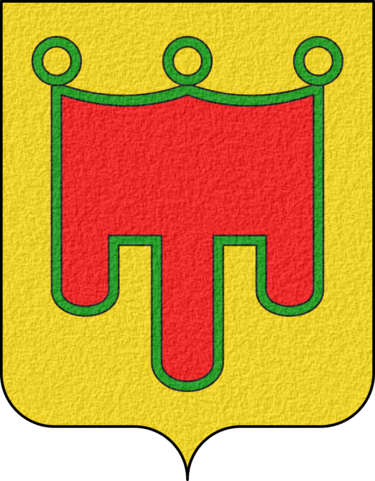
Coat of Arms
Not available
| Region | Auvergne (now part of Auvergne-Rhône-Alpes) |
|---|---|
| Capital | Clermont-Ferrand |
| Blazon | Or, a gonfalon Gules fringed Vert |
| Tinctures | Or (gold), Gules (red), Vert (green) |
Coat of Arms of Auvergne — Or, a gonfalon Gules fringed Vert
Or, a gonfalon Gules fringed Vert.
The arms of Auvergne date to the medieval Counts of Auvergne, who held the region as a powerful fief in the heart of France. The gonfalon — a symbol of military command — reflects the martial authority of these lords. The county was progressively absorbed by the French crown, passing to the royal domain under Louis IX in the 13th century. The heraldic identity of Auvergne survived the end of the county and was later used by the province, then the modern region.
The banner of Auvergne displays the arms on a gold field: the red gonfalon with green fringe is the central motif. The colors gold and red (Or and Gules) form the primary palette associated with Auvergnat identity.
The heraldic colors of Auvergne were established by the medieval counts and carried through the provincial period. The distinctive three-color combination — gold, red, and green — appears on regional representations from the 13th century onward and has never been significantly altered.
Following the 2016 merger into Auvergne-Rhône-Alpes, the arms and colors of historic Auvergne remain prominently used in the departments of Allier, Cantal, Haute-Loire, and Puy-de-Dôme. They appear at cultural events, sporting fixtures, and official communications that celebrate Auvergnat identity.
The coat of arms of Auvergne is blazoned: Or, a gonfalon Gules fringed Vert. It depicts a red gonfalon (a type of war banner) with green fringe, displayed on a golden field — the arms of the medieval Counts of Auvergne.
A gonfalon is a type of war banner or pennant, typically suspended from a horizontal crossbar and often fringed. In the arms of Auvergne, the gonfalon is red (Gules) with green (Vert) fringe, set against a gold (Or) background. It is a rare charge in French heraldry.
Vercingétorix, the Gallic chieftain who led the great revolt against Julius Caesar in 52 BC, was leader of the Arverni tribe — the ancient people who gave Auvergne its name. He is commemorated by a monumental statue at Clermont-Ferrand and is considered a founding symbol of Auvergnat identity.
Since 2016, the administrative region of Auvergne was merged with Rhône-Alpes to form Auvergne-Rhône-Alpes. The historic arms remain widely recognized and associated with the four departments of the historic Auvergne.
The arms of Auvergne use three heraldic tinctures: Or (gold) for the field, Gules (red) for the gonfalon, and Vert (green) for the fringe. This combination of gold, red, and green is unique among French regional arms.
Last reviewed by the Emblema Mundi editorial team on June 29, 2026.