Westeros Sigil
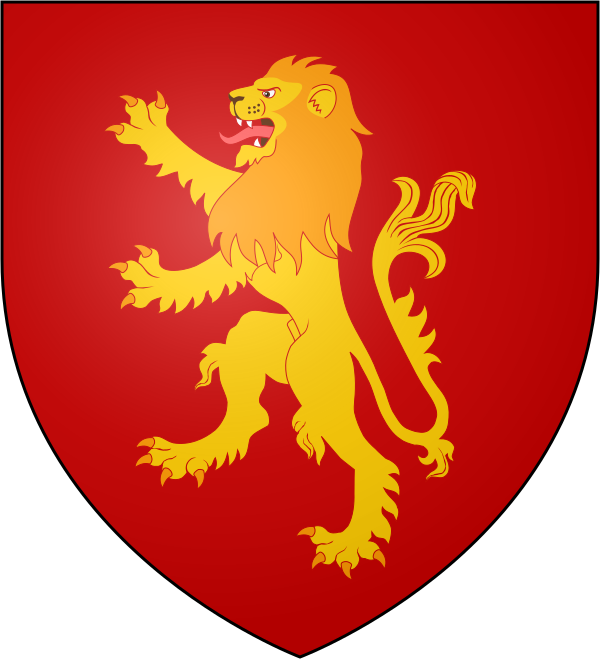
Gules, a lion or
Words Hear Me Roar!
The richest and most feared house in Westeros bears the least distinctive device imaginable. No beast is commoner in European arms than the lion, and no pairing of tinctures more worn than gold on red. The lion of Casterly Rock is, heraldically, the standard issue.
Lords of Casterly Rock and Wardens of the West. They hold the gold mines, they own the fleet at Lannisport a mile to the south, and the motto everyone actually quotes is not the one on the shield.
Click on a country to learn more
A golden roaring lion, on a field of crimson.
Rendered in classical terms: Gules, a lion or.
The sigil is given early and plainly — A Game of Thrones, chapter 5 (Jon I) — and repeated throughout the series, on cloaks, on banners, on the red cloaks of the household guard.
The books say crimson. Blazon has no such word: the red of heraldry is gules, one of the fixed colours, and it covers every shade a painter might reach for. A herald reading “crimson” would write gules and think no more about it.
That is worth noting because it is the opposite of what happens elsewhere in this atlas. Where other houses force the vocabulary — a grey that is barely a tincture, an orange that is a stain — the Lannister description needs no translation at all. It was already heraldic before anyone blazoned it.
Here is the thing nobody says about the most famous shield in the setting after the direwolf: it is utterly generic.
No creature appears in European arms as often as the lion. It is the first beast of the repertoire, borne by kings, counts and country gentlemen alike, in every kingdom that ever granted arms. And of all the ways to tincture one, gold on red is among the most worn: the lions of England, the lion of León — which is a pun on the kingdom’s name — and a hundred lesser houses besides.
A herald handed Gules, a lion or would not blink. He would ask what difference distinguishes it from the dozen other families already bearing it.
Read it as a boast and it falls flat. Read it as a statement of position and it works: the Lannister arms do not claim to be unusual. They claim to be the standard.
Other great houses of Westeros bear things nobody else has — a flayed man, a kraken, a direwolf, a sun run through with a spear. Those are arms that say look at what we are. A gold lion on red says we are what a great house looks like, which from the wealthiest family in the realm is a different and colder kind of assertion.
The official words are:
Hear Me Roar!
And they are almost never used. The line everyone in Westeros actually quotes, friend and enemy alike, is the unofficial one:
A Lannister always pays his debts.
In European practice the motto is the least fixed part of an achievement of arms. The shield is granted and inherited; the motto is not part of the grant in English practice, may be changed at will, may be dropped, and is often not recorded at all. Families have carried three or four across the centuries without anyone objecting.
Westerosi houses treat their words as part of the arms, transmitted with the shield. The Lannisters are the exception that proves the European rule: they have a granted motto that describes the charge, and a second one, granted by nobody, that describes the family — and the second has driven out the first.
Note what each one does. Hear Me Roar is simply the shield read aloud: the lion is roaring, so the words roar. It adds nothing. A Lannister always pays his debts adds everything — it is a promise, a threat and an accounting term at once, and it is the only house motto in this atlas that works as all three.
Arms follow a name, and the Lannister name has changed hands twice in ways a herald would want recorded.
The house traces itself to Lann the Clever, a trickster of the Age of Heroes who is said to have got Casterly Rock out of House Casterly by cunning rather than conquest. The Casterlys vanish from the chronicles; the Lannisters appear.
And the Rock is still called Casterly Rock. Three hundred years after the Conquest and thousands of years after Lann, the greatest seat in the west bears the name of the family that lost it, not the family that holds it. A European house would have renamed the castle inside a generation.
The second turn is stranger and better documented. When King Gerold III died leaving only a daughter, a council crowned her husband — Ser Joffrey Lydden, an Andal — and he took the Lannister name. The house became Andal from that point; the First Men name survived on a man who was not born to it.
European heraldry has a formal device for exactly this. A name and arms clause is a condition attached to an inheritance requiring the heir to assume the testator’s surname and bear his arms — used for centuries, and precisely to stop a name and a shield dying out when a line runs to daughters. Ser Joffrey Lydden is that clause in narrative form.
So the Lannisters descend from Lann the Clever through the female line, and their name has twice survived a man of another house. For a family whose whole standing rests on being the Lannisters of Casterly Rock, both facts sit oddly close to the surface.
Or is one of the two metals of heraldry, and it means nothing beyond itself. A gold charge is not a claim to gold. Thousands of impoverished European families bore or on their arms for centuries without ever owning a coin of it.
The Lannisters are the case where the tincture turns out to be literal. Their gold mines are what make them the wealthiest of the great houses — not their lands, not their fleet, not their army. The metal on the shield and the metal in the ground are the same metal.
It runs into the region too. The port below the Rock is renowned for its goldsmiths and its goldwork. A road that runs east out of the westerlands is called the gold road. The arms, the trade, the roads and the mines all say the same word.
Which makes the unofficial motto sharper than it first appears. A Lannister always pays his debts is a sentence about money, spoken by a house whose shield is made of it.
A note on the map, because this page is honest about where its pin sits.
The seat of House Lannister is Casterly Rock. The marker on the map beside this article is set on Lannisport, the walled city less than a mile to the south — the largest settlement in the westerlands, one of the great ports of the Seven Kingdoms, where the river road, the gold road and the ocean road meet the sea.
It is not an arbitrary place to put them. The Lannister fleet is anchored there. The goldsmiths work there. And among the titles of the Lord of Casterly Rock is Shield of Lannisport.
The city is also home to kin. A branch of the family lives in Lannisport itself, prospering on trade rather than on mines, blond like their cousins and considerably less grand; more distant relations called Lannys, Lannetts and Lantells live there too, many of them yellow-haired.
A heraldic caution, and this atlas would rather state it than smooth it over: the books never blazon arms for the Lannisport branch. The arms described on this page are those of Casterly Rock. What the cousins in the port bear, if anything distinct, is not recorded.
A golden roaring lion on a field of crimson — in classical terms, Gules, a lion or. The official words are Hear Me Roar! and the seat is Casterly Rock. The sigil is given in A Game of Thrones, chapter 5.
The opposite. No creature is commoner in European arms than the lion, and gold on red is among the most worn pairings there is — the lions of England, the lion of León. The richest house in Westeros bears the least distinctive device in the book, which may well be the point: it does not claim to be unusual, it claims to be the standard.
Because a motto is the least fixed part of a coat of arms. Hear Me Roar! is the official one and merely describes the charge; A Lannister always pays his debts was granted by nobody and is the line everyone actually uses. In English heraldry a motto is not part of the grant and may be changed at will, so the situation is perfectly regular — it is simply rare to see it happen so completely.
Because the Lannisters did not build it. Lann the Clever is said to have got the Rock out of House Casterly by cunning; the Casterlys disappear from the chronicles, and the castle keeps their name to this day. The seat of the west is named after the family that lost it.
They are kin, not the same branch. The great house is seated at Casterly Rock; a smaller branch lives in Lannisport a mile to the south and prospered on trade. The books never blazon separate arms for them, so the lion described here is the lion of the Rock.
A note on method. The heraldic statements above are taken from the books’ own wording where the text gives it, and the absence of a recorded blazon for the Lannisport branch is stated rather than filled in. The comparisons with European practice — gules, or, the frequency of the lion, the standing of a motto, name and arms clauses — are statements about real heraldry, not about the books. The television adaptation is not used: it redesigned several sigils, and on a heraldry site the two cannot be mixed.
Last reviewed by the Emblema Mundi editorial team on 28 September 2026.