Country · South America
Paraguay flies the only national flag in the world that is not the same on both sides. The obverse carries the National Coat of Arms, a golden star between a palm branch and an olive branch; the reverse carries the Treasury Seal, with a lion, a Phrygian cap and the motto Paz y Justicia. The red, white and blue tricolour was settled by the Congress of 25 November 1842.
Click on a country to learn more
| Country | Republic of Paraguay |
|---|---|
| Tricolour flag | In use from 1812; sole national flag from 25 November 1842 |
| Modern standardisation | Decree 11,400 of 15 July 2013 |
| Ratio | 11:20 |
| Colours | Red (justice), white (peace), blue (liberty) |
| Obverse | National Coat of Arms — golden star, palm and olive |
| Reverse | Treasury Seal — lion, Phrygian cap, Paz y Justicia |
| Flag Day | 14 August |
| Territorial division | 17 departments and Asunción, the Capital District |
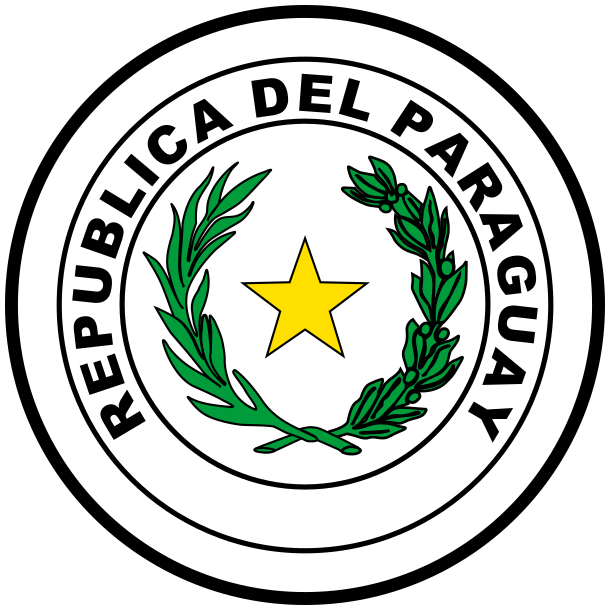
National Coat of Arms (obverse) — A golden star between palm and olive; legend “República del Paraguay”.
A circular seal. At the geometric centre, a five-pointed star of yellow. About it, a palm branch to the left and an olive branch to the right, in their natural colours, interlaced at the base in the manner of a wreath. On the border, without coloured ground, the legend “República del Paraguay” in black letters.
Paraguay’s coat of arms is unusually spare for South America: no condor, no radiant sun, no mountains. Only a star, the palm of victory and the olive of peace, set as a wreath.
It descends from a seal created under the rule of José Gaspar Rodríguez de Francia and used between 1820 and 1842. The main difference is that the older star was white and six-pointed — the same star that appeared on the flags of that period. The description in force was fixed on 25 November 1842 by a resolution of the Extraordinary General Congress, in the Law of the National Flag.
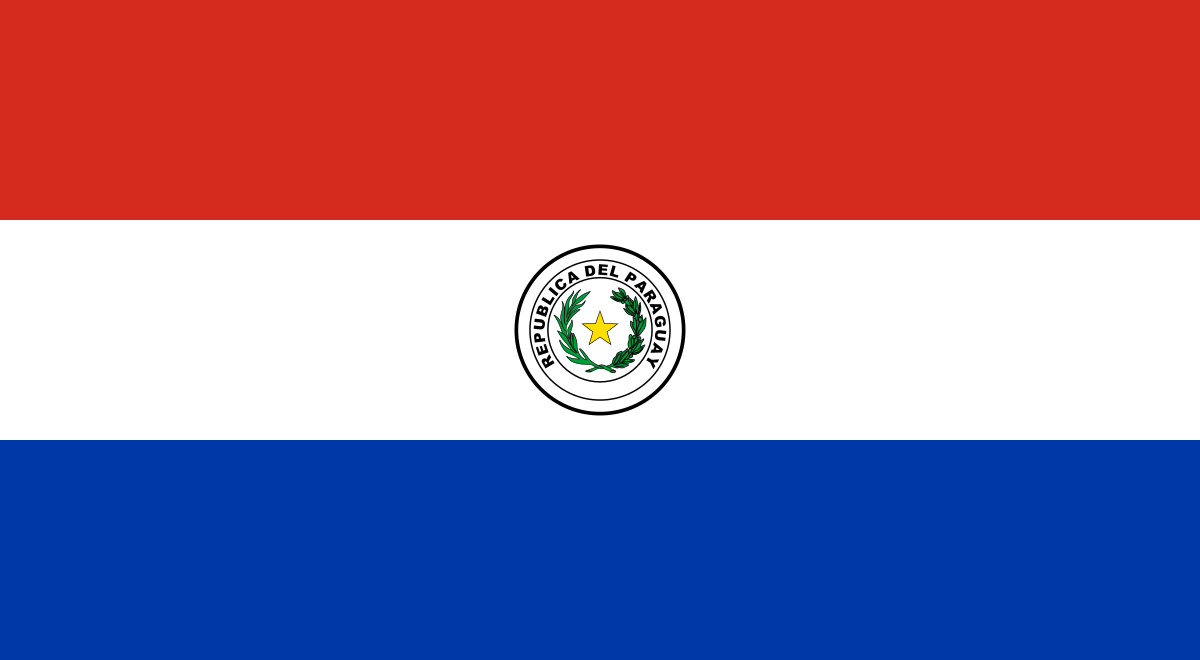
Flag (obverse) — Red, white and blue bands; National Coat of Arms at the centre.
The Paraguayan flag is a horizontal tricolour of red, white and blue, in bands of equal width and a ratio of 11:20. The traditional reading gives each colour a republican virtue: red for justice, white for peace, blue for liberty. Blue also carries an older inheritance: it was the colour of the Virgin Mary of the Assumption, patron saint of the capital.
Between independence and the Congress of 1842, Paraguay changed its flag several times:
The official design in force was standardised by Decree 11,400 of 15 July 2013, which regulated the national flag and the coats of arms in line with the 1842 resolution and set aside the never-legislated versions that Harold Theodor Ronnebeck had put into circulation in the 1980s, under the Stroessner dictatorship, and which added red borders to the design.
This is what makes the Paraguayan flag a singular case among national flags: its two sides do not carry the same emblem. Whoever sees it from one side and then the other does not see the same thing twice.
On the principal face, at the centre of the white band, sits the National Coat of Arms: the golden star between palm and olive, with the legend República del Paraguay. This is the emblem of the State, the one used on documents and by institutions.
On the opposite face sits the Treasury Seal (Sello de Hacienda), an entirely different emblem: a lion seated in profile, facing right, roaring, its tail raised; behind it, a spear topped with a red Phrygian cap, the classic emblem of liberty; and on the border, the motto “Paz y Justicia” — Peace and Justice.
The contrast between the two faces sums up the grammar of nineteenth-century republican symbolism rather neatly: on one side the star and the branches, that is the State and its concord; on the other the lion and the Phrygian cap, that is the force that defends a hard-won liberty.
Paraguay is divided into 17 departments, plus Asunción, which forms the Capital District and belongs to none of them. The Paraguay River separates the populated, farming east from the Chaco in the west, far larger and all but empty.
Each department has its own coat of arms, and many towns preserve arms in the Hispanic tradition, inherited from colonial Asunción, which was for decades the head of the Provincia Gigante de las Indias. They can be explored one by one on the interactive map on this page.
Because it is the only national flag that carries a different emblem on each side. The obverse bears the National Coat of Arms — a golden star framed by a palm branch and an olive branch, with the legend “República del Paraguay” — while the reverse bears the Treasury Seal, showing a lion, a spear topped with a red Phrygian cap and the motto “Paz y Justicia” (Peace and Justice).
By the traditional reading, red stands for justice, white for peace and blue for liberty. Blue also carries an older association: it was the colour of the Virgin Mary of the Assumption, patron saint of the capital, Asunción.
The tricolour had been in use since 1812, but it was the Extraordinary General Congress of 25 November 1842, chaired by the consuls Mariano Roque Alonso and Carlos Antonio López, that made it the sole national flag and fixed the two emblems on its faces in the Law of the National Flag. The official design in force today was standardised by Decree 11,400 of 15 July 2013.
The lion of the Treasury Seal is shown seated in profile, roaring, its tail raised, guarding a spear topped with a red Phrygian cap — the classic emblem of liberty in the republics born of the Atlantic revolutions. The motto “Paz y Justicia” runs around the border.
On 14 August. The tricolour was first raised on 15 August 1812, but in 1913 the Teachers’ Association asked for the commemoration to be moved one day earlier so that it would not clash with the anniversary of the founding of Asunción, celebrated on 15 August.
Last reviewed by the Emblema Mundi editorial team on 21 September 2026.